Be careful using Silicone II

  • We are currently upgrading MFK. thanks! -neo
a simple water test would verify this. Why waste time assuming?
Sure, if I had the ammonia test kit with me at the time. When I noticed the symptoms, the first logical thing to do is to do a large WC than to run over to LFS to buy a test kit. I only keep pH and nitrate test kits presently because those are the two measurable parameters in my tanks. My NH3 kit has expired and trashed long time ago since no levels were ever detected.

After losing about half the fish, the survivors have returned to normal feeding. It's a good lesson for me, not to take short cut. If I had used Type I or soaked the thing in water overnight and rinsed a few times, it woudn't do the damage. The symptoms are classical ammonia poisoning, lithargy, heavy breathing, and red streaks followed by fin burnt if the fish did not die quickly. Once damage is done, it may not be reversiable for some fish as fish continued to die one to two days after the big WC.
 
Sure, if I had the ammonia test kit with me at the time. When I noticed the symptoms, the first logical thing to do is to do a large WC than to run over to LFS to buy a test kit. I only keep pH and nitrate test kits presently because those are the two measurable parameters in my tanks. My NH3 kit has expired and trashed long time ago since no levels were ever detected.

After losing about half the fish, the survivors have returned to normal feeding. It's a good lesson for me, not to take short cut. If I had used Type I or soaked the thing in water overnight and rinsed a few times, it woudn't do the damage. The symptoms are classical ammonia poisoning, lithargy, heavy breathing, and red streaks followed by fin burnt if the fish did not die quickly. Once damage is done, it may not be reversiable for some fish as fish continued to die one to two days after the big WC.
perhaps this thread would serve a better purpose in the "Lessons Learned" forum?
 
Ammonia or not is really irrelevant at this point I guess. But with all the things posted about GEII and the availability of GE I, it would be a simple thing to just use GE I for any aquarium projects instead.
 
  • Like
Reactions: Athletic_Amph
Ok , I have a little bit of experience here with silicone and aquarium. First the silicone 2 you used killed your fish because it has mold inhibitors in it. "Mold Free" on the label is referring to that no mold can grow on the silicone when cured. Great for bath and shower and even exterior.

Second curing has alot to do with its environment.

I have resealed tanks and put a fish in the tank in 24hrs with no Ill affects.
I have some experience with both aquaria and non aquaria useage of 1 and 2 part sealants and this is Spot on. The terms Mold free or Resistant when used by GE means formulas containing added mold inhibiting chemicals. The proprietary GE mold inhibitors are considered better than most other over the counter brands. The chemicals are intended to remain in the cured caulk with as little leach out as posable as leach out reduces protection levels and time frame. When first cured there is a higher % on and near the surface skin and the diffusion rate is very high. After time the diffusion rate drops off but does not stop completely.

If it does not have "aquarium safe" on the tube don't use it.
 
It takes some searching, but your free to go and look on patents, alot of GE products have patents and the contents are 100% mentioned even down to amounts.

I know of only 2 GE products that dont have a anti mould agent in (from patents). Both are special products, i expect one of them is used in aquarium sealants.

The only problem with patents, they dont tell you brand names or the product name. It used to be easier to figure out, you could get a MSDS for the product and work backwards, now the rules with MSDS mean unless your a agent or distributor, you only have access to the short MSDS, that is nearly always useless.

Small amounts of Ethanol and Methanol dont hurt, they are often used in Nitrate filters (0.2ppm). I dont use non aquatic sealant, but i might go hunting through patents and see what is in the Ammonia ones. I havnt looked at sealants for a good few years now.

A word of caution...............

Some sellers on ebay, sell 'aquarium' sealer cheaply. It is often cheap stuff from 'overseas' with chinglish instructions, this stuff is normally ordinary sealant and you shouldnt go near it.
 
  • Like
Reactions: Frank Castle
... If it does not have "aquarium safe" on the tube don't use it.

AFAIK, the only silicon labels that say that are available from LFS and cost 2x or more than GE I.

GE I used to state "aquarium safe". Rumor has it, it exposed GE to too much litigation so they dropped it.

My current understanding is that if the label says "safe for short term exposure to food for human consumption" or some such language and "in accordance with such and such federal standard" is listed with a bunch of numbers, then it is safe for a fish tank.

That's what the current GE I label says....

OK, I picked up my lazy behind and got the tube of GE I:

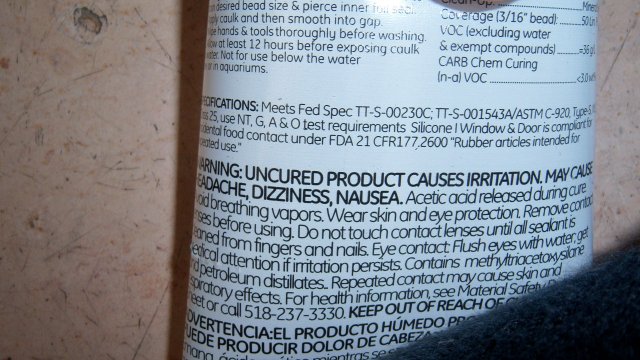
SPECIFICATIONS: Meets Fed Spec TT-S-00230C; TT-S-001543A/ASTM C-920, Type-S, NS, Class 25, use NT, G, A, and O test requirements Silicone I Window and Door is compliant for incidental food contact under FDA 21 CFR177.2600 "Rubber articles intended for repeated use."

100_7297.JPG
 
Last edited:
I would have to look into it, but its the Likely the main VOC (Volatile Organic Chemical) mentioned on the label is Methanol, has to be a small amount because of the food contact statement.

Can you smear a 2-3mm blob on paper, then dip the paper for 1 min in around 100ml water?

Then do a ph test on on the water according to test kit instructions? (wash test container well after).

I got a feeling the PH is going to be around 10-11, maybe slightly higher. So is probably not Ammonia as such, but Ammonium Chloride and one of the other chems in it is basic, this would produce Ammonia. But the killer here is likely anti microbial inhibitors.

I would test your aquarium and keep an eye on Ammonia levels. If it killed fish and was anti microbial s, your likely to see a fairly large filter recycle. Based on the conclusion if the agent was in high enough concentration to kill fish, then it is very highly likely to kill the filter. UNLESS, it has a pretty high PH. In that case the suspect would be Ammonia poisoning and the filter will be fine.

Be cautious dont make assumptions, keep an eye on the Ammonia levels, if it was high Ammonia, then the levels shouldnt now increase, if it was inhibitors the Ammonia will increase.
 
  • Like
Reactions: thebiggerthebetter
I forgot to mention that the label I photographed above says specifically in the Instructions section: "Not for use below the water line or in aquariums."

I assume this too was done by GE to guard against lawsuits.

Also, can a layman like us readily distinguish an ammonia "burn" from an action of many other corrosive and toxic agents - methanol and other alcohols, acetic acid, hydrochloric acid, or even uncured silicone monomers and oligomers that dissolve into the fish tank water having not had enough time to polymerize, etc.? Naively I'd think that...

... The symptoms are classical ammonia poisoning, lithargy, heavy breathing, and red streaks followed by fin burnt if the fish did not die quickly. Once damage is done, it may not be reversiable for some fish as fish continued to die one to two days after the big WC.

... Viejafish may be right but such symptoms may fit a lot of poisoning or chemical-burn cases or abrupt pH change cases for the little that I know. Such symptoms appear rather nondescript and generic.

Just my $0.02.
 
  • Like
Reactions: RD.
When I put together my cave for the 75 gallon I left it in the laundry room for about two weeks I was so paranoid.
 
I forgot to mention that the label I photographed above says specifically in the Instructions section: "Not for use below the water line or in aquariums."

I assume this too was done by GE to guard against lawsuits.

Also, can a layman like us readily distinguish an ammonia "burn" from an action of many other corrosive and toxic agents - methanol and other alcohols, acetic acid, hydrochloric acid, or even uncured silicone monomers and oligomers that dissolve into the fish tank water having not had enough time to polymerize, etc.? Naively I'd think that...


... Viejafish may be right but such symptoms may fit a lot of poisoning or chemical-burn cases or abrupt pH change cases for the little that I know. Such symptoms appear rather nondescript and generic.

Just my $0.02.
I agree but as i said above, i would keep checking Ammonia levels, to me its more likely to have been anti mold agents. if that is the case then levels high enough to kill fish, will kill off a filter. Depending how much silicon was used, i find it hard to see enough Ammonia being in the product to kill like that.

A well settled filter can handle a reasonable mount of Ammonia. Then the other question is how high is the PH normally? If its normally fairly low (<7), then i really start to doubt Ammonia.

But its pretty much guess work, and IMHO its always better to spend more for the right stuff.
 
  • Like
Reactions: thebiggerthebetter
MonsterFishKeepers.com