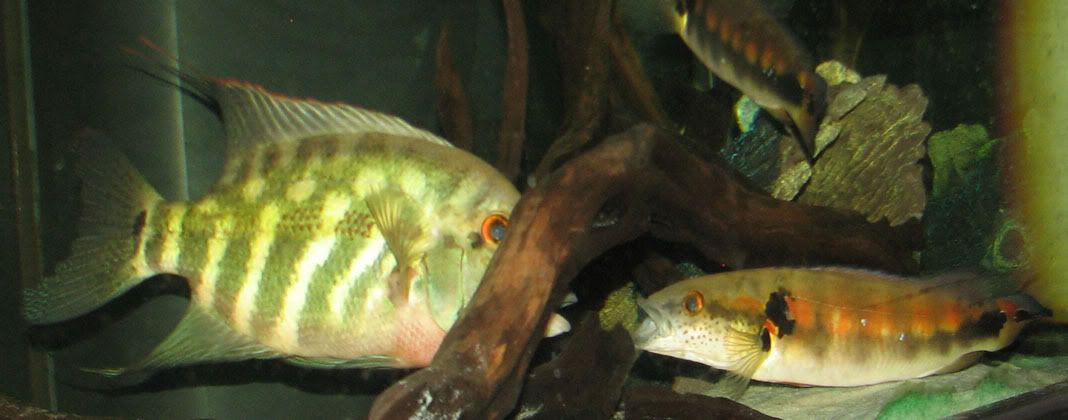
Here's a video of my prime "push back" matchmaker ("isn't afraid to push back" ... well said Ryan!). He was the super glue holding the psittacus pair bond together and strong. http://youtu.be/kxxwd4ee1iE
Well heck, this is a little disheartening.. I guess the search is on for some 'target' fish then and a tank upgrade. I appreciate the advice and of course the pictures and videos.
Well heck, this is a little disheartening.. I guess the search is on for some 'target' fish then and a tank upgrade. I appreciate the advice and of course the pictures and videos.
Sent from my iPhone using MonsterAquariaNetwork app
Sorry you feel disheartened. But the way I look at it, the only predictable thing about cichlids is their unpredictability. We can benefit from the experience of others but then something happens where a new factor is discovered which results in doing things in an even better, more successful way. I kept six adult 'psittacus' in a 125G (footprint 5'x2') with a mix of other fish (some CA, some CA), well stocked with lots of large plastic plants and big chunks of driftwood. They never paired or spawned in there but co-existed remarkably well, to my surprise. It sounds like we've had our share of grief with this species. And we have, like any other species. However, I cherish my time with this fish. It has been one of the most fulfilling and challenging experiences to have raised and successfully bred what I consider to be one of the most, if not the most magnificent SA cichlid to have ever entered this hobby.
(I think I might get a response from Discus keepers on this one). To me, they are still 'gentle giants'.
I used to try different tricks to make things work. It's no longer the primary goal. If I can't provide enough for a species, I'd rather not keep it. What's the point? All the fish in the video spawned in that tank, except the G. altifrons, which spawned later in a 220. There was never any threat of violence. The psittacus paid no attention to any other fish, nor did the pair perceive any threat. I doubt in the wild that 1) male would kill females regularly or 2) pairs are pressured to stay together. If the male gets rough, the female simply has to be able to get far enough from his territory. Same thing with in the tank. Just need enough space and some distraction.



 on this one). To me, they are still 'gentle giants'.