Clam/mussel ID and can I feed to my fish

  • We are currently upgrading MFK. thanks! -neo
Thank you jjohnwm jjohnwm for the kind words, and thank you (again) Rtc/tsn Rtc/tsn for doing the right thing. And thank you ALL for considering this.
One more thing to be happy and proud of is that for whatever evolutionary reasons, North America contains the highest known diversity of freshwater mussels, higher than anywhere else in the world. This is something that is not true of a number of animal and plant groups. Whereas South America, Asia, and Africa have decent numbers of species, their biodiversity of FW mussels pale in comparison to the NorthAmerican mussel fauna, by far. Europe has the lowest diversity, with just a few species. So this is something to be proud of, but with it, should come the responsibility of contributing towards the urgent need to protect them. How? By getting to know about them, loving them, cleaning our waterways, loving the fish, combating the introduction of non-native species (of all types), curtailing pollution and habitat modification. Just getting to know about them goes a loooong way! Cheers!
 
Thank you jjohnwm jjohnwm for the kind words, and thank you (again) Rtc/tsn Rtc/tsn for doing the right thing. And thank you ALL for considering this.
One more thing to be happy and proud of is that for whatever evolutionary reasons, North America contains the highest known diversity of freshwater mussels, higher than anywhere else in the world. This is something that is not true of a number of animal and plant groups. Whereas South America, Asia, and Africa have decent numbers of species, their biodiversity of FW mussels pale in comparison to the NorthAmerican mussel fauna, by far. Europe has the lowest diversity, with just a few species. So this is something to be proud of, but with it, should come the responsibility of contributing towards the urgent need to protect them. How? By getting to know about them, loving them, cleaning our waterways, loving the fish, combating the introduction of non-native species (of all types), curtailing pollution and habitat modification. Just getting to know about them goes a loooong way! Cheers!
Thank you for saying something before I did put him in an aquarium setting. Yesterday when I was fishing I found 2 more. I did not take them but I did take a picture of one in my hand for size comparison but I put it back after. Here’s the picture. The thing is freaking massive and weighed the same as a baseball F8A18429-744F-4FD5-BF22-A7A262743EA9.jpeg
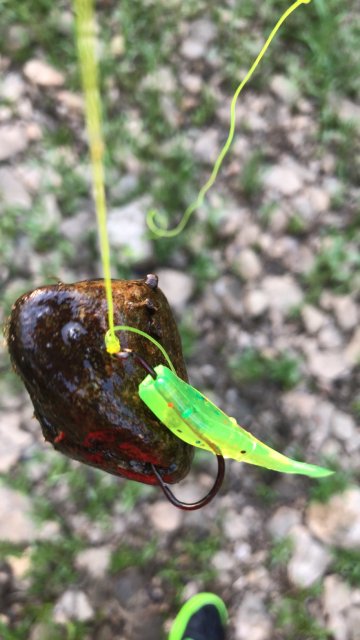
I also thought this was hilarious I felt something tugging on my line so I went to set the hook and this thing almost hit me in the head. Somehow I hooked into a rock on the creek bed F3259EE4-8719-40E9-BB0D-D67A27961166.jpeg
 
SuperCool!
Believe it or not, that second mussel is NOT of the same species as the one you found before. I believe it is yet another species of the genus Lampsilis. It seems as if your creek is a nice healthy place!
I used to do work on taxonomy and ecology of FW mussels in a creek called Ohio Brush Creek, where in some small stretches, one could find as many as 13 different species coexisting. The total known FW mussel fauna of the entire creek, a tributary of the Ohio River is in the order of 35 different species!
In the photo, specimens from our mark-recapture study -->
- Top, Amblema plicata (Three Ridge)
- bottom, Tritogonia verrucosa (Pistol Grip)

These individual mussels are each in the ranges of 10-15 years old (three ridge) and 5-10 years old (pistol grip)

A.plicata T.verrucosa OhioBCrk 25Aug2005 019.jpg
 
SuperCool!
Believe it or not, that second mussel is NOT of the same species as the one you found before. I believe it is yet another species of the genus Lampsilis. It seems as if your creek is a nice healthy place!
I used to do work on taxonomy and ecology of FW mussels in a creek called Ohio Brush Creek, where in some small stretches, one could find as many as 13 different species coexisting. The total known FW mussel fauna of the entire creek, a tributary of the Ohio River is in the order of 35 different species!
In the photo, specimens from our mark-recapture study -->
- Top, Amblema plicata (Three Ridge)
- bottom, Tritogonia verrucosa (Pistol Grip)

These individual mussels are each in the ranges of 10-15 years old (three ridge) and 5-10 years old (pistol grip)

View attachment 1464005
That’s crazy. I honestly never knew how fascinating a shell with a bit of goop in it could be lol. Honestly I really do want to keep one in an aquarium setting. Sometime soon I might have a empty 29g tank so could it be possible to do something with that. With a legal mussel that isn’t from my local creek
 
The pistol grip is really cool. I haven't seen any with that interesting of a shell down here.

If you are dead set on keeping them here are the Florida regs. They aren't easy though.

21FLFW-LR.pdf (eregulations.com)
Page 27 covers mussels in Florida
 
Thank you FLA for posting the laws for Florida and Ohio and other valuable input.
BTW, our studies of mussels in Ohio (several years) were all under permits from the State of Ohio to myself and colleagues from the Cincinnati Museum of Natural History.
Rtc/tsn - You should not feel bad about trying with the non-native, invasive and present-everywhere Asiatic CLAM, Corbicula fluminea. They are in every creek by the millions. They are cool looking, not endangered, hardy, and will filter stuff out of the water. I have seen in them in people's tanks and they last a good while. I am sure they are in your creek as well. They are NOT a mussel, they are NOT native, they ARE invasive and damaging to an extent, so regulations against taking a few should not exist (however, one should check first).
 
What will benefit you the most is to be on FB/social media pages following your local watershed /county conservation projects/discussions/ on whats going on or even Nanfa to educate yourself more about the wildlife in those waters. Since you are out and about fishing. You are the best weapon out there to help wildlife by being educated and spreading the word around.

I like the population census some teams do sampling what they find in a local water body and its published online. I never knew my local watershed had dojo loaches as invasives so ive been trying to catch one/spot them. ?
 
MonsterFishKeepers.com