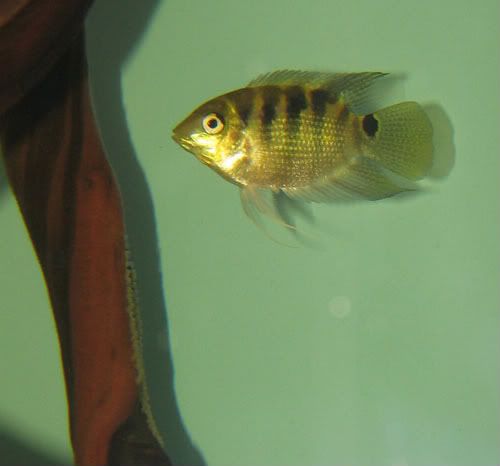
Couple of festivum ?'s

  • We are currently upgrading MFK. thanks! -neo
ryansmith83;3806101; said:
I see you're in Port Orange... I'm in Palm Coast. What LFS did you go to? If you wait a bit, I may have a ton of festivum fry that you could just have. :D

I usually go to Mr. Petman on A1A, it's the closest. Not very good though. Palm Coast isn't far at all, that would be very cool. Let me know, I don't mind waiting.
 
Mr. Petman used to be a great store but the quality has declined so much in the last ten years or so. I always stop by Amazon Jungle in Ormond Beach because they sometimes have oddball stuff (festivums, keyhole cichlids, etc.). You don't usually see those types of cichlids in most of the stores here.

Do you ever go to Daytona Aquarium on 92? I've dropped off excess fry and grow-outs with Gary for years.

Sorry to send this thread O/T... I'll try to get some video of my festivums later so that you can see what I mean about their behavior.
 
Appreciate that. Yours sound particularly aggressive, with mine the only damage is to each other, and it's minor nipping, no hard fin ray or body damage.

Daytona Aquarium is probably about the best from what I can tell. I got a very nice chocolate cichlid out there, and he's also got some nice driftwood (there's a piece in my tank).
 
I recently posted about my M. guyanae which were not eating. They are eating well now that they've been moved from the 30g quarantine to the 125g Guyana biotope.

However, they are very aggressive, as several of you posted in this thread. At first, the one that I *think* is a male staked out a spot around some wood and would ambush the female whenever she would swim by. Within of few days the roles reversed, and strongly. Now, the female is constantly chasing the male and beating the crap out of him. She doesn't have a mark on her, beautiful long streamers, clean fins, etc. He looks ragged. They are wild fish, each at close to 5" long. I had hoped to breed them.

Any suggestions about the aggression? Is there any hope to breed this pair? If you've had success breeding them, please provide any tips you're willing to share.
 
Mesonauta really do best in groups or as individuals. If the pair is not a compatible mated pair, you'll probably have to separate them. I always kept mine in groups of 6. Are there tankmates with them? Dithers may help.
 
G'day,
Heres a pic of my largest festivum(have not measured him but he is a substantial fish )they live with Satonoperca Leucosticta. And it works well.

He can be aggressive, and he does not let me keep catfish.....
The leuco's just respect him and get out of his way.....fast.
But there's no hassles really , it is an interesting, active but relaxing tank to view.
All the best with yours, they are great fish.

cheers

P5200572a.jpg
 
ryansmith83;5033739; said:
Mesonauta really do best in groups or as individuals. If the pair is not a compatible mated pair, you'll probably have to separate them. I always kept mine in groups of 6. Are there tankmates with them? Dithers may help.

Hi,

Yes there are 5 Geophagus dicrozoster (3"), 1 Satanoperca cf. leucostica (4"), 3 Apistogramma steindachneri (3"), and a twig cat, Farlowella acus (8"). They both occasionally move toward the eartheaters to clear them away but nothing violent.

The female festivum is dead-set on nailing the male once every few minutes though. He hangs out on one side of the tank, she the other, and she'll cruise to the other end just to kick his backside periodically. I got them from Rapps hoping they were a mated pair....what sort of behavior should I expect to see if they consider pairing up? Or is this pre-spawn behavior? I have no idea what to look for with festivums.
 
Are you sure they are male and female?

I had two pairs in each of the groups of six that I raised. They're much like other cichlids -- there would be courtship displays where the fish would show off for one another, colors would change, fins and bodies twitching. Then they'd pick out a spawning site, usually in the top half of the tank, and defend it from all the other fish. After a few days I'd always find eggs. Both parents do a good job of chasing off outsiders.

If one of your fish is ragged and beat up, you may want to put a divider or something in until it heals and has a chance to rest. If it gets stressed it could end up sick and not eating again. It doesn't sound like the dominant fish is going to lay off any time soon.

 
ryansmith83;5035095; said:
Are you sure they are male and female?

I had two pairs in each of the groups of six that I raised. They're much like other cichlids -- there would be courtship displays where the fish would show off for one another, colors would change, fins and bodies twitching. Then they'd pick out a spawning site, usually in the top half of the tank, and defend it from all the other fish. After a few days I'd always find eggs. Both parents do a good job of chasing off outsiders.

If one of your fish is ragged and beat up, you may want to put a divider or something in until it heals and has a chance to rest. If it gets stressed it could end up sick and not eating again. It doesn't sound like the dominant fish is going to lay off any time soon.


Thanks for the advice.

About their sexes, I am not 100% certain they are different. The only reason why I ordered the big ones was to get a male and female; I specifically asked Rapps for a pair. There is a subtle difference in the head shape between them. One has a slightly more pointed head. The one I think is a male appears to have a bulkier head. But the differences are quite subtle.

Do you have photos of males/females that you could share? I searched the forums for threads/pics on the subject but didn't find any that were particularly diagnostic.
 
The only real difference I ever noticed in mine was size. Males always ended up twice as big as females. Most of my males were pushing 8" after a year, while females started spawning around 3 - 4". They only grew to maybe 6". The males would also be much stockier with a thicker forehead.

Here is a video of a young pair. These fish were less than a year old. As you can see, the only real difference is that the female is smaller. In both groups I kept (which were wild-caught) the females were always smaller than the male.

[YT]RtTNVFS6fGk[/YT]

Here's a young female with eggs:

b4a06524.jpg


And a large male:

7620e3de.jpg
 
MonsterFishKeepers.com