Creating cold tolerant tropical fish.

  • We are currently upgrading MFK. thanks! -neo

itrebebag99

Plecostomus
MFK Member
Mar 16, 2017
300
144
61
26
Illinois
Hypothetically, if you took a few dozen tropical fish (maybe one that is already semi-cold tolerant, such a blue tilapia) and chilled the water down to the point where they start going unconscious or dying. You let all but a few die, and then remove the few survivors, and breed them. If you continue this process over many generations, could you in theory, breed a cold tolerant cichlid? This is a completely hypothetical experiment, I was just wondering if it was possible, and if so, why hasn't it been done?

 
It may be possible but it would probably take many years and generations of breeding. This is not like breeding for a color trait or fancy fins. This to me is on the evolutionary scale to try to breed for environmental response would be like breeding a fish that doesn't normally have the ability to breath air (like some can) to some day be able too.
 
  • Like
Reactions: tlindsey
Hello; While this is not exactly what you are asking about, it may be related. There appear to be cases of warm region species finding their way into colder areas they are not native to. (invasive species). It was thought these species would not be able to survive or reproduce in the colder places. Seems to be turning out some of these invasives are able to become established.

I have read a couple of theories as to why this is possible. One is that way back in the species existence they faced colder conditions and some of the gene combinations are still in the "gene bank". (May not be the best term but I cannot recall.) Some few of the offspring may express these cold adaptive traits and thus have a slightly better chance of survival.
I think the "killer bees" and "fire ants" were expected early on to be stopped by colder climates. I think they have moved into areas where it was not expected they could survive.
I know that fire ants were just 20 miles south of Knoxville TN over seven years ago.

Another is that a species may have behaviors which enable them to cope with colder places. These behaviors may not be used in their native areas, but apparently can be called upon when needed.
 
That's actually pretty cool. I wonder if you took an invasive cichlid from a Miami canal, and took a specimen of the same species from it's native tropical region, if the invasive cichlid would be more cold tolerant, since it has to survive sub-tropical winters.
 
Miami may be sub tropics but the coldest average temperature is still 68 according to the weather channel that's far from what I would say was cold.
Lots of tropical species can take temps in the high 60's for short amounts of time anyway.

I would dare to say that there are probably thousands of betta fish siting in houses in the middle of summer at this moment being subjected to 68 degrees
 
Miami will occasionally drop below 50°F, and rarely below 40°F, I just want to point out. Yeah the water probably holds a lot of heat, but the water temperature still might drop some.

Okay, maybe the Miami canal was a bad example, lets take the Mozambique tilapia in the Salton Sea for example. Winter air temperatures can drop to 24°F. Yeah, the water holds heat, but surely that is still a colder environment than the tilapia's native Africa, right?
 
The Mozambique Tilapia is a native to Southern Africa.

I read a study the university of California did on the Salton sea in 2000 for the entire year. They listed just about every aspect of the water conditions you could think of.
The coldest surface water temperature recorded was listed at 57f which is around 14c
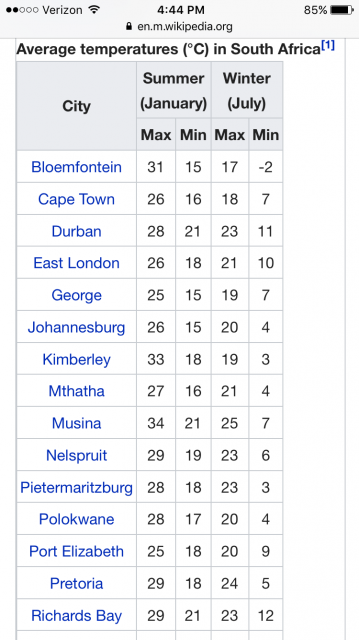
And a quick google search of Southern Africas climate resulted in this chart of some of the city's recorded average temperatures.

IMG_0341.PNG
So from this information we can see that the temperatures at the Salton sea are within the ranges of this fishes native waters.

I think fish are adaptable to environmental changes given enough time, a person may be able to get fish to live in water temperatures lower than what would be considered normal for them but, I think if a fish can take lower temperatures for short periods of time doesn't make it a cold water fish. The fish would have to be able to live in colder water for a lengthy time and thrive.
 
The fish would have to be able to live in colder water for a lengthy time and thrive.
hello; You are on the right track. For a species to become established it must be able to survive at all stages of life. Adults may be able to tolerate sub par conditions but if the offspring at the egg or fry stage cannot survive then the species will not become established.
 
  • Like
Reactions: BIG-G
Instead of Miami, you might want to try some of Uropthalmus or Tilapia that inhabit waters near Sarasota. Though there are many fish kills during cold snaps there, it seems enough survive to keep the populations up. And they may be (as skjl47 stated) favoring an ancestral gene that allows survival in colder climates.
There are Gymnogeophgus in southern South America that survive very cold temps, and these may be from gene adaptations that allowed them to evolve into separate species from warm water Gondwanan Geophagines and which now require cooling off periods to survive.
When I lived in Milwaukee I would put my Gymnogeophagus in an unheated basement that easily dropped into the low 50sF during Jan and Feb, and the Gymno's seemed all the better for the temp drop.
 
Yes, you are correct their are cichlids that are adapted to cooler environments but hypothetically speaking someone could try to breed some sort of hybrid from a species that has adapted to live in cold water with a tropical species that has not, with the hopes of breeding those "cold water" genes into a warm water fish.
I still don't think it would work.
But other than that I don't believe it would be possible to take a fish adapted to live in a set range of temperatures and breed that out with the intentions of having a fish at the end of the experiment that could live in water 40 or 50 degrees cooler than what it's ancestors are adapted to.
If it is possible it would still take several lifetimes I imagine
 
MonsterFishKeepers.com