In reality what is the difference between a canister and a sump?
The definition of canister is really, just a very tiny, self contained sump.
The problem with a can, is its lack of ability to deal with the elephant in the room, nitrate toxicity.
A typical can contains some mechanical media to deal with particulate,
and standard bio media that deals with ammonia and nitrite, which is determined ¨not by tank volume¨, but nutrient output of fish.
Because those bacteria that neutralize ammonia and nitrite are microscopic, it doesn´t require much physical space to do, so the a can is adequat.
but......
Nitrate is really only dealt with by water changes, and plant uptake that use nitrate for sustenance.
So for a me, a well planted sump, is the only answer.
The sump space for me is about 10% mechanical, 10% biological, and the other 80% hevy planting that uses the majority of space.
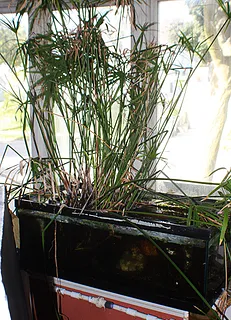
Below is a pic of my sump.

As you can see, the dark area on the left , holds the 1500 gph pump, an entire wall of mechanical media, and a few bags of biomedia, (about 20% of the 6 ft sump)

the majority of space is reserved for plants that consume nitrate.
With this configuration my test results show ammonia at zero, nitrite is zero, and nitrate is almostundetectable.

The definition of canister is really, just a very tiny, self contained sump.
The problem with a can, is its lack of ability to deal with the elephant in the room, nitrate toxicity.
A typical can contains some mechanical media to deal with particulate,
and standard bio media that deals with ammonia and nitrite, which is determined ¨not by tank volume¨, but nutrient output of fish.
Because those bacteria that neutralize ammonia and nitrite are microscopic, it doesn´t require much physical space to do, so the a can is adequat.
but......
Nitrate is really only dealt with by water changes, and plant uptake that use nitrate for sustenance.
So for a me, a well planted sump, is the only answer.
The sump space for me is about 10% mechanical, 10% biological, and the other 80% hevy planting that uses the majority of space.
Below is a pic of my sump.
As you can see, the dark area on the left , holds the 1500 gph pump, an entire wall of mechanical media, and a few bags of biomedia, (about 20% of the 6 ft sump)
the majority of space is reserved for plants that consume nitrate.
With this configuration my test results show ammonia at zero, nitrite is zero, and nitrate is almostundetectable.