

Just wanted to know what every one thought. I actually figured from experience and hearing from others that wild cichlids display certain colors and body shapes that are second to none and can't alway's be duplicated, in later generation's from the actual wild fish.
DO WILD CICHLIDS DISPLAY MORE VIBRANT COLORS THAN SECOND GENERATION FISH
- Thread starter caribemob
- Start date
You are using an out of date browser. It may not display this or other websites correctly.
You should upgrade or use an alternative browser.
You should upgrade or use an alternative browser.


I suppose they can, but its not likely. The genetics in a fish are exactly that, their genetics. F1 arent "weaker" than the parents and more than likely will look as good if not better than the parent, for the simple fact that they are raised in a tank, fed better and more consistently and have lived in a tank their whole lives, not caught in a river/lake and shipped all over the world. Genes are genes. What they usually will display is 0 tolerance for other species in a smaller tank. Theyve had to protect their 10 sq ft (or whatever) place in the wild so getting them to get along with others in a tank has been harder for me...with aggressive fish at least.
I think the better question/ poll should have been "Can you tell the difference between a WC fish or a farm raised/F1/F2 etc?"
Because youd NEVER be able to tell the difference. Thats the whole deal with this F0/F1 hype...if you take care of a petsmart Jag better than a wild caught Jag, chances are the petsmart one will look better. If you do the same for both, you wont EVER be able to tell the difference.
Its been my experience with Wild Caught fish, that they are hiders and not nearly as sociable as F1s...and F1s dont have the trouble breeding that WC do because F1s have never had the opportunity to live in the wild and see what it should be like without human intervention.
If I have a choice (with aggressive fish), Ill take F1 over WC. Theyre more social, easier to breed, easier to get to eat and seem to have a better "tank life" immunity system. To me , their colors depend on their health, diet, environment and genetics.
I think the better question/ poll should have been "Can you tell the difference between a WC fish or a farm raised/F1/F2 etc?"
Because youd NEVER be able to tell the difference. Thats the whole deal with this F0/F1 hype...if you take care of a petsmart Jag better than a wild caught Jag, chances are the petsmart one will look better. If you do the same for both, you wont EVER be able to tell the difference.
Its been my experience with Wild Caught fish, that they are hiders and not nearly as sociable as F1s...and F1s dont have the trouble breeding that WC do because F1s have never had the opportunity to live in the wild and see what it should be like without human intervention.
If I have a choice (with aggressive fish), Ill take F1 over WC. Theyre more social, easier to breed, easier to get to eat and seem to have a better "tank life" immunity system. To me , their colors depend on their health, diet, environment and genetics.
i understand, i was just saying i've seen wild fish that maybe there jaws were bigger, teeth, and nunchal hump more prominent along with the color, i think a jag does look the same wild or not, but take a fish like a salvini or a dovii and it gets alot more appealing wild IMHO, Thanks for your take on it though
I voted no. Personally there are very few cases were wild fish look any different then F1 and often the F1's look healthier and are much better adapted to aquarium life. Plus by the 3rd generation with selective breeding you can breed for even better colors and have better looking fish then wilds.
I have several wild fish and many F1 and other tank bred fish. In only one case is the wild fish substantially nicer then the F1's. All of the others I actually prefer the F1's and tank bred strains.
I have several wild fish and many F1 and other tank bred fish. In only one case is the wild fish substantially nicer then the F1's. All of the others I actually prefer the F1's and tank bred strains.

I agree that genes don't change at appreciable frequency considering the time scale in question here. But I do want to add that the combinations do, and they matter.
The difference here is not WHERE breeding takes place - in the wild vs. in a tank. The difference is in the parents involved. Inbreeding over many generations may produce individuals that are homozygous for some deleterious recessive alleles, and therefore exhibiting undesirable traits. The same process also happens in the wild but at a much lower frequency, considering fish are obligated outcrossers.
But this will not happen in F1. The first generation you can see this difference is F2, and it's not for all the individuals. In other words, genetically speaking, F1 produced in a tank are the same as those produced in the wild. It becomes a problem when siblings are allowed to mate and produce F2. This is why a lot of responsible breeders swap fish to introduce "new blood" into their programs.
I would also like to point out that breeding in "captivity" can have significant advantages, if you selectively breed FOR certain traits. Race horses do run faster than their wild progenitors (I think!).
The difference here is not WHERE breeding takes place - in the wild vs. in a tank. The difference is in the parents involved. Inbreeding over many generations may produce individuals that are homozygous for some deleterious recessive alleles, and therefore exhibiting undesirable traits. The same process also happens in the wild but at a much lower frequency, considering fish are obligated outcrossers.
But this will not happen in F1. The first generation you can see this difference is F2, and it's not for all the individuals. In other words, genetically speaking, F1 produced in a tank are the same as those produced in the wild. It becomes a problem when siblings are allowed to mate and produce F2. This is why a lot of responsible breeders swap fish to introduce "new blood" into their programs.
I would also like to point out that breeding in "captivity" can have significant advantages, if you selectively breed FOR certain traits. Race horses do run faster than their wild progenitors (I think!).
i thought being in the sun's ray's and a real good eco system would produce a more showy and true brute of the sp., that wa just MIO
I agree with VRWC. It takes many, many generations before a species can change its inherent genetic makeup. In a natural setting (i.e. natural selection is at play) it can take hundreds to thousands of years, and even then an environmental change is required for a new trait, rather a mutation, to be able to afford any degree of a competitive advantage.
In captivity, natural selection is absent, so you can speed up the genetic drifting quite a bit through intentional or accidental manipulation. But, you certainly can't do it in a generation or two (or three, four....). After years of breeding closely related individuals you can definitely get something quite different than in the wild.
Almost everything one sees as superior in a wild fish is the result of environmental factors like food, space, and exposure to sunlight. For years I've been growing fish in outdoor ponds only to see their incredible coloration fade dramatically after a few weeks indoors.
So, a wild fish will likely display superior coloration as you pull it from its lake or river, but that coloration will quickly fade if you do not provide it with the same conditions it enjoyed in the wild. Similarly, an F1 taken from a tank and raised all summer in an outdoor setting will color up tremendously.
Case in point........ Wild labiatus after spending time in an aquarium:

That same fish after a month or so outdoors:
This umbee wasn't wild caught, yet has anyone seen anything to surpass it?
In captivity, natural selection is absent, so you can speed up the genetic drifting quite a bit through intentional or accidental manipulation. But, you certainly can't do it in a generation or two (or three, four....). After years of breeding closely related individuals you can definitely get something quite different than in the wild.
Almost everything one sees as superior in a wild fish is the result of environmental factors like food, space, and exposure to sunlight. For years I've been growing fish in outdoor ponds only to see their incredible coloration fade dramatically after a few weeks indoors.
So, a wild fish will likely display superior coloration as you pull it from its lake or river, but that coloration will quickly fade if you do not provide it with the same conditions it enjoyed in the wild. Similarly, an F1 taken from a tank and raised all summer in an outdoor setting will color up tremendously.
Case in point........ Wild labiatus after spending time in an aquarium:
That same fish after a month or so outdoors:
This umbee wasn't wild caught, yet has anyone seen anything to surpass it?

I voted other. In some species it may be the case. Not a difference between F0 and F1 but say 10 generations down the line, the gene pool can be weakened because people breed and try to keep/raise/sell as many fry as possible.Therefor we end up with a lot of weaker fish floating around that would probably have fallen to predation in its wild environment. However, if selective breeding is done(mans way of replicating natures survival of the fittest policy), by only keeping a maximum of 20-30 of the best fry you will often see better size and color from the tank bred counter parts, not to mention a better resilience for tank life. If this weren't the case, all our fish in Australia or other parts of the world would have to be considered somewhat inferior. I personally don't think this is the case as I have seen just as many quality specimens here in a country that can't import most of these fish legally anymore. This is not to say that the introduction of wild genes into the breeding population would not be a good thing from time to time to keep the species true.
Just for the record, I don't own one wild fish
Just for the record, I don't own one wild fish
I wish the people that voted YES would put their 2 cents in. Id like to hear the reasoning behind their choice.
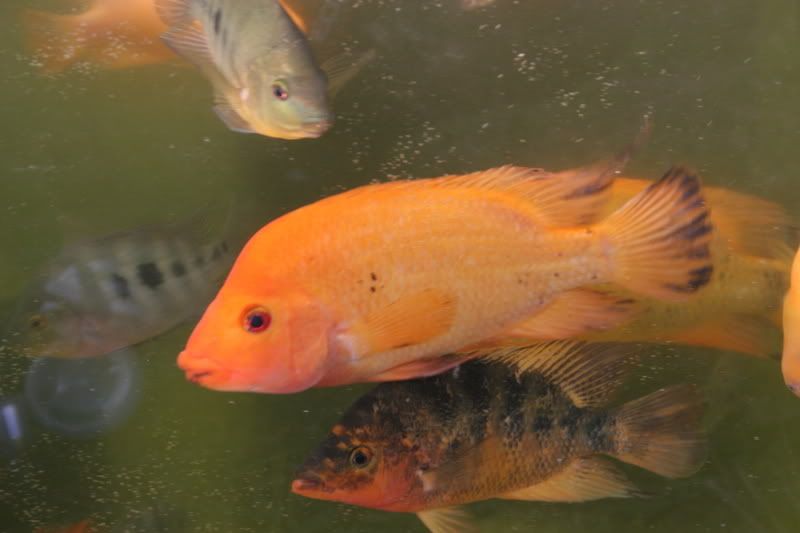
yes i have , courtesy of umbeeking, the madgelena variant, notice the ones in the tank only are 8'' with that color, which is second to none IMHOcchhcc;3804495; said:I agree with VRWC. It takes many, many generations before a species can change its inherent genetic makeup. In a natural setting (i.e. natural selection is at play) it can take hundreds to thousands of years, and even then an environmental change is required for a new trait, rather a mutation, to be able to afford any degree of a competitive advantage.
In captivity, natural selection is absent, so you can speed up the genetic drifting quite a bit through intentional or accidental manipulation. But, you certainly can't do it in a generation or two (or three, four....). After years of breeding closely related individuals you can definitely get something quite different than in the wild.
Almost everything one sees as superior in a wild fish is the result of environmental factors like food, space, and exposure to sunlight. For years I've been growing fish in outdoor ponds only to see their incredible coloration fade dramatically after a few weeks indoors.
So, a wild fish will likely display superior coloration as you pull it from its lake or river, but that coloration will quickly fade if you do not provide it with the same conditions it enjoyed in the wild. Similarly, an F1 taken from a tank and raised all summer in an outdoor setting will color up tremendously.
Case in point........ Wild labiatus after spending time in an aquarium:
That same fish after a month or so outdoors:
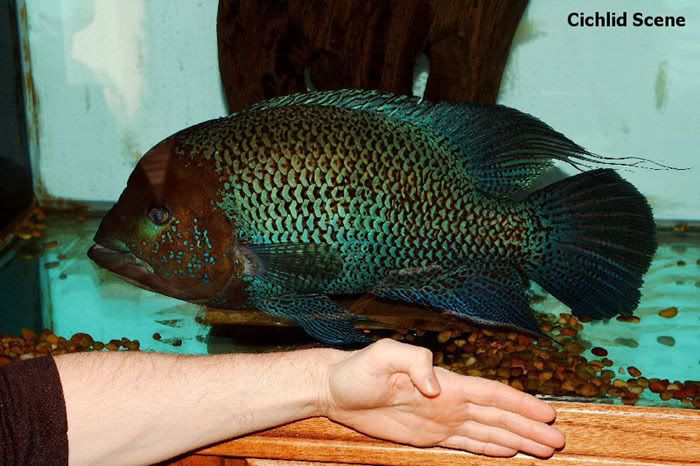
This umbee wasn't wild caught, yet has anyone seen anything to surpass it?


