Dosing for PraziPro

  • We are currently upgrading MFK. thanks! -neo
Hey thought I would just give an update here cause I finally have something to update on!
It has been months now since I finished the prazipro treatment (still not convinced they ever had gill flukes) but they took the medicine without issue. From there my JD acted the same. Ate nothing but live worms and other frozen live foods like mysis shrimp or blood worms. But over the months, his head shaking has drastically diminished...very gradually. Now he rarely does this behavior but still does occasionally. However I have also removed all active carbon filtration. So it's hard to say what has had the greatest effect.
However, I have gotten my JD back to eating flakes and pellets as of 3 to 4 days ago. The foods are very specific will update with pics soon!
 
Hey thought I would just give an update here cause I finally have something to update on!
It has been months now since I finished the prazipro treatment (still not convinced they ever had gill flukes) but they took the medicine without issue. From there my JD acted the same. Ate nothing but live worms and other frozen live foods like mysis shrimp or blood worms. But over the months, his head shaking has drastically diminished...very gradually. Now he rarely does this behavior but still does occasionally. However I have also removed all active carbon filtration. So it's hard to say what has had the greatest effect.
However, I have gotten my JD back to eating flakes and pellets as of 3 to 4 days ago. The foods are very specific will update with pics soon!
 
  • Like
Reactions: kewpiefishypewpie
Why do you think a pH of 7.8 is too high for either JDs or festae?
JDs come from Cenotes in Mexico where the water can have a pH of nearly 9.00, is very alkaline, and at times, the Cenotes nearest the Caribbean are even brackish. Most of the rock (that is their substrate) is ancient coral reef, which dissolves slowly with each rain, creating very hard, high pH, liquid rock for their water.
And festae come from rivers west of the Andes that are not soft water like the Amazon, but are also alkaline from the rains and glaciers that wash minerals down that side of the mountains, so a pH of 7.8 and higher is not at all out of normal range.
027 zps4b102ffd
 
  • Like
Reactions: MaseBoogie
I've have only read that 7.8 is a higher than ideal pH for the Jack Dempsey. Then I was told that it was actually only true for wild caught JD's and tank bred ones are more hardy so I don't think that pH was necessarily a problem but was just thinking of all the possibilities. After doing more research I have totally nixed the notion of doing R/O water for fresh water. Makes no sense, especially when I have such clean water from the tap here in the Colorado foothills. The little Festae has really never shown any negative symptoms or signs of illness since I bought her.

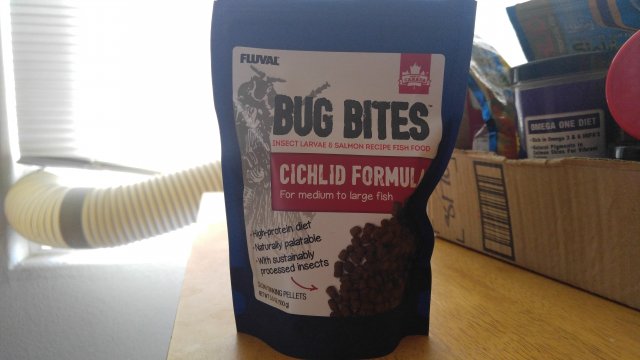
At any rate the JD has been doing way better and I have even gotten him eating like I mentioned before. I went and bought a flake food with spirulina as the primary ingredient. There's no brand for this food, they only sell it by the scoop at my LFS, but I am assuming any spirulina flake would do. The JD has been eating these consistently for about 2 weeks. The other thing my JD goes totally ape sh*t over is a new pellet food I decided to try on a whim. It's from the brand Fluval (who knew they made food?) and the pellets are called Bug Bites. Black fly larvae is what is mostly used I believe but there's salmon and some other stuff in there too. I will attach a pic for everyone to reference, while this food DOES have drawbacks, I still highly highly recommend it and it seems like really high quality food to me.
Here's my opinion of Bug Bites:

Pro's- High quality ingredients, sustainable model (using unused food products to feed flies), my extraordinarily picky JD loves them! I have tried a million foods Hikari, Omega 1, you name it I've tried it and my JD has turned it down. For years now, if it wasn't moving my JD wouldn't give it the time of day. But these pellets are the exception. I've read countless forum posts of other folks who have picky JD's so hopefully a few of them will stumble onto this thread and give this food a try!

Con's- It says that the pellets are 'slow sinking' but they aren't, they float. This is a problem for me because I don't like to have my cichlids eating from the surface as some fish (e.g. Frontosa's) have difficulty expelling air after eating food from the surface. So I have had to find a work around. The process is this, let the pellets soak in water for 5 minutes and they'll get soft, but not to the point they'll fall apart. Then I take my feeding tongs and squeeze each pellet, air bubbles come out, and then the pellet sinks after that. Then they are good to go into the tank and my fish eat them like normal. Bit of a hassle, but after all I been through with this fish, I'm not complaining.

Anyways thought I'd just finish this thread off and let everyone know the happy ending. This JD is already pushing 10 years old, and I'm happy to say that he seems to be in the best health of his life at the moment. All comments and questions are welcome!

0709170943.jpg
 
  • Like
Reactions: Jeevee
Why do you think a pH of 7.8 is too high for either JDs or festae?
JDs come from Cenotes in Mexico where the water can have a pH of nearly 9.00, is very alkaline, and at times, the Cenotes nearest the Caribbean are even brackish. Most of the rock (that is their substrate) is ancient coral reef, which dissolves slowly with each rain, creating very hard, high pH, liquid rock for their water.
And festae come from rivers west of the Andes that are not soft water like the Amazon, but are also alkaline from the rains and glaciers that wash minerals down that side of the mountains, so a pH of 7.8 and higher is not at all out of normal range.
027 zps4b102ffd
Hey nice video it's seems like that's taken in the wild somewhere? No info on the YouTube sight but I'd love to go somewhere to see these fish in the wild. Where was this taken?
 
MonsterFishKeepers.com