

Female Marmorata?
- Thread starter HerCrenVie
- Start date
You are using an out of date browser. It may not display this or other websites correctly.
You should upgrade or use an alternative browser.
You should upgrade or use an alternative browser.
That one is debateable, torn between lent and marm. Normally Lents retain MORE of their spots as they mature than Marms.
The fish you posted pictures of doesn't have very many facial spots, which makes me skeptical. There are so many variants though, and it seems each one varies in more than one way. Its possible it is a lent, and this variant just has less facial spots.
It almost looks like it might be from the Rio Negro, don't qoute me on that though...lol.
Either way! Great fish! Get more pictues ASAP!!
The fish you posted pictures of doesn't have very many facial spots, which makes me skeptical. There are so many variants though, and it seems each one varies in more than one way. Its possible it is a lent, and this variant just has less facial spots.
It almost looks like it might be from the Rio Negro, don't qoute me on that though...lol.
Either way! Great fish! Get more pictues ASAP!!
Exactly. Lents normally have a lot of black spots on the head. On this fish of mine the spots are few and they're aren't even clear. And Lents have clearly divided lateral blotches. That fish in the link was ID'd by FRANK WARZEL. I'm not an idiot. I'll try to get more pics.Peanut_Power;1657781; said:That one is debateable, torn between lent and marm. Normally Lents retain MORE of their spots as they mature than Marms.
The fish you posted pictures of doesn't have very many facial spots, which makes me skeptical. There are so many variants though, and it seems each one varies in more than one way. Its possible it is a lent, and this variant just has less facial spots.
It almost looks like it might be from the Rio Negro, don't qoute me on that though...lol.
Either way! Great fish! Get more pictues ASAP!!

HerCrenVie;1657990; said:Exactly. Lents normally have a lot of black spots on the head. On this fish of mine the spots are few and they're aren't even clear. And Lents have clearly divided lateral blotches. That fish in the link was ID'd by FRANK WARZEL. I'm not an idiot. I'll try to get more pics.
My male lent has very few spots on his head and as he matures they are becoming less and less. In addition, Warzel writes that:
"...individual C. lenticulata can be extremely variable in their patterning. While one fish was covered uniformally in small black spots, another had such spots only in the region of the stripes on the back." *hence no head spots.
I think head spots is a very poor method of diffentiating these two species. While marmorata may not exhibit head spots ever as adults, lenticulata sometimes do and sometimees don't.
Furthermore, Warzel writes:
"C. marmorata is basically the only species which can be confused with C. lenticulata, although typical specimens of the two are easily differentiated. In contrast to the case in C. marmorata, in C. lenticulata the light areas seperating the bands on the back always extend as far as the dorsal fin and od not have dark edges. Moreover C. lenticulata has a more or less bold pattern of spots on these bands or along tha axis of the body."
Based on this I interpretate it to mean that if the light areas seperating the bands extends to the base of the dorsal, and if the bands are spotted, it is lenticulata. Both pictures you provided show these attributes.
Now compare that to these marmorata. Note that the areas seperating the bands do not extend to the base of the dorsal and that the bands are solid, not spotted.


Now compare them to these lenticulata. Note the areas seperating the bands carry to the base of the dorsal and that the bands are spotted.

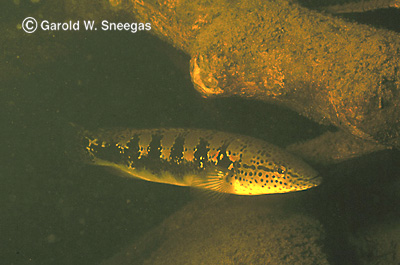


Basically, if the bands along the flanks encircle the spaces seperating them it is marmorata. If not, then they are lenticulata.
I stand by my assesment that both the fish you are getting and the one pictured in the link you provided are lenticulata.
There is a third group of pikes that have been circulating through the hobby as lenticulata of which I am not entirely sure they are.
*my interpretation
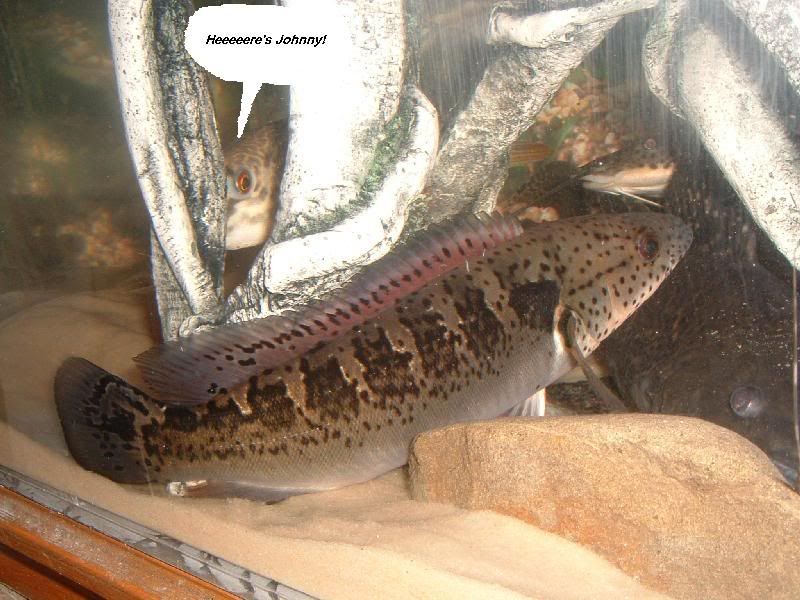
That was a very very informative post, Scat. Do you think it's somehow possible that mine could be a Marm/Lent hybrid? You see, in all the pics you provided, those Lents' lateral blotches are clearly separated. In my fish it's a continuous band. In that aspect it's very similar to a Marmorata. Also, it's clear from my pics that the blotches (bands) on my pike do not extend to the base of the dorsal fin. Not even close.
HerCrenVie;1658268; said:That was a very very informative post, Scat. Do you think it's somehow possible that mine could be a Marm/Lent hybrid? You see, in all the pics you provided, those Lents' lateral blotches are clearly separated. In my fish it's a continuous band. In that aspect it's very similar to a Marmorata.
I doubt it's a hybrid. I don't see enough evidence to make think it's even a possibility. The midband on your fish doesn't appear to be any more continuous than the 2nd or 5th pics of the lents I posted and due to the variablility it's not surprising that yours may look a little different. Also, it's the light colored spaces which extend to the base of the dorsal and that seperate the dark band/blotches which Warzel referred to, not the dark bands themselves. The fact that the dark bands/blotches on your fish do not even reach the base of the dorsal make me think lenticulata as well.
When all is said and done, I'd be very excited to get your fish. It's a race of lenticulata that has been quite difficult to come by and absolutely spectacular when happy, especially the females. Please do post more pics. I'd love to see them!!
Alright since even people on *********** say she's a Lent. What race is she? How many races are there? Can I safely say she's a "true" Lent? I'll get pics in a few hours; the water is a little cloudy from a major overhaul.Scatocephalus;1658279; said:I doubt it's a hybrid. I don't see enough evidence to make think it's even a possibility. The midband on your fish doesn't appear to be any more continuous than the 2nd or 5th pics of the lents I posted and due to the variablility it's not surprising that yours may look a little different.
When all is said and done, I'd be very excited to get your fish. It's a race of lenticulata that has been quite difficult to come by and absolutely spectacular when happy, especially the females. Please do post more pics. I'd love to see them!!
HerCrenVie;1658287; said:Alright since even people on *********** say she's a Lent. What race is she? How many races are there? Can I safely say she's a "true" Lent? I'll get pics in a few hours; the water is a little cloudy from a major overhaul.
Hard to tell what race form the pic you have thus far but I'd have to guess that it originates from the Rio Negro. The races from the Atabapo and Orinoco look quite different.
And I bought her for only S$80! W00ta!Scatocephalus;1658299; said:Hard to tell what race form the pic you have thus far but I'd have to guess that it originates from the Rio Negro. The races from the Atabapo and Orinoco look quite different.
