For The Aimara, I have some questions

  • We are currently upgrading MFK. thanks! -neo

mdmuping

Plecostomus
MFK Member
Feb 9, 2011
111
29
61
on the Earth
1) How often do you feed your Aimara per day? everyday?
2) How often and How much the water shoud be change?: I change the water once a week about 50% of the tank. But someone told me, The Aimara like to live in the old water( low pH). So changing the water every 2 week or every month. Do you agree?
3) How about the black water for Aimara? Someone told me black water can make the condition of water similar the amazon's river, although not 100%. How is your opinion about this? Or Have you ever use the black water for your Aimara?
4) i had seen the thread about mixing the Aimara and the snakehead in this web. i think it is good idea if i put the giant snakehead 10 inches in size within the 14 inches Aimara's tank. I think the stress of Aimara should be reduced if it has the tankmate. Stay alone in the take make it has alot of awareness. I think the 10 inches giant snakehead is the good choice for tankmate. beacuse
4.1) i choose the medium size of snakehead that larger than the Aimara'mouth, i hope the Aimara reluctant to eat the snakehaed. The Aimara should know that the snakehead can make it be injured. For this reason, i do not choose the large snakehead.
4.2) they swim in different level.
i would like to know your opinion about my idea.
However, " i do not know if i will not do it"
please guess the result. between
a. the aimara stay with the snakehead without any attack
b. aimara attack the snakehaead
c. Snakehead attack the Aimara
I will show you the correct answer:)
 
1) How often do you feed your Aimara per day? everyday?

18" every three days
10" every two days

2) How often and How much the water shoud be change?: I change the water once a week about 50% of the tank. But someone told me, The Aimara like to live in the old water( low pH). So changing the water every 2 week or every month. Do you agree?

I change about 15% - 20% per week. They tend to live in waters with high flow and tend to have a higher PH anywhere between 6.5 and 8 will be fine.

3) How about the black water for Aimara? Someone told me black water can make the condition of water similar the amazon's river, although not 100%. How is your opinion about this? Or Have you ever use the black water for your Aimara?

Instead of black water I just drop a couple of dried leaves in all my tanks, as they break down they release nutrients into the water. It's far from black water but I think it's made a difference.

4) i had seen the thread about mixing the Aimara and the snakehead in this web. i think it is good idea if i put the giant snakehead 10 inches in size within the 14 inches Aimara's tank. I think the stress of Aimara should be reduced if it has the tankmate. Stay alone in the take make it has alot of awareness. I think the 10 inches giant snakehead is the good choice for tankmate. beacuse

As a keeper of both Snakeheads and Hoplias this sounds like a really bad idea. Both are terratorial and 99% of the time something is going to go wrong, particulaly as the two species you are talking about are the most aggresive of their genus. 4' tanks is not big enough for the two of them even at the size they are now, there is nowhere to get away. The secret to keeping Hoplias or Snakeheads for that matter with other fish is to keep them with fish that don't present a territorial threat or can't be eaten. I have a 10" aimara in a 6x3 with three 5" SD's. They are definatly to big to eat and even though they don't present a territorial threat they still get chased.

What makes you think your Aimara is stressed?

4.1) i choose the medium size of snakehead that larger than the Aimara'mouth, i hope the Aimara reluctant to eat the snakehaed. The Aimara should know that the snakehead can make it be injured. For this reason, i do not choose the large snakehead.

The aimara will have never seen a snakehead and will not have any idea that the snakehead can fight back, for the size to have an impact on not fighting you would need a much larger fish where it can see it has no chance. The issue with these two fish will not be who eats who it will be territoral.

4.2) they swim in different level.
i would like to know your opinion about my idea.
However, " i do not know if i will not do it"
please guess the result. between
a. the aimara stay with the snakehead without any attack.

I am going with no.

b. aimara attack the snakehaead,

yes, particulally as you are introducing into his territory.

c. Snakehead attack the Aimara.

Possible if aimara was introduced into snakehead tank.

If somebody has got away with it they are very lucky:)
 
Thank you very much Jelly. So clear!!!. Why do i think my Aimara is stressed? I noticed that it show dark color.and stay only in the corner of tank. If it feels comfort, its color should be lighter than this in the same environment.

Is your Aimara swim in the mid of tank like the H curupira? or stay in the buttom at the corner like my aimara?

I think you correct about the time for feeding. Now i feed it two times aday. 2 to 3 shrimp/meal. At the fist time it swollow but i can see the shrimp in the tank later. It mean that it vomit later. The causes of this, i think, are 1) It be stressed 2) The interval for feeding is more often. I do not know the habbit of Aimara interms of time for feeding, amout of feeding and tiome interval for feeding.


Why do you feed your 18" Aimara every 3 days? I would like to know your idea or you had the problem like me before. How about the amout fish do you feed?

Compare with the H curupira. I think
1) H .curupira is more active. My term "active" is swimming alot. It comes to me for asking the food everytime. But the Aimaracome to me for deefensive.
2) H curupira eat alot compared with the Aimara
3) H curupira is less aggressive than Aimara.
Are there any difference in terms of the habbit, no including the structural apperance?
 
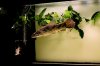
In this photo showed in the previous thread, it looked relax. Swim in the mid tank and the color is not dark. After i pick the flag-tail out, the aimara stay in the corner and the color change into dark mode. For this reason , putting the tankmate can make it more relax. So I would like to try again.

20110223_0049_1_1.jpg
 
1) Every second day.
2) 25% water change every week.
3) Not interested in doing black water but planning on doing the leaf treatment as stated by jelly.
4) I would never attempt that, as stated also by jelly, they are two very aggressive species and need they're own space. I also think the Aimara would attack and kill the snakehead.
 
  • Like
Reactions: redman
mdmuping;4961229; said:
In this photo showed in the previous thread, it looked relax. Swim in the mid tank and the color is not dark. After i pick the flag-tail out, the aimara stay in the corner and the color change into dark mode. For this reason , putting the tankmate can make it more relax. So I would like to try again.

Hi is this aimara? It looks too pretty lol.
 
it turns darker when resting at the black side walls? darker coloration does not mean its stress ,its just camouflaging


guess there no fast and hard rules for predatory community tank , might work for you but not for others ,it all goes down to the temperament of your fish , some time it could even attack each other after maybe a few years in the tank
 
My pleasure. I hope I don't go on to much.

When you say dark colour, is dark with goldy metalic patches on the top or solid dark colour all over? The stressed colouring of both of mine seems to desplay the gold patch colouring.

Larger predatory fish naturally don't eat every day and can become over weight when over fed, we tend to give them larger items than they normally would eat. They would try to but opertunity and difficulty in the wild prevent this, I am sure they would normally eat more than I am feeding but they would also use alot more energy getting it. As juveniles they eat more often to grow quicker but eat smaller meals. Some of this is my educated opinion rather than provon fact but works for me.

I feed my 18" a 6"ish sprat/Whitebait and a 2" chunk of trout or salmon every feeding, The smaller one just a little less but more often for now. I like to keep my fish on the edge of hunger otherwise I find they become lazy.

I don't think you are completly off with the other fish making them feel more comfortable. General fish phycology, if there are other small fish swimming around then there aren't any big predators around. It is well known that if you put a baby Micropeltes into a large space without fellow babys or other fish they become very shy and stressed. I would think that small aimara would possible follow the same pattern. My smaller aimara in a 3' tank was very confident and fed well, once moved into a 6x3 became very nervous and hid in a corner. Only now some weeks on has he started to come out and have a go. One of the traits I noticed of a stressed aimara was that they will attack the food but not eat it. I added three large Silver Dollars, to big to eat, this seemed to help but I can't catagorically say it did or didn't make a difference. If you are going to try, the other fish needs to be two big to eat and not a territorial threat. Your 4' might not be big enough though, I also wouldn't go an individual fish, it will probably become a target, my SD's do get chased but the space and numbers allow them to escape.


Compare with the H curupira. I think
1) H .curupira is more active. My term "active" is swimming alot. It comes to me for asking the food everytime. But the Aimara come to me for deefensive.

Agreed. curupira is a more open water fish, the aimara swims when it needs to. Both are active but in different ways, The Curupira will swim up and down the tank and almost shoal with other fish in the tanks. I have found that my aimara is very active when I am there, wants food and trys to bite me. Wasn't very active prior to adding a bit of flow, now will swim around a bit now, particulally into the flow. Does however sit on the bottom sometimes.

2) H curupira eat a lot compared with the Aimara

It depends on the maturity of the fish, my curupira is about 15"-16" so is probably a mature adult now and eats a lot less than my aimara.

3) H curupira is less aggressive than Aimara.
Are there any difference in terms of the habbit, no including the structural apperance?

Yes. curupira come from more open water habitats were territory is a little easier to come by, so I think requires less effort to find a home. For aimara, I would think it's very difficult to find a good rock to sit behind and catch passing food in fast flowing rapids. So competion will be high requiring a more aggressive approach to defend there rock.

:WHOA:(Means nothing but my 5 yr old daughter wanted me to put it on the message)
 
jelly;4962094; said:
My pleasure. I hope I don't go on to much.

When you say dark colour, is dark with goldy metalic patches on the top or solid dark colour all over? The stressed colouring of both of mine seems to desplay the gold patch colouring.

Larger predatory fish naturally don't eat every day and can become over weight when over fed, we tend to give them larger items than they normally would eat. They would try to but opertunity and difficulty in the wild prevent this, I am sure they would normally eat more than I am feeding but they would also use alot more energy getting it. As juveniles they eat more often to grow quicker but eat smaller meals. Some of this is my educated opinion rather than provon fact but works for me.

I feed my 18" a 6"ish sprat/Whitebait and a 2" chunk of trout or salmon every feeding, The smaller one just a little less but more often for now. I like to keep my fish on the edge of hunger otherwise I find they become lazy.

I don't think you are completly off with the other fish making them feel more comfortable. General fish phycology, if there are other small fish swimming around then there aren't any big predators around. It is well known that if you put a baby Micropeltes into a large space without fellow babys or other fish they become very shy and stressed. I would think that small aimara would possible follow the same pattern. My smaller aimara in a 3' tank was very confident and fed well, once moved into a 6x3 became very nervous and hid in a corner. Only now some weeks on has he started to come out and have a go. One of the traits I noticed of a stressed aimara was that they will attack the food but not eat it. I added three large Silver Dollars, to big to eat, this seemed to help but I can't catagorically say it did or didn't make a difference. If you are going to try, the other fish needs to be two big to eat and not a territorial threat. Your 4' might not be big enough though, I also wouldn't go an individual fish, it will probably become a target, my SD's do get chased but the space and numbers allow them to escape.


Compare with the H curupira. I think
1) H .curupira is more active. My term "active" is swimming alot. It comes to me for asking the food everytime. But the Aimara come to me for deefensive.

Agreed. curupira is a more open water fish, the aimara swims when it needs to. Both are active but in different ways, The Curupira will swim up and down the tank and almost shoal with other fish in the tanks. I have found that my aimara is very active when I am there, wants food and trys to bite me. Wasn't very active prior to adding a bit of flow, now will swim around a bit now, particulally into the flow. Does however sit on the bottom sometimes.

2) H curupira eat a lot compared with the Aimara

It depends on the maturity of the fish, my curupira is about 15"-16" so is probably a mature adult now and eats a lot less than my aimara.

3) H curupira is less aggressive than Aimara.
Are there any difference in terms of the habbit, no including the structural apperance?

Yes. curupira come from more open water habitats were territory is a little easier to come by, so I think requires less effort to find a home. For aimara, I would think it's very difficult to find a good rock to sit behind and catch passing food in fast flowing rapids. So competion will be high requiring a more aggressive approach to defend there rock.

:WHOA:(Means nothing but my 5 yr old daughter wanted me to put it on the message)

Thank you very much....my friend. I like your opinion very much.Because they came from both the basic data and your experience. I hope, our discussion may has a value for someone who has the Aimara.
Today, I had put the giant snakehead in the Aimara tank, at the first time the Aimara bite it, but no any severe injury to the snakehead. i hope they will stay together. I will pray for it.:(
I will pick new H curupira soon. I will show you later too.:)
 
Great response Jelly. You help make MFK a better place. I do not even own an Aimara but your exp helps us all.
 
MonsterFishKeepers.com