I’ve had far too many issues with heaters failing in the “on” position and killing off tankfuls of very expensive fish.
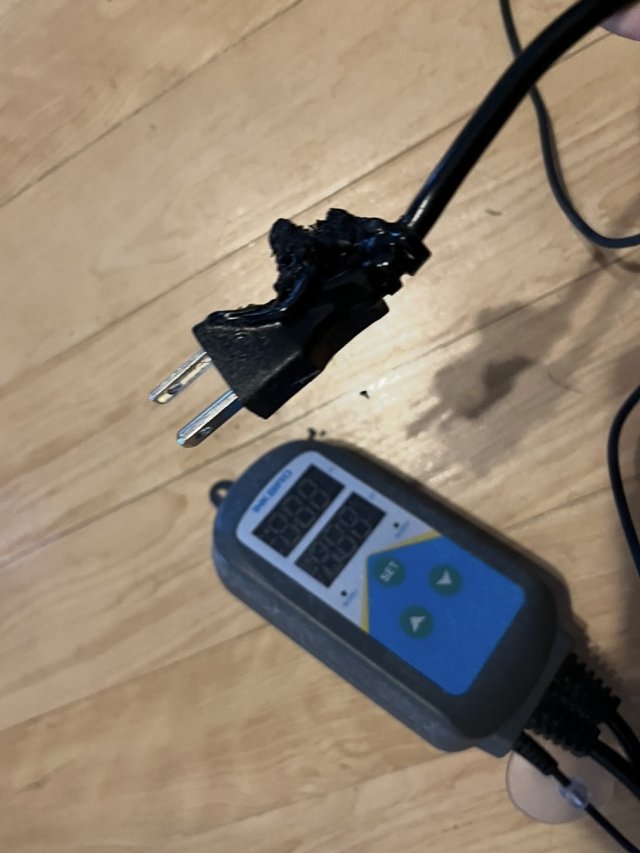
Was happy to find these thermostats and used them on all my tanks for peace of mind until I recently came home to a funky smell and smoke and found that the plug of my thermostat was melting and extremely hot.
I have no clue how or why it failed but I’m now a bit freaked out and uneasy about fully trusting any of these heaters or thermostats regardless of where they’re made.
I’m considering ditching heaters altogether and looking at species that don’t need a heater so I can sleep at night
Anyone have any guesses on why this happened? I have no understanding of electricity
View attachment 1571899
Hello; Early in this thread was mentioned a 1000 watt heater. That is considerable flow of electric power at full capacity. I do not know how much/many heaters you had working off this thermostat. Regardless assuming the plug was not close to some other heat source on the outside it looks like it melted from the inside.
I have a small electric heater in a bathroom. Set at 1250 watts. I run it for a short time when taking a shower during winter weather. I plug it directly into the wall outlet and not an extension cord nor power strip. I unplug it after every use. The plug and cord will be warm to the touch after maybe ten to fifteen minutes. This is from the resistance of the metal conductors in the plug or wires of the cord.
Household plugs and wiring are a compromise of cost for materials and function determined by the manufacturer. The thinner the wire the hotter it will become due to resistance of the wire. A thicker wire strand will carry the same current with less resistance as so will not get as hot.
Same for the metal prongs in the plug itself a thicker meta prong does not resist so much.
Then there is how the manufacturer connects the wire to the metal prong. I have had a few apart. To save money some makers use the less stable ways to connect. Some make a good solder connection. Some just a mechanical pinch or some such.
Knowing myself I would likely replace the plug with a heavier duty plug. Maybe the wire feeding the unit depending on how stout the feed wire is.
On to guessing. My first guess is a combination of two things. First is too much power drawing item(s) plugged into the system along with continuous use. I imagine somewhere in the paperwork is mention of how much can safely be plugged in.
A second guess is perhaps an extension cord is used or perhaps a power strip rather than being plugged into the wall outlet directly. I get it, sometimes a wall outlet is too far away. Again the thickness of the wire of such makes a difference. Use an extension cord rated for more power.
A story. Some years ago my brother bought a 30 foot camper. We parked at my place while he waited for a spot at the campground. We first use a couple of common light duty extension cord because it was handy. The camper drew too much current. So, i dug out my 100-foot heavy duty cord and it worked fine. It was as much the distance (length) as the draw.
One other thought. If you did not have the fish room wired for big tanks it might be wise to spread the load over as many breakers as you can. By this I mean you may have more than one wall outlet in the room but they all may run from one breaker in the houses electric panel. Often the overhead lights are on a separate breaker for example so a short in a wall outlet will not kill the lights. Flip off the circuit breaker for the outlets which run the tanks and see if any other wall outlets in the area still have power.
Good luck