Well for this to truly work you would need ample room for stuff to be able to breed and thrive and not be eaten before that happens. Obviously a massive tank with a relatively low stocking on the more predatory things would be the best case scenario. You could accomplish this with "safe" areas for the prey in a smaller setup but it would need to really be pretty attractive to that animal to keep a small population there breeding.
Agree with the above.
In nature fish are generally in a feast or famine situation. If food is available, its eaten until gone, and this is the problem in any but the largest tanks, even with the smallest fish.
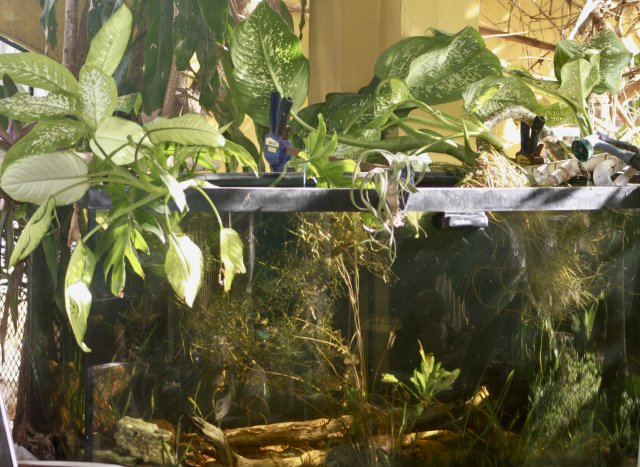
In my current tank, I try to run it as naturally as possible. No heater, no artificial lights (only sun), a pump and sumps for filtration and during seasonal changes, water changes are done using only rain water during the rainy season.

This can be disconcerting when rains drips tannins in the tank to such a degree, as to make it impossible to see much more than 2" into it, also blocking out the sun enough to make all plants melt back, and drop pH from low 8s, to 7 or below, there were 15 fish.
Even though the tank is 180 gallons, and the largest fish are no more than 7", the seasonal changes have brought on spawning ruts, where the 2 dominant males have lately killed any other males, and divided the entire tank in half.
Natural waters are very much influenced by terrestrial vegetation growing in them, and or sending roots that suck out a plethora of nutrients.
I use terrestrial plants for this, but compared to real live, I believe they are a pittance.
The pics below is from 2 days ago, the rains have slowed, and am doing 20% daily water changes with municipal water.
I added about a dozen fairly large shrimp into the tank (small ones in the sumps) but they only lasted a couple weeks with the cichlids.
The first fish were about 2 dozen mosquito fish, and they barely lasted a week once the young (2-3" cichlids back then) once the cichlids were added.
I believe a 6 ft tank, with fish no larger than a couple inches (killifish, small live bearers, neons or the like), initially heavily stocked with adult gammarus, other crustaceans, mollusks and aquatic insects, and heavily planted might work, but any larger fish such as cichlids (even dwarf type) is probably not a reasonable candidate for sustainability without regular intervention








