

I was worried about the glass as well, but after much reading, the chance of broken glass is pretty random and unusual. if you are worried, put something on the bottom panel- like the material they use to make cutting boards.
Informative video of mantis shrimp
- Thread starter jbnebres
- Start date
You are using an out of date browser. It may not display this or other websites correctly.
You should upgrade or use an alternative browser.
You should upgrade or use an alternative browser.
Good close-ups to mantis shrimp eyes. Music is a lil off- kinda trippy
[yt]VY-oyA_FUug[/yt]
"The mantis shrimp (which oddly is neither a mantis nor a shrimp, but a crustacean that resembles both) has arguably the most complicated visual system of any animal on Earth. Its compound eyes sit on independently moving stalks and can see colors ranging from ultra-violet to infra-red. Each eye is divided into three regions for tracking motion, forms, depth, and color. All of this, it is theorized, is done without the aid of its tiny brain. Now add to this an entirely new kind of vision previously unknown: the mantis shrimp can see circular polarized light.
We humans can see the effects of linear polarized light when we put on polarized sunglasses and go out on a boat. Linear polarization is observed when transparent materials reflect light, so on a sunny day, the oceans surface will look glassy to us. Put on polarized sunglasses and the glare is eliminated. Circular polarization is a bit more complicated. It has to do with out-of-phase stereo imaging, which can best be explained by the effect you get when you put on 3-D glasses and watch a movie in 3-D. Thats circular polarization."
Matt Ransford. "The Eye of the Mantis Shrimp: The Most Advanced Eye on Earth Gives It's Owner a Fighting Chance." March 28, 2008. www.popsci.com, 12/21/08 http://www.popsci.com/scitech/article/2008-03/eye-mantis-shrimp
Another informative site on mantis eye and vision - http://blueboard.com/mantis/bio/vision.htm
[yt]VY-oyA_FUug[/yt]
"The mantis shrimp (which oddly is neither a mantis nor a shrimp, but a crustacean that resembles both) has arguably the most complicated visual system of any animal on Earth. Its compound eyes sit on independently moving stalks and can see colors ranging from ultra-violet to infra-red. Each eye is divided into three regions for tracking motion, forms, depth, and color. All of this, it is theorized, is done without the aid of its tiny brain. Now add to this an entirely new kind of vision previously unknown: the mantis shrimp can see circular polarized light.
We humans can see the effects of linear polarized light when we put on polarized sunglasses and go out on a boat. Linear polarization is observed when transparent materials reflect light, so on a sunny day, the oceans surface will look glassy to us. Put on polarized sunglasses and the glare is eliminated. Circular polarization is a bit more complicated. It has to do with out-of-phase stereo imaging, which can best be explained by the effect you get when you put on 3-D glasses and watch a movie in 3-D. Thats circular polarization."
Matt Ransford. "The Eye of the Mantis Shrimp: The Most Advanced Eye on Earth Gives It's Owner a Fighting Chance." March 28, 2008. www.popsci.com, 12/21/08 http://www.popsci.com/scitech/article/2008-03/eye-mantis-shrimp
Another informative site on mantis eye and vision - http://blueboard.com/mantis/bio/vision.htm
Enhanced img. Dr. Roy Caldwell
http://berkeley.edu/news/media/releases/2003/11/images/shrimp_fluor.jpg
"The use of fluorescent colors as signals has not been shown in the sea. [Yet] Here,
we show that fluorescent coloration used in postural signaling by the mantis shrimp
Lysiosquillina glabriuscula contributes to signal brightness and visibility, particularly at
greater depths."
Fluorescent Enhancement of Signaling in a Mantis Shrimp C. H. Mazel,T. W. Cronin,R. L. Caldwell,N. J. Marshall
http://www.nightsea.com/mantis.htm
we show that fluorescent coloration used in postural signaling by the mantis shrimp
Lysiosquillina glabriuscula contributes to signal brightness and visibility, particularly at
greater depths."
Fluorescent Enhancement of Signaling in a Mantis Shrimp C. H. Mazel,T. W. Cronin,R. L. Caldwell,N. J. Marshall
http://www.nightsea.com/mantis.htm

"Based on our recent work, these animals have a lot more to see than we thought,"
Caldwell said. "Their signals are just a lot more complex than we ever imagined,
because they have these detection systems that we don't have. They have polarized
light signals we can't see, and now we find they have fluorescence signals we barely
see. In fact, we show that one set of receptors in this stomatopod eye is specifically
tuned to look at that yellow-green wavelength and pick out that signal." -Dr. Roy Caldwell
Caldwell said. "Their signals are just a lot more complex than we ever imagined,
because they have these detection systems that we don't have. They have polarized
light signals we can't see, and now we find they have fluorescence signals we barely
see. In fact, we show that one set of receptors in this stomatopod eye is specifically
tuned to look at that yellow-green wavelength and pick out that signal." -Dr. Roy Caldwell
"Though most underwater creatures, including crustaceans, octopi, squid and many fish, have limited or no color vision,
those that do can take advantage of fluorescence to expand their range of behavioral signals."
Robert Sanders - MantisShrimp Fluoresce to Enhance Signaling in the Dim Ocean Depths http://berkeley.edu/news/media/releases/2003/11/14_shrimp.shtml
Click
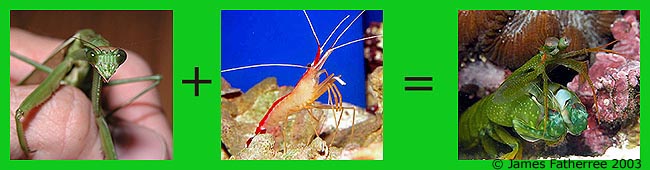
"I reached in to pull out the lifeless body, only to realize that it wasn't so lifeless. It popped a
slit in my finger in less than 25/10,000ths of a second and the blood was running fast before I
could get my hand out of the water. So, they really are thumb splitters, or at least index finger
splitters. Imagine that! There are times when I feel like I'm real smart. There are times
when I know that I am not."
- James Fatheree
This is an interesting site that explores a personal experience with these critters. James Fatheree
does a great job explaining how he came to/cared for mantises. From describing mantis'
appendages to mantis shrimp diet, this is another informative website that brings to light the
needs/cautions in stomatopoda.
------------------------------------------------------------------------------------------------------------
On another note, another good source:
A B.U T . c o m ' s
Mantis Shrimps | Photos & Profile <- CLICK
An abundant amount of info- from DIYs, Maintenance, Setups, etc.

[img source: http://www.abovebelowphotos.com/albums/album06/Smasher_Mantis_Shrimp.jpg]
slit in my finger in less than 25/10,000ths of a second and the blood was running fast before I
could get my hand out of the water. So, they really are thumb splitters, or at least index finger
splitters. Imagine that! There are times when I feel like I'm real smart. There are times
when I know that I am not."
- James Fatheree
This is an interesting site that explores a personal experience with these critters. James Fatheree
does a great job explaining how he came to/cared for mantises. From describing mantis'
appendages to mantis shrimp diet, this is another informative website that brings to light the
needs/cautions in stomatopoda.
------------------------------------------------------------------------------------------------------------
On another note, another good source:
A B.U T . c o m ' s
Mantis Shrimps | Photos & Profile <- CLICK
An abundant amount of info- from DIYs, Maintenance, Setups, etc.
[img source: http://www.abovebelowphotos.com/albums/album06/Smasher_Mantis_Shrimp.jpg]
[VIDEO IMG FRAME SOURCE: DR. ROY CALDWELL, REEFCENTRAL.COM ]
http://www.reefcentral.com/vid/bluering/bluering_content.html <-Video Link
A VIDEO SHOWING HOW TAME AND RESPONSIVE THESE STOMATOPODS GET
[yt]-m6qrMoYtCc&feature[/yt]
"Mantis shrimp are incredibly intelligent for crustaceans.
Stagger knows that the tongs mean food, and searches
every inch of them for the expected krill.. unfortunately,
this time I was just teasing him for the video, hah. He
got a live crayfish later, so he was pleased. "
[SOURCE: SYNIRR, YOUTUBE]
-----------------------------------------------------------------------------------------
THIS VIDEO SHOWS A MANTIS SHRIMP DEFENDING HIMSELF FROM AN OCTOPUS
[yt]IrTHlT2ChtM&feature[/yt][SOURCE: E4RTHW0RM, YOUTUBE]
[yt]-m6qrMoYtCc&feature[/yt]
"Mantis shrimp are incredibly intelligent for crustaceans.
Stagger knows that the tongs mean food, and searches
every inch of them for the expected krill.. unfortunately,
this time I was just teasing him for the video, hah. He
got a live crayfish later, so he was pleased. "
[SOURCE: SYNIRR, YOUTUBE]
-----------------------------------------------------------------------------------------
THIS VIDEO SHOWS A MANTIS SHRIMP DEFENDING HIMSELF FROM AN OCTOPUS
[yt]IrTHlT2ChtM&feature[/yt][SOURCE: E4RTHW0RM, YOUTUBE]
I have seen these in Person. Should only be in a species only tank. Highly aggressive.
I have heard they can pack a punch equal to a .22
I have heard they can pack a punch equal to a .22
Meet one of youtube's celebrity invertebrates, Mr. Mantis..
[yt]VQ-9q3RM9KI[/yt]
[yt]3EEMeVSQWw0[/yt]
This guy is pretty intense.
[yt]VQ-9q3RM9KI[/yt]
[yt]3EEMeVSQWw0[/yt]
This guy is pretty intense.
A mantis shrimp burrowing itself into a new home. Really clear footage.
I never browsed the oceanfootage.com website before, but I'm sure they have more quality clips beyond mantis shrimp.
Part I. (sand fountain)
Part II.(Up close, starts to look like hand puppet)
[SOURCE: http://www.oceanfootage.com/stock_footage/invertebrates_footage.htm]
I never browsed the oceanfootage.com website before, but I'm sure they have more quality clips beyond mantis shrimp.
Part I. (sand fountain)
Part II.(Up close, starts to look like hand puppet)
[SOURCE: http://www.oceanfootage.com/stock_footage/invertebrates_footage.htm]
