Is a bare tank better or worse for aggression?

  • We are currently upgrading MFK. thanks! -neo
Crowding can diffuse aggression of American as much as with African, but the scale is different. Have you seen large Midas coexist peacefully in 300+ gal tank in youtube or in public aquarium. Midas max out to 15 inch, Mbuna 6 inch, so you need proportionally much bigger tank to achieve crowding harmony.

Cichlid living in group in the wild doesn't make them more peaceful or more amenable to crowding management. Mbuna and Tropheus live in large congregation to graze algae on rock in the wild, yet they are the most aggressive species in respective lake. Predatory haps that spread out in the wild are the more peaceful species in captivity.

Few people keep solitary Africans because they are small fish. But I have kept one 6 inch Chipokee in a 10 gal after he killed every one in the community tank. He is a glass banger and attack even his own reflection.

I've never had luck crowding large aggressive cichlids. It seems to work for some but not for others. I've never kept Africans because I've been too busy keeping CAs for the last 29 years. What would I know?
 
  • Like
Reactions: kingflowerhorn
Crowding can diffuse aggression of American as much as with African, but the scale is different. Have you seen large Midas coexist peacefully in 300+ gal tank in youtube or in public aquarium. Midas max out to 15 inch, Mbuna 6 inch, so you need proportionally much bigger tank to achieve crowding harmony.

Cichlid living in group in the wild doesn't make them more peaceful or more amenable to crowding management. Mbuna and Tropheus live in large congregation to graze algae on rock in the wild, yet they are the most aggressive species in respective lake. Predatory haps that spread out in the wild are the more peaceful species in captivity.

Few people keep solitary Africans because they are small fish. But I have kept one 6 inch Chipokee in a 10 gal after he killed every one in the community tank. He is a glass banger and attack even his own reflection.

When I was a kid, my science teacher had a cobalt blue zebra in the class living by itself. This fish had lived by himself in the tank for at least 2 years. My teacher didn't want it anymore and I had a fish thank so he gave it to me. I didn't really know much about African cichlids. I had a bunch of convicts that were all bigger than him and a giant pink Tilapia in my tank. After I put him into my tank, he harassed and terrorized every fish in there. I ended up having to buy a separate tank for him. From that experience, I was under the impression that you couldn't put a cobalt with any other fish until I went to the petstore and they had about 40 african cichlids including a bunch of cobalts in a 20 gallon tank all swimming around together and looking happy.

Moral of the story to me is that crowding will work unless the fish has been living by itself for a long time.
 
It's a great way to show off your fish poop. I'll give it that but unless you're trying to sell them quick before the new batch is ready the only thing you're doing is making it slightly easier to clean fast.
 
I've never had luck crowding large aggressive cichlids. It seems to work for some but not for others. I've never kept Africans because I've been too busy keeping CAs for the last 29 years. What would I know?

The reason may be your tank is not large enough. I have seen a number of Midas colony tanks in both public and private settings. I was amazed how peaceful these beasts get along in big tanks, none less than 300g though. There are critical mass and critical space requirements for crowding to work, which are function of the fish size

Once I had 3 tiny Thorichthys in a 10 g tank, where 2 hided all day long and the dominant one chased them as soon as they emerged. After I transferred them to a 30g with a group of other species growouts, the chasing stopped instantly, and the two weaklings were bold and came out all day long ever since. But as the fish gain in size, what worked before may break down overnight. Many people eventually failed crowding Mbuna because they failed to replenish the critical mass or failed to providing them larger accommodation.
 
Last edited:
Several good comments above. My immediate thought was it depends on the species, so I agree there, and also agree there's often a critical mass for tank size or footprint and this varies according species. Plus, there's very often individual behavioral differences within a species, so there's not always a guaranteed formula in every case. Also, the choice doesn't have to be bare tank vs. highly scaped tank. Spare tanks, open but with substrate and minimal or moderate aquascaping can also work very well with some types.

So, to get the best answer the question is what species? Some are social, some not social but tolerant, some intolerant, some aggressive primarily to similar looking fish but not so much other fish, some need to be either alone (or paired) or else in a group of a minimum number, like 6 or 8 or more. Depends on the species.
 
Nice article. I'd forgotten it. There's also been a study showing brain development of fry is more limited in bare tanks. I've done different kinds of tanks, some densely planted/densely scaped and some open and spare, but never bare tanks, not for fry or any species. I want at least some element of naturalism in the tank, not just a glass box. Just my preference.

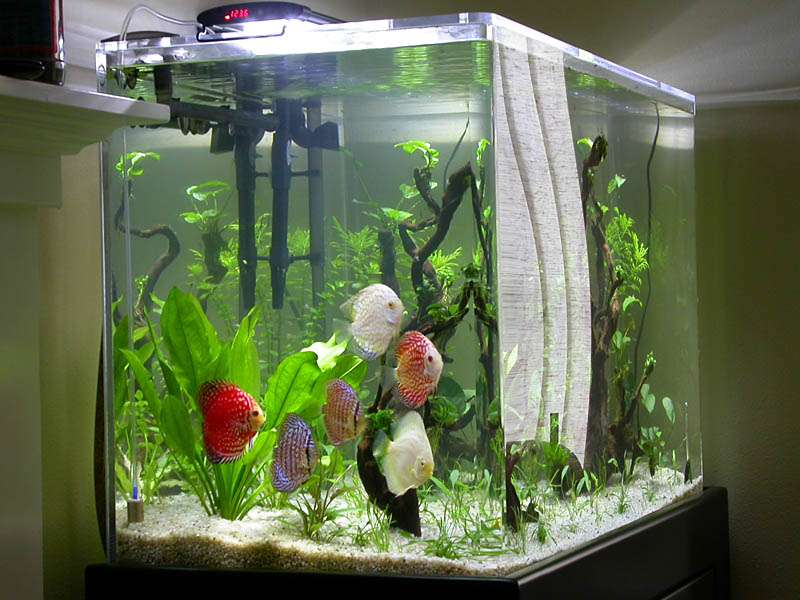
Feeding can make a difference. I kept discus years ago, for several years and very successfully. Never did the bare tank, daily huge water change, no other fish routine. It's simply not needed if you know how to feed them without resorting to beef heart, excessive protein, etc. and they'll grow quite well without all of that if you know what you're doing. My point being, the arguments of some for bare tanks stems from a particular approach to care and feeding, but there are other options.

Beyond any of that, their natural habitat, size of tank, which species and how many-- it all goes into what the tank looks like for me.
 
  • Like
Reactions: Stanzzzz7
Nice article. I'd forgotten it. There's also been a study showing brain development of fry is more limited in bare tanks. I've done different kinds of tanks, some densely planted/densely scaped and some open and spare, but never bare tanks, not for fry or any species. I want at least some element of naturalism in the tank, not just a glass box. Just my preference.

Feeding can make a difference. I kept discus years ago, for several years and very successfully. Never did the bare tank, daily huge water change, no other fish routine. It's simply not needed if you know how to feed them without resorting to beef heart, excessive protein, etc. and they'll grow quite well without all of that if you know what you're doing. My point being, the arguments of some for bare tanks stems from a particular approach to care and feeding, but there are other options.

Beyond any of that, their natural habitat, size of tank, which species and how many-- it all goes into what the tank looks like for me.

All pro Discus keepers do bare tank for fry... You simply are able to have less waste and constant water changes in the beginning. I guarantee you any Discus that aren't raised in a bare bottom tank as fry will not end up round and fat and grown to full potential.

Here's a perfect example, this guy claimed to have done water changes 50%-75% almost every other day or a few times a week. The Discus are Stunted, will probably reach 4-5 inches max.

68V3hso.jpg
 
All pro Discus keepers do bare tank for fry... You simply are able to have less waste and constant water changes in the beginning. I guarantee you any Discus that aren't raised in a bare bottom tank as fry will not end up round and fat and grown to full potential.

Here's a perfect example, this guy claimed to have done water changes 50%-75% almost every other day or a few times a week. The Discus are Stunted, will probably reach 4-5 inches max.

68V3hso.jpg
Those discus are in a tank that's way too small- that's probably what stunted them. Wild caught discus do manage to get big despite their origins lol.
 
  • Like
Reactions: Stanzzzz7
All pro Discus keepers do bare tank for fry... You simply are able to have less waste and constant water changes in the beginning. I guarantee you any Discus that aren't raised in a bare bottom tank as fry will not end up round and fat and grown to full potential.
I could write a long post here about myths regarding discus fish, but keeping it short so as not to go too far off topic-- Mr. Stendker of Stendker Discus in Germany would be among the discus pros who would disagree with you, as he has stated more than once at fish shows, in articles, etc. In fact, Stendker, among others describe some common beliefs about keeping discus as myths, including how often to feed fry, which is part of the equation in keeping them healthy and growing well without needing so many water changes.

Exhibit A, as in any Stendker video I've ever seen, including feeding videos at their breeding facility, there is sand (and often plants, driftwood, etc.) in his tanks: Stendker at Interzoo

And in any case, I know that other approaches work from my own experience of keeping discus for years.
 
Last edited:
MonsterFishKeepers.com