Is there a way to grow a fish to its max potential size in home aquariums?

  • We are currently upgrading MFK. thanks! -neo
What about them? Do they exist, sure, have I personally seen them - nope. Never. High nitrates where I live typically equates to dirty polluted water. Even those who live with higher than normal nitrate levels from the tap, most likely understand that as nitrates rise, so does overall pollution levels.

The point is, every time someone uses nitrates as an indicator for pollution, you come in posting your studies regarding nitrates, to which I agree, but at the same time it would be nice if you also explained to fellow members that generally speaking, a rise in nitrates generally equates to a rise in overall pollution. I have explained this myself several times on the forums, including correcting others, and supporting your view. I just find that your dogmatic approach to not be in the best interest of the forum, as some people may misread your info as it being ok to have high nitrate levels, because generally speaking, it's quite the opposite.

Thanks
 
In terms of growth I like to take the micro view of: What inhibits and what promotes cellular growth and replacement. Of course we don't exactly know what all triggers such as chemicals, vitamins and minerals are in that case. But I try to look at other areas of the animal kingdom and pull generalized info from them. As an example, I consider Nitrates to be the equivalent of leaving an animal in a room with rotting bits of food. A tiny piece in the corner and youll probably never notice it. Allow tiny pieces to build up everywhere and of course theres going to be adverse side effects to health.
 
What about them? Do they exist, sure, have I personally seen them - nope. Never. High nitrates where I live typically equates to dirty polluted water. Even those who live with higher than normal nitrate levels from the tap, most likely understand that as nitrates rise, so does overall pollution levels.

Why not just use a calendar?

Some people have 20-30 ppm nitrate tap water. Is that water bad for fish?

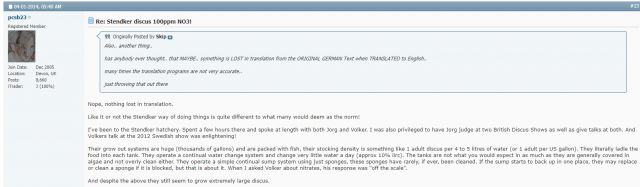
Then you have Stendker who grows world class discus despite high nitrates/low rates of water exchange:

2020-05-04 14_25_27-Stendker discus 100ppm NO3! - Chromium.png

Years ago, I couldn't find a straight answer on nitrate toxicity so I started looking at studies but that brief immersion didn't make anything clearer.

I took the opportunity to ask the aquatic vet when I took my fish to UC Davis and she said to just keep it under 150 ppm. UCD is the #1 veterinary school in the country and either #1 or #2 in the world. These are the vets who take care of the fish at public zoos and aquariums. These positions are the most competitive so you really have to be the best of the best.

I haven't lost a fish in 8 years. Some of my fish will be old enough to vote this year. Ironically, I was doing massive water changes (like 50% daily) when I last lost fish.
 
Why not just use a calendar?

I do. But since when does one size fit all in this hobby? Clearly there are different levels of fish keepers in this hobby, so when having discussions regarding topics such as this I think that's its in the best interest of the bobby to keep that in mind.


Some people have 20-30 ppm nitrate tap water. Is that water bad for fish?

Nope, and I don't believe I have said that it was. In fact if you check back to previous discussions on this topic you will find that I agree with your viewpoint.

Then you have Stendker who grows world class discus despite high nitrates/low rates of water exchange:

At best, anecdotal evidence provided on a forum by someone who has visited their facility. Ho-hum. I personally would take away next to nothing from that comment.

I took the opportunity to ask the aquatic vet when I took my fish to UC Davis and she said to just keep it under 150 ppm. UCD is the #1 veterinary school in the country and either #1 or #2 in the world. These are the vets who take care of the fish at public zoos and aquariums. These positions are the most competitive so you really have to be the best of the best.

Again, no disagreement regarding "nitrates", but as mentioned a number of times, I regard nitrates as nothing more than a measuring tool for pollutants. As nitrates rise, so do pollutants/bacteria, pollutants/bacteria that no aquatic vet in their right mind would tell you are good for a fishes health at elevated levels.

I rarely lose fish, ever, they die from old age, or I pass them on to others to enjoy. With species that can tolerate large water changes, I also typically perform massive water changes (80%+) as often as I have time, but always at least once a week. Not saying this is the only way, only my way, but the solution to pollution is dilution, and the vast majority of fish species thrive in well kept conditions, such as clean, unpolluted water. Not the other way around.
 
At best, anecdotal evidence provided on a forum by someone who has visited their facility. Ho-hum. I personally would take away next to nothing from that comment.

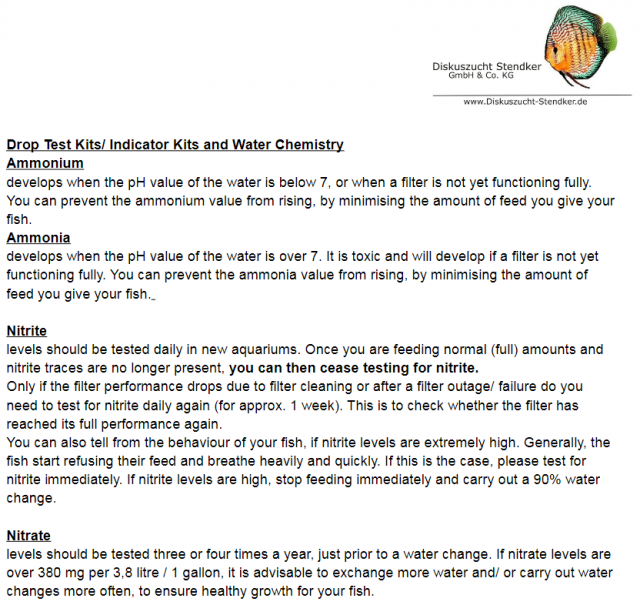
2020-05-04 16_11_13-3.3_Wasserwerte_und_Wasserchemie_en.pdf - Chromium.png

Again, no disagreement regarding "nitrates", but as mentioned a number of times, I regard nitrates as nothing more than a measuring tool for pollutants. As nitrates rise, so do pollutants/bacteria, pollutants/bacteria that no aquatic vet in their right mind would tell you are good for a fishes health at elevated levels.

Vet at world class institution: 150 ppm

World class discus breeder: 100 ppm

No doubt with a large margin of error. Nobody would suggest a number that was even close to being harmful.

And this is nitrate from not changing water not nitrate alone.
 
In fairness, that stendker post states they use a continuous drip system that is around 10% total volume per day. So 70% per week. It also notes that the tanks are covered in algae, which would compete with harmful pathogens. Lastly, stendker discus are man made hybrids that have been line bred for many many generations.

The information in this thread is fascinating. However, when I think of how filthy my tank would have to get in order to hit triple digit nitrate readings, I just can't believe that would be good for the fish. I gravel vac and change water twice a week and never fail to remove an incredible amount of waste. Not to mention the state of the filter socks after a week. It's not like nitrate just falls out of the sky. It comes from waste.
 
Why not just use a calendar?

Some people have 20-30 ppm nitrate tap water. Is that water bad for fish?

Then you have Stendker who grows world class discus despite high nitrates/low rates of water exchange:

View attachment 1416210

Years ago, I couldn't find a straight answer on nitrate toxicity so I started looking at studies but that brief immersion didn't make anything clearer.

I took the opportunity to ask the aquatic vet when I took my fish to UC Davis and she said to just keep it under 150 ppm. UCD is the #1 veterinary school in the country and either #1 or #2 in the world. These are the vets who take care of the fish at public zoos and aquariums. These positions are the most competitive so you really have to be the best of the best.

I haven't lost a fish in 8 years. Some of my fish will be old enough to vote this year. Ironically, I was doing massive water changes (like 50% daily) when I last lost fish.

Don't electrolytes get out of whack with funky dissolved solids and urine?
 
Stendker discus have a reputation of marketing their discus as being extra hardy, and from what I have seen over the years they are just that. And of course stating that their fish are pretty much bulletproof, on their website, certainly makes for good advertising.

Yet I have never seen anyone outside of their facility promote growing out juvenile Stendker discus, in dirty water. In fact, their USA based discus wholesaler, Discus Hans, the in the video below states that small discus are more work, require more water changes, and that "You have to keep the water clean". Of course you do, and anyone that has raised discus is captivity knows that when you get lazy with water changes, the net result is stunted sicky fish. Start at 6:30 if you don't care to watch it all.


A past comment from one of our own experienced discus keepers.

^ Yeah, that's rubbish. I've been keeping discus for 15+ years. 50% water changes per week on sub-adult fish will stunt them. People have been trying for as long as I've been online to get away with cutting out water changes and those are always the people that have A) sickly fish, or B) "adult" fish that top out at 4". That's not the adult size of a discus. They are a lot like Uaru in the sense that keeping them in subpar conditions will result in their overall health going downhill.

As Ryan well knows, it's not just about nitrates. Once the fish are semi-adult to adult, much easier to keep them going in higher nitrate values. But this discussion was about optimizing growth in an aquarium, not maximum nitrate values that one can get away with - which as most experienced fish keepers will understand, will vary from species to species, and also vary due to various stages of growth.

In the following video, Hans explains how his water changes are performed, every day, or every other day.


And this is how they do things in Asia.

 
I think the word "nitrate" is a bit nebulous, and most aquarists look at is a somewhat of a mysterious chemical without the understanding of its implication. It is a sign that a new tank is cycled, and a very welcome sign at first.
To me, the word nitrate, is synonymous to "fish piss", or urine to those with less a crass vocabulary than I.
Freshwater fish are constantly pissing (urinating) thru their gills, and a part of that piss (ammonia) is used by beneficial bacteria in filters and substrate, but the rest is in solution in the tank, and remains in the tank, unless diluted by a water change.

Plants and algae thankfully use some of it up, but to use the constant supply coming from constantly pissing fish, requires there to be a very high percentage of plants, compared to fish.

So what other tools do aquarists have to dilute fish-piss-soup, the easiest, and most efficient are water changes.
(protein skimmers and nitrate reactors can also be used, but are out of most average aquarists realm)
So the more nitrate in the tank, the more the tank water is concentrated fish piss soup.

i.e.....If your tank water tests at 50 ppm nitrate, and you change 50% water every 2 weeks, the first water change removes 50% of the piss soup, but 2 weeks later as fish add more urine, that soup is more concentrated and your next 50% water change does not keep up, etc etc.

If you live in an area with high natural nitrate, this is catch 22,
The EPA mandates a nitrate MCL of no more the 10 ppm, because more than 10 ppm can be dangerous to new born humans.

The water provider where I worked as a chemist, tolerated no more than 1ppm in our supply
 
MonsterFishKeepers.com