Life habits polypterus

  • We are currently upgrading MFK. thanks! -neo
Yes, there has been a post, but it required lots of reading. Lol. This was publiushed by Nathan Russel Harrington in 1898. It was during his first zoological expedition of the Nile. It's a shame of his passing in 1899 due to fever while in Africa. There would of been more polypterus observations and we would know more about them.

Both zooligists polypterus researches from the turn of the century below.
* Post #1 Nathan Russel Harrington

* Post #5 Samuel Budgett

https://www.monsterfishkeepers.com/forums/threads/polypterus-migration.688381/
 
  • Like
Reactions: Polyaddict86
Reading a little further... they are also using abductive reasoning! While abductive reasoning is still seen in modern science, most journals would not allow a paragraph like this to go to press; simply too much speculation. Fun that they were able to get the local folk-lore into the article!

1. Migration. — Several of the fresh-water fishes found in the
Nile migrate each season to the Mediterranean to spawn. This
is the case with the eel (Hanash) and the several species of
mullets. It has never been supposed that Polypterus could be
found in any considerable numbers north of the second cataract,
so that there seemed to be little likelihood that this fish migrated.
When, however, fish were found in this lower part of the river
more abundantly than in any other part known, except the
head waters, it became a possibility that Polypterus had migra-
tory habits. Investigation of the distribution of Polypterus at
points intermediate to the second cataract and the mouth
showed that in the large brackish Lake Menzaleh, an enlarge-
ment of the Delta, no adult fish could be got, although it
was reported that two young Polypteri were obtained here
the year before. The single specimen in the Natural History
Museum at Cairo was the only one which had been seen in the
local markets there for a number of years. At Assiout, 325
miles from the sea, the fishermen did not recognize the stuffed
specimen shown them, but when the name, "aboubichir," was
mentioned they said that such a fish was occasionally found
there ; that it came from bad crocodiles' eggs and went down
the river, while the good eggs brought forth young crocodiles
that went up river !


I'm going to apply abductive reasoning the next time I get caught do something my wife does not approve. Clever method, lol
 
  • Like
Reactions: Polyaddict86
https://www.researchgate.net/public...du_Tchad_en_periode_de_Tchad_Normal_1966-1971

The abstract:

abstract.jpg

Lots of cool info in this paper for you poly-nuts. Including discussion of migration, the timing of spawning, the length of spawning activity, size-specific maturation of eggs prior to spawning, differences in spawning physiology between habitat types, and more.

The catch? It's in French! Happy translating.....
:rolleyes::p:D
 
Jaws, interesting read thanks for posting.

For being an old article there is both some good insights and erroneous assumptions.

i enjoying reading their observations and comparing to what I observe in my tank. (Obvious some limitations with this comparison)
The description of the side to side head swimming action is spot on although to different degrees on different bichirs. My hybrid swings his head violently side to side when he swims vs my Delhezi which barely moves it.
Their observation of nocturnal feeding habits is also observed with my fish to different degrees- my two weeksii only feed at night ( in fact I have never seen my big guy feed) I have found the CB's tend to be more willing to feed aggressively during the day)
I do chuckle at their dismissal of air breathing in Polypterus. We all see their reliance on atmospheric air in our tanks.
The male female ration also tend ps to be supported in what we see in the hobby.

We really need some new research into our fish. I am sure I am not alone when I see any nature show on rivers in Africa, with the hopes of seeing or hearing about bichirs. Heck I even had my fingers crossed that Jeremy Wade might catch one on River Monsters
 
Jaws, interesting read thanks for posting.

For being an old article there is both some good insights and erroneous assumptions.

i enjoying reading their observations and comparing to what I observe in my tank. (Obvious some limitations with this comparison)
The description of the side to side head swimming action is spot on although to different degrees on different bichirs. My hybrid swings his head violently side to side when he swims vs my Delhezi which barely moves it.
Their observation of nocturnal feeding habits is also observed with my fish to different degrees- my two weeksii only feed at night ( in fact I have never seen my big guy feed) I have found the CB's tend to be more willing to feed aggressively during the day)
I do chuckle at their dismissal of air breathing in Polypterus. We all see their reliance on atmospheric air in our tanks.
The male female ration also tend ps to be supported in what we see in the hobby.

We really need some new research into our fish. I am sure I am not alone when I see any nature show on rivers in Africa, with the hopes of seeing or hearing about bichirs. Heck I even had my fingers crossed that Jeremy Wade might catch one on River Monsters

I thought b.s when they said polys arent hardy fish lol.

I feel like my congicus and koloton swim head side to side more than the others
 
  • Like
Reactions: Polyaddict86
I also would have liked to know what species of catfish they were eating
 
  • Like
Reactions: Polyaddict86
I also would have liked to know what species of catfish they were eating

Most catfish or a large percentage is likely Synodontis species. They're plentiful and occasionally a younger polypterus is a bycatch in their nets.

Here's pics from Corubal (koliba) river.

guinea35.jpg guinea36.jpg
 
  • Like
Reactions: Polyaddict86
I assumed it would have been a syno but have a hard time believing they could get one down and live to tell the tale

There's other smaller catfishes that have crazy and some with very long spines. Not sure how polys fair with swallowing one of these. But if u recall a thread I posted for endli & Senegal stomach contents. A high ratio were tilapia species.
 
We really need some new research into our fish. I am sure I am not alone when I see any nature show on rivers in Africa, with the hopes of seeing or hearing about bichirs. Heck I even had my fingers crossed that Jeremy Wade might catch one on River Monsters

There is lots of poly research going on :)
Poly research.jpg

Polys are interesting in a broader evolutionary context because they are non-teleosts, which puts them in a very exclusive group of extant freshwater fish including gars, lungfish, paddlefish and bowfins. Polys are particularly interesting among these non-teleost fish because no one is quite sure what to do with them (as a group) from a history-of-life perspective. Work aimed at figuring out this larger issue is the main focus of research on Polys. In this figure I've broken down the 515 papers I've found by subject area tags; in red are areas of research that would correspond to figuring out the "big" question... what the heck are these fish and how are they related to other fish.
Research on Polys.jpg

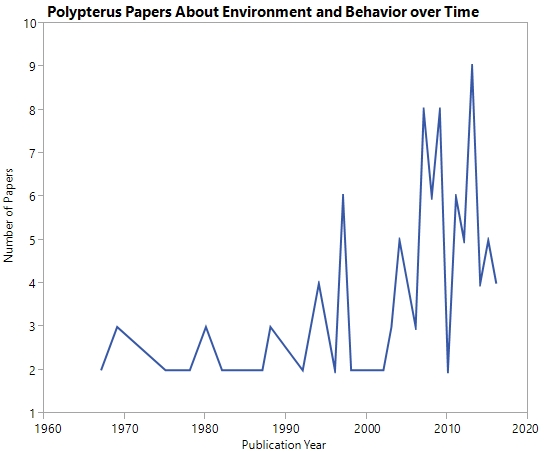
As you can see above, there are some papers that have been tagged as studies of the ecology or behavior of Polys. Here's what that work looks like:
Poly ecology.jpg
I'd say the research into Poly ecology/behavior has actually taken off in the past 10 years!:eek::rolleyes:
 
  • Like
Reactions: Vancouver_98683
MonsterFishKeepers.com