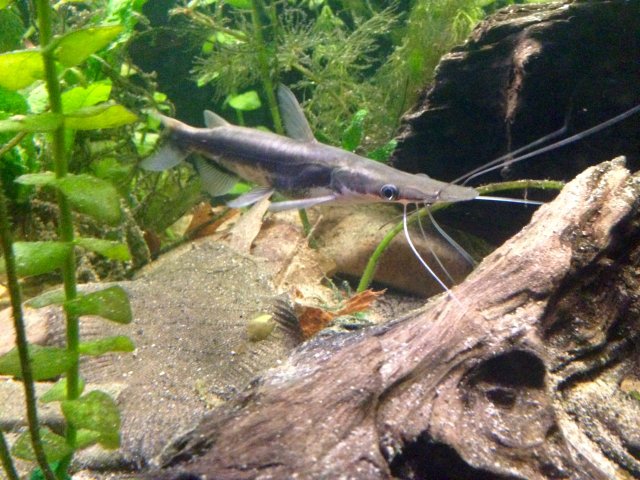
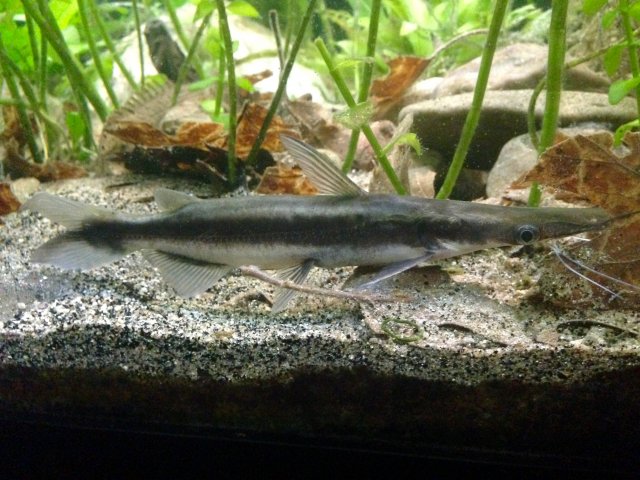
AFAIK, we as hobbyists cannot tell one from the other from exterior features. There are vague indications.
My impression, vague too, is that true lima appear more frequently in UK and Europe but still the vast majority is elongatus. As I stated, I am aware of only a few reports of true lima in the US and perhaps a few dozen in EU over the last decade or so.
Just my impression. I've never made a special effort to find out more exactly.
Here is a small write-up I made on lima/elongatus.
Most important first: Lima maxes out at 2', elongatus at 1'.
Check out this thread which includes a relevant piece from the most recent genus revision:
http://www.monsterfishkeepers.com/f...elongatus-ID-thread&highlight=trigonocephalus
These are ambush predators that float with minimal motion ~ vertically head down among vegetation or debris pretending to be a twig or a plant and wait for a suitable prey to come by close enough.
Young Sorubim species like the company of each other and usually, with enough of them, would do the head standing together, which is an unusual and cute sight. Adults are said to largely lose the gregarious trait. My eight are ~7" and float like that together parallel to each other in a tight formation half the time at about 45-60 degrees to horizontal.
IME and IMO, the vast majority of people thinking they are buying a Sorubim lima are actually buying a Sorubim elongatus in the US, so chances are great that yours is S. elongatus, which tops out at 1', not 2' as S. lima does. Not once have I seen any Sorubim labeled elongatus. They are all labeled either common snovelnose or lima shovelnose.
They appear quite hard to tell apart from the exterior features for laymen like us:
http://www.planetcatfish.com/forum/viewtopic.php?f=13&t=30938&hilit=+elongatus (that's one of mine I was trying hard to ID years ago). As you could see, our colleague Back (high level hobbyist) from Finland thinks the position of the mandibular barbels with respect to the gular and other skull features may be telling. I do not remember this approach having been validated by a known respected ichthyologist but I think the latest genus revision justifies this ID approach.
I've never seen a 2' one in person, not even one that'd be longer than 11"-12" TL, while I have owned and seen scores of them. Mine never grew beyond ~11", which makes me assume they were all elongatus but I have not had them long enough to be dead sure. For now, this leads me to believe that most/almost all we have in the US are elongatus. I have seen only 1 or 2 approximately two-footers on the photos originating from the USA here on MFK (here are some pics of an almost fully grown lima:
http://www.monsterfishkeepers.com/f...e-lima-shovelnose-catfish&highlight=elongatus ) and a few in between 1' and 2'. Our colleagues in Europe say they see 2'-ers sometimes, not as rarely as we do in the US.
The Cat-eLog entry for elongatus
http://www.planetcatfish.com/common/species.php?species_id=697offers kind of soft ID: "...Very generally, Sorubim with spots are usually S. elongatus. (TBTB edit: as opposed to the other 4 species in this genus; this appears mostly true IME with ~20 of these fish.) They are more of a black water species and, as with most such species, tend towards more variable, spotted patterning."
They need not live feedings, unless we are talking earth worms or ghost shrimp, lizards, land frogs, etc. They are small predators that snatch small fish (anything that can fit in their mouth which is relatively and surprisingly big for their slender body structure but not that big compared to other medium and large Pimelodidae catfish), crustaceans, and insects in the wild. I always feed mine frozen/thawed foods - small whole fishes, fish pieces, shrimp/prawn/etc. or shrimp pieces if too large (do not peel; raw is better than cooked), and other sea/aquatic animal foods.
They can be trained to take pellets but the cases where they thrive on pellets are few it appears to me, even on Hikari Massivore pellets. I have never seen them fat and happy on pellets, rather always thin and slow-growing. Anyone, correct me, please, if your experience differs. EDIT Dec 2016: my latest batch of 8 has started on cut fish but with time taken to pellets (offered to tank mates) all by themselves and now are taking 50% or more pellets. Doing and growing very well so far. If I recall correctly Necrocanis reported his specimen doing exceptionally well on pellets too.
When very small, mine like freeze-dried and fresh bloodworms, plankton (mini-shrimp-like creatures), etc.
The growth on elongatus is not fast, perhaps 6"-7" in one year starting from ~3". As you see, I think my experience with lima is most likely zero, so IDK how fast they grow. The fact that they reach 2x larger adult size may or may not matter.
Check this excellent link:
http://www.seriouslyfish.com/species/sorubim-lima/ - the info is well written and arranged. In the notes it says: " (TBTB: S. lima is) Distinguished from S. elongatus by having modally 9 pectoral rays; 21 anal-fin rays; 16 gill rakers..." The page does not state the counts for elongatus anywhere. Neither have I found a species page for S. elongatus. Unless I am missing something, I find this odd and not as helpful as it could have been otherwise. All other pointers refer to things that are subjective. Nevertheless, I enjoyed reading the page and learned a lot.