Mesoheros Festae Gender

  • We are currently upgrading MFK. thanks! -neo

MapleKM

Feeder Fish
May 2, 2026
4
0
1
36
Lincoln NE
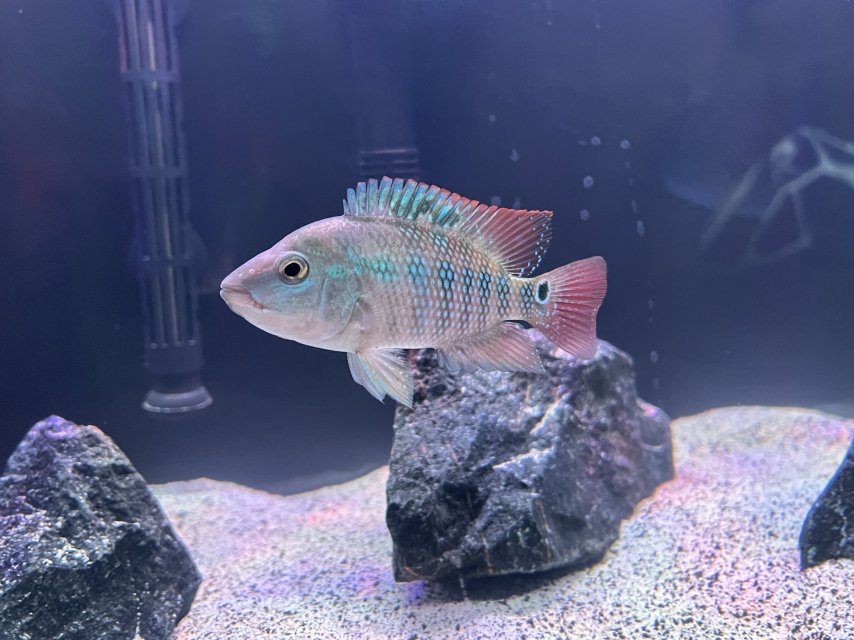
2 wild Mesoheros Festae looking for experience trying to determine gender. Larger one is about 4.5-5” smaller is 3.75”
Have 2 picks of each only a few days apart. The larger one has a good amount of spangles, green color around the face but also the front half the dorsal is black. This one has a more streamlined body and already a little sloped head bump. I think this is a male?
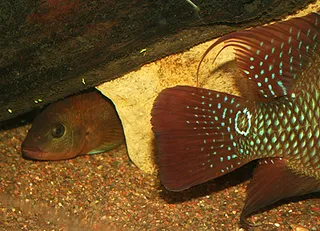
Second 2 pics are of a potential female. Still has some spangles Ive seen many posts about them fading as they reach maturity. It has the signature black spot on the dorsal as well as more of thicker body and sharper angle on the head.
IMG_7807.jpegIMG_7755.jpegIMG_7767.jpegIMG_7809.jpeg
 
Thank you for the reply
First 2 pics females. Last pic female. 3rd looks to might be female as well but still
Young
I would be thrilled if both are females. The larger one just had me a little confused has the green around the gills / face and the pelvic fins are more iridescent then black. Maybe it’s still a little soon and the deeper red orange on the body and black pelvic fins will start to turn. It does look like the spangles in the fins are only near the ends of the fins. Definitely not evenly spread like I’ve seen most males as they mature.
 
1779364132754.png1779364166407.png
Above are 3 young females, they are have dark pigment in the dorsal, and very few spangles.
Below is a male, note the array of spangles, throughtout the body (somewhat like your 3rd pic) and lack of solid dark coloration (black, blues) in the dorsal
1779364509103.png1779364600007.png1779364642945.png
And compare size, at the same age, the male is at least double in size of females.
Yours seem to be quite small and young at this point, so you may need more time.
In all my pics even the females are 5+ innches and the male over 10 inches.
 
  • Like
Reactions: A201
Just for clarity, you did say the 1st 2 of your pics are the exact same fish, and the 2nd 2 pics are a different fish but both pics are the same fish right?
 
That is correct
Just for clarity, you did say the 1st 2 of your pics are the exact same fish, and the 2nd 2 pics are a different fish but both pics are the same fish right?
Pics 1 and 2 same fish different tank with darker environment.
Pics 3 and 4 same again in a tank with white sand then in a darker environment.
All pictures taken only about a week apart.
 
Thank you for the detailed response!
The larger one just has me a little confused with the green around the gills / face and the pelvic fins are more iridescent then black, the body and end of the fins spangled. Maybe it’s still a little soon and the deeper red orange on the body and black pelvic fins will start to turn. It does look like the spangles in the fins are only near the ends of the fins. Definitely not evenly spread like I’ve seen most males as they mature.

I had a pair from Rapps Rio Esmeralda’s collection 7 ish years ago. It was day and night with those two. Male like you said reached 8” by time the female hit about 5.5”. But even at a small size I don’t remember much spangling on the female. In your experience do young females display this spangling especially like the first 2 pictures at the ends of the fins and lose it as they reach maturity? Sorry for all the questions.
View attachment 1576137View attachment 1576138
Above are 3 young females, they are have dark pigment in the dorsal, and very few spangles.
Below is a male, note the array of spangles, throughtout the body (somewhat like your 3rd pic) and lack of solid dark coloration (black, blues) in the dorsal
View attachment 1576139View attachment 1576140View attachment 1576141
And compare size, at the same age, the male is at least double in size of females.
Yours seem to be quite small and young at this point, so you may need more time.
In all my pics even the females are 5+ innches and the male over 10 inches.
 
What interests me, is that populations from different river systems, may display different colored patterns from others, depending or topography or foliage cover, so a population of one species may look drastically different that a different than the same species, from another river only a few males away, so each population must be judged on their own terms.
IMG_8559.jpeg
Above is an indivual of Andinoacara from the Pacora river.
Below Andinoacara individual from the Ipeti river, notably different.
IMG_2407.jpeg
If the ancestors of a certain population are from open, less foliage covered river, their color patterns may be totally different the a population only a few miles away
Another set of drastically different species from opposite rivers, two of the same Darienheros species
IMG_0240.jpeg
IMG_2728.jpeg
The one above caught in a open, less foliage covered area of the Mamoni river
The same species below caught in a very terrestrial foliage covered narrow stream.
IMG_8836.jpegIMG_0219.jpeg
Within the same species, location collection point variations may be quite different, in other countries.
Below 2 variations of the Mexican Chuco intermedia species,but from different river systems.
1779392250003.png1779392308634.png

And of course as you already noted, place species on a light colored substrate, and you can expect a totally opposite coloration than if placed on a darker substrate.
 
MonsterFishKeepers.com