

Moneywart plants showing (thin growth?)

  • We are currently upgrading MFK. thanks! -neo

Finthusiast

Plecostomus
MFK Member
Sep 2, 2019
316
177
51
34
Hi, I am seeking to learn more about keeping my plants healthy in my tank and currently have a (fresh) ecosystem in the making! I know some but not enough to keep a lively planted tank the way they should grow.
I want to share specifically whats been happening in my current 10 gallon tank with moneywart from a freshwater lake. I have had them for months and they have mostly stayed alive but they seem to be growing a bit (thin?) and also there is a distinct difference in growth from when they were in the lake (thicker growth at bottom of plant) and when I added them to the tank (thinner growth at top of plant). The bottom is turning brown (dieing?) and at the top (thinner, newer, growth) it is all staying a nice green color however it IS thinner and definitely lacking some kind of nutrient that causes it to become thin (I guess?)
My question is what specifically needs to be done in this situation in order to help it grow properly? My current plant routine is: add to tank, light on 7 hours per day. That is all I do so far and it stays alive for months and is still alive but I want this stuff to do well and also dont want to harm or bother my fish (I dont know about plant nutrients relating to fish safety/water parameters)

ie: I dont want to add nutrients that are not necessary and possibly overload on some while not having enough of the others. Is there a simple additive that will supply general level nutrients to most plants that will work? Or do I need to use some of one nutrient and none of others(based on this growth pattern)? Also any info related to moneywart specifically please let me know. What does moneywart “need” as far as nutrients?
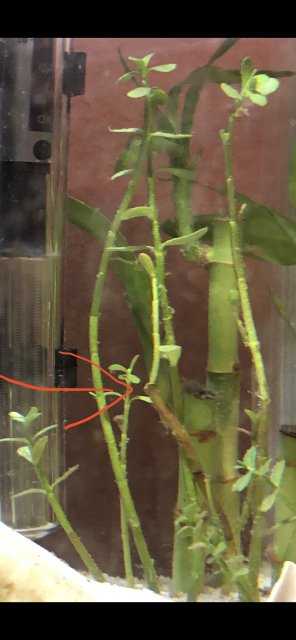
3BAB8C7C-0C07-4BE0-AD52-C100C2153B9C.jpeg

Well thanks to anyone who reads this and thanks again to anyone who has info lol sorry I may have got carried away in length but I got it all out there lol! :)

 
As a general rule plants require carbon dioxide, sufficient light and nutrients.

There is a term called light compensation point, i.e. the level of usable light over the tank, below which certain plants don't grow and wither and die. This point is plant species dependent. Generally, if you say the plant keeps growing than I'd rule this out. If it stays the same height for weeks on end, then it does not get sufficient light....Plants can grow fast, even if not that good looking due to other deficiencies.

Plant nutrients are generally separated in two groups, either macro and micro nutrients or mobile and immobile nutrients.

Mobile nutirents are nitrogen in the form of ammonium, nitrate, phosphorus, potassium, magnesium, zinc and molybdene.
Immobile nutrients are calcium, iron, boron, copper, sulfur, etc..

Macro nutrients are nitrogen in the form of ammonium, nitrate, potassium, phosphorus, calcium, magnesium...Micro nutrients are metals such as iron, boron, copper, zinc

Immobile, mobile nutrients gives a clearer picture due to the easier way to remember plant deficiency diagnosis.

Mobile and immobile refers to the trans-portability of the nutrient in the plant, i.e. mobile nutrient deficiency generally manifests in old growth(falling out old leaves) where immobile nutrient deficiency manifests in new growth, e.g. stunted, discolored or deformed new growth. However, severe mobile nutrient deficiency, for example lack of of nitrogen,will first show up in old growth(falling out leaves for example) and if the issue is not corrected, will eventually affect new growth by stunting it, hence why they are mobile nutrients. On another hand a tank rich in mobile nutrients such as nitrogen will have darker green plants, species dependent of course....

The macro and micro refers to how much of each they're required. The macro nutrients are required in much larger concentration than micro nutrients. As a general rule, macro nutrients are mobile nutrients and micro nutrients are immobile nutrients with some slight mix and swap if you compare the lists I mentioned..

Carbon dioxide is also essential but the only way to get more of it besides what's produced in the tank, is to artificially inject a tank. However, science says that carbon requirement and light requirement are inversely related, meaning the more light you have, the less carbon the plants would need, and the more carbon you have, the less light your plants need. Obviously, it can be plant species dependent but the worse scenario is low carbon dioxide and low light(as in low tech tanks). The optimal for plants is high light, high carbon dioxide but the rule to remember is that they can compensate for each other. In a non CO2 injected tank you want above average plant light. Too much light and insufficient plant mass on another hand can cause algae. The higher the plant mass, the better the chances of a balanced tank....

Additionally worth mentioning is that carbon dioxide can be produced sufficiently enough in a low tech non-injected tank in rich substrate such as soil and high oxygenation via aerobic(oxygen driven) decomposition.

I will let you think about the above and decide where you need improvements.

The one thing I did not mention in the above is flow distribution, which determines how well nutrients and CO2 are delivered the plants.
 
  • Like
Reactions: Finthusiast
Well based on what you just shared it seems I need to add both macro and micro nutrients (not sure which ones tho?) because the bottom (older) part of the plant is withering and the new growth seems to be coming in a bit deformed.
I appreciate your teachings this has been a massive jump in my understanding of plant nutrients. Could you give me a little nudge into what specifically is happening here? Thanks again for the lesson!

edit: oh also I should add more light to compensate the lacking co2?
 
Try micros first. I would also take a few stems and replant them in a different area of the tank,where they get more light. I'd cut out the bottom and replant the tops.

Generally, the response time in a low tech is a week or two. I'd dose every couple of days. If it works, you can always modify the dose. If that doesn't work, start also adding macros. As you said, the chances are both are a problem but it helps diagnose things one by one, so you know for yourself in the future what looks like what....Don't be afraid to experiment...

It also helps to have different plants as the signs are more visible on some than the others. To rule out CO2 deficiency, you can add some floating plants like salvinia. They take up aerial CO2 and would be only limited to nutrients if there's sufficient light. The greener and bigger the salvinia the more nitrogen there is. If it grows pale and stunted, not enough nutrients.
 
  • Like
Reactions: Finthusiast
Awesome thanks I will look into that floating plant salvinia for sure. So what do I need to buy as nutrients “micro” and “macro”?
Like what specific product do you recommend for adding nutrients?
 
Read the label would be my advise. Different manufacturers combine different sets and combinations. You want to have some form of both macro and micros on hand, normally sold in separate packages. The brand I use and quite like is called Easy Life. The micro nutrient mix bottle is called Easy Life Profito. I also use Easy life Ferro additionally as my water is hard and iron deficiency is rampant. I dose extra Iron for that reason. They have Easy life Nitro, as a potassium nitrate macro nutrient which I also have, and I also have their Potassium supplement. I use each on per need basis but in my own plants I have sort of learned to see the signs. It is important to learn how your own plants react to different deficiencies.

I've added some more general info that might help you understand the basics.

Important macro nutrient is KNO3, which is potassium nitrate and can be obtained in powder form as well as manufactured liquid form variants. Fish tanks do produce nitrogen in the form of ammonium and nitrate but despite that, being a macro nutrient, nitrogen is quite often deficient, especially in tanks with high mass. Adding inorganic nitrogen has no negative effect on the fish's well being.
Deficiency in nitrate manifests as dying older leaves, often a uniform yellowing and falling off, and stunted new growth later on. It is the most important nutrient for plants.

Potassium deficiency can show up as tiny pin holes on the leaves. My hydrophila is exceptionally sensitive to potassium and iron. It is the first to show the typical signs. Different plants require different amounts of each nutrients.

Phosphorus is produced via fish's food normally so it doesn't need supplementation often. Phosphorus deficiency is linked with the appearance of green spot algae or necrotic patches on larger leaves..Plants such as anubias may require higher phosphorus concentration and I've seen this sort of deficiency mostly on anubias, in the form of yellow/necrotic melting patches in the middle of the leaf.

Magnesium sulfphate can be obtained cheaply. It's other name is Epsom salts. Deficiency in magnesium manifests as pale leaves with dark green veins. I have also seen this on anubias a lot. It is not to be confused with iron deficiency which shows up as pale/bleached new growth but the veins of the plant are not dark green . Iron being an immobile nutrient, will not affect older growth but what has grown damaged will remain that way.... Dosing Iron would show an immediate response to new growth. The leaves and stalk would also perk up upon dosage on iron deficient plants. It is one of the most common micro nutrient deficiencies, especially in hard water. It is worth noting that algae can also be iron deficient at the same time as plants and upon dosing iron, one may start noticing algae but this is because it colors up, same as the plants would recover color. The algae was always there but not so visible :)

Calcium is normally sufficient if your water is hard or moderately hard. But hard water does not mean enough magnesium. So magnesium can be dosed separately, in the form of Espom salts from any pharmacy...

There are many options to buy nutrients for aquariums, the cheapest being getting them in powder form and making your own mix for which there are many suggestions and recipes online but I'd start with pre-manufactured liquid forms during the learning period. Make sure they contain the basics and follow the instructions on the label. In a low tech tank ready made bottles can last you ages.
 
  • Like
Reactions: Finthusiast
I am beyond thankful to you for providing this information! I will be looking into these supplements today for my two tanks. I have a 75 gallon tank and Id like to be maintaining the same plants in there so same rules apply to big and small tanks? I have a decent lighting set up in the 75 gallon I will post a link to that if you dont mind giving me 2¢ and am using small aragonite black gravel as the substrate which I also will send you a link to. Will these get the job done for my plants in general? Thanks again for the help my friend!


Btw the led light I have is the 156 led
 
Couple of questions (not trying to overwhelm you lol)
So before I add anything just want to share my ten gallon is reading high nitrate levels (over 40ppm). Would adding this potassium nitrate make it even higher or is this unrelated? Also Im not sure if I need the potassium as I dont see any pinholes. (It hasnt occured to me til now that maybe my fish is plucking the leaves off sometimes and could be why they look (skinny?) lol I know its all mixed up info by now but I just want to share as much as possible to get the right solution. I will hold off on buying anything till I know for sure what will help. Thank you very much for all the help you are giving me! I will continue to seek guidance as much as you will share but no pressure haha ;)
 
MonsterFishKeepers.com