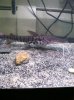
My 14" blind tsn rescue

  • We are currently upgrading MFK. thanks! -neo
One thing I feel I must comment again on (that has been brought up by Necrocanis) is that IMO blindness will not hold your TSN back. Most pims, TSN included, do their best and most efficient hunting at night when the eye sight is not needed at all. What's needed are barbels and maybe other sensory electrical organs like the lateral line, the pits, etc... and that's enough. Their usual prey relies on sight during the day light hours, which renders it pretty vulnerable at night and that's what these cats use to their advantage. These cats are nothing like perch-likes, pikes, etc. which are predators relying on the eye sight.

When I give my two 10" jurs guppies and leave the night light on all night, many/most of the guppies are still alive and well after weeks and weeks (I do offer dead foods too meanwhile). Then all I need to do is to not leave the light on one night, and in the morning, there is not a single guppy left on their 120 gal tank.

Totally agree with this statement lots of cats dont really use eyesight to hunt anyway. And some are so aggressive the will still bang and bump into things with good eyes and non live food.
 
I think I might take your advise and switch off of pellets. Now I notice the difference in the smell when using live/dead food. Also my cat stopped eating them and seemed to do much better


Sent from my iPhone using MonsterAquariaNetwork app

Yea me personally i couldnt stand the smell, nice to know the cat is doing good TSN are one of my favorite cats. A nice healty TSN is like a freshwater shark LOL.
 
First let me say i dont have a issue with people who choose not to use live just those who keep saying its bad and your fish will die thats untrue. Anything that is done improperly can kill your fish. Every cichlid and goldfish i ever saw with bloat(not mine never had a fish with bloat) were feed flakes or pellets. So the biggest thing with disease transfer to me is improper care and handling of feeders( not quarantining them). Just as i wouldnt go buy a new fish and dump him into a stable established tank i wont do it with the feeders either. The cruelty part i dont buy at all everybodys idea of cruelty is different and the zoo was probably one of the worst example to use. For instance it is cruel u say to feed live prey because the animal cant escape but it isnt cruel to keep a animal with a natural home range of 50-150 square miles in a cage. Its funny how we can always justify the cruelty we accept while vigoroulsy opposing the cruelty we dont. accept.

You got your live feeding routine to near perfection which is huge and happens very, very seldom from what we can see going around. It is very hard to do and you accomplished it, so congratulations are in order! So the danger here is in generalizing, ..... and absolute, all-sweeping statements are nearly never true anyway. I don't think you'd disagree that for 90%-99% of hobbyists, feeding live is risky but, as you and MonsterMinis and Co prove it, it can be done right in terms of the disease transference. And that's that.

As for the cruelty, yes tis' such a grey area. Yes, we accept the "cruelty" of keeping animals captive, of line breeding, selection breeding, cross-breeding, etc. for the higher purpose of learning about the animals and having them help us (e.g., dogs). Clearly there are more humane and less humane ways to keep a fish or any other animal, wild or domesticated. People know this line much, much better when it comes to mammals and maybe birds, but 99.999% are clueless when it comes to fish because of the communication barrier, so to speak.

Anyway, yes, the captivity (of predators in our discussion case) is acceptable by all/most people (except maybe PETA people) for the sake of the higher purpose. Let's not mix it with the cruelty to the prey. Yes, keeping fish captive is not ideal (ideal would be if we could swim like the fish with them in the wild but let's stay reasonable). But adding "avoidable" cruelty to the live prey offered to them makes things worse.

I am sure it can be argued the other way around, that live feedings lessen the "burden/cruelty" of a large predator being held captive and/or beneficial to their health, vigor, vitality, psychology, etc. And this is why I cited the zoos and public aquaria and animal-based amusement parks, etc. as those people are PROFESSIONAL wildlife keepers and have animal psychologists and scientists on staff and do research including on this topic and read cutting-edge scientific papers on this topic and experiment with their subjects (like the well publicized orca and dolphin research). It could be wise to humble ourselves before those with better knowledge and follow their example, even if we don't understand all the whys and what's for now. Neither do they but at least, for sure, they know far, far more!

 
You got your live feeding routine to near perfection which is huge and happens very, very seldom from what we can see going around. It is very hard to do and you accomplished it, so congratulations are in order! So the danger here is in generalizing, ..... and absolute, all-sweeping statements are nearly never true anyway. I don't think you'd disagree that for 90%-99% of hobbyists, feeding live is risky but, as you and MonsterMinis and Co prove it, it can be done right in terms of the disease transference. And that's that.

As for the cruelty, yes tis' such a grey area. Yes, we accept the "cruelty" of keeping animals captive, of line breeding, selection breeding, cross-breeding, etc. for the higher purpose of learning about the animals and having them help us (e.g., dogs). Clearly there are more humane and less humane ways to keep a fish or any other animal, wild or domesticated. People know this line much, much better when it comes to mammals and maybe birds, but 99.999% are clueless when it comes to fish because of the communication barrier, so to speak.

Anyway, yes, the captivity (of predators in our discussion case) is acceptable by all/most people (except maybe PETA people) for the sake of the higher purpose. Let's not mix it with the cruelty to the prey. Yes, keeping fish captive is not ideal (ideal would be if we could swim like the fish with them in the wild but let's stay reasonable). But adding "avoidable" cruelty to the live prey offered to them makes things worse.

I am sure it can be argued the other way around, that live feedings lessen the "burden/cruelty" of a large predator being held captive and/or beneficial to their health, vigor, vitality, psychology, etc. And this is why I cited the zoos and public aquaria and animal-based amusement parks, etc. as those people are PROFESSIONAL wildlife keepers and have animal psychologists and scientists on staff and do research including on this topic and read cutting-edge scientific papers on this topic and experiment with their subjects (like the well publicized orca and dolphin research). It could be wise to humble ourselves before those with better knowledge and follow their example, even if we don't understand all the whys and what's for now. Neither do they but at least, for sure, they know far, far more!


Cool we both have diff opinions but i see you are one of the few who can see both sides of the story. Very cool guy(or gal) in my book.
 
To each its own, absolutely. Thanks for understanding that I (a guy) was simply conveying my own thoughts and feelings and far be it from me to teach/tell others how to conduct their hobby... unless they ask... and then again, all I can offer is my thoughts and opinions, which are constantly evolving too.
 
Looking better all ready. Muscle bellies are filling out nicely. Keep at it and in a few more weeks that thing will be healthy as a hog. ;)

Sent from my SCH-S738C using MonsterAquariaNetwork App
 
Looking better all ready. Muscle bellies are filling out nicely. Keep at it and in a few more weeks that thing will be healthy as a hog. ;)

Sent from my SCH-S738C using MonsterAquariaNetwork App

Thanks. I found the build thread I asked about. I plan on copying the build once he's back to normal


Sent from my iPhone using MonsterAquariaNetwork app
 
MonsterFishKeepers.com