

Natural Habitat of Kelberi and Azuls

  • We are currently upgrading MFK. thanks! -neo
Hybridization in the wild will turn the fish that you love into something that's no longer...

Matt

For me at least, I think I'd still love the hybrid. Lucas F, reports that hybridization takes place in man-made environments. However,since Azuls and Kels also occur together even in their natural habitat (ie Mato de Grasso), that leads me to think hybridization even in their natural habitat is possible. I think their progeny might actually look cool. But beauty is in the eye of the beholder.
 
Developing cool looking hybrids in the confines of a glass box is one thing. In the wild is another.

The differences in Cichla (of the same species) from different locations is based on their adaption to the unique conditions of that place.

That two different species of Cichla don't naturally hybridize in one location is based on evolutionary processes that are null and void if you transplant them from that location to another (whether a man-made reservoir or a natural body of water).

Reminds me of the different Gymnogeophagus in Uruguay. Every place has different ones. It would be a real shame if people started dumping ones from one place into somewhere else. A mess.

Matt

For me at least, I think I'd still love the hybrid. Lucas F, reports that hybridization takes place in man-made environments. However,since Azuls and Kels also occur together even in their natural habitat (ie Mato de Grasso), that leads me to think hybridization even in their natural habitat is possible. I think their progeny might actually look cool. But beauty is in the eye of the beholder.
 
Points duly taken.

I started the thread to show how Kels and Azuls live. I was hoping that these videos might help hobyyists develop a biotope. But as Lucas F, stated, the videos do not show their natural habitat. (I could not discern that due to a language barrier).

Here is what I was able to find:
http://www.aquapress-bleher.com/index.php?option=com_content&task=view&id=83&Itemid=53

And this: pg 50 shows cichlids.
http://horizon.documentation.ird.fr/exl-doc/pleins_textes/doc34-04/23202.pdf

Also this one in English:
http://www.checklist.org.br/getpdf?SL016-06

This seems cool too:
http://fish.mongabay.com/data/ecosystems/Para-Tocantins.htm
 
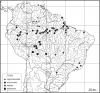
Tucunaré localização.png
tucunare localização 2.png

These maps include introduced points. Theyre not complete, there are others places where peacock is already introduced, its from a Kullander research. However I believe its the best information we have about where the peacocks are really native.

And about hybridization: I would really like to try to put kelberi x pinima or kelberi x piquiti and check if their sons are fertile, would be nice to check this.

And I would really like to check that info about hybridization by myself, the friend that told me this couldnt end his research that wasnt about hybrids, he just couldnt identify they since they had both species caracteristics (piquiti is pretty different from kelberi). he worked at Itaipu dam, in Paraná river.

In the future I would like to check the presence of hybrids in Ceará of pinima x kelberi.

Tucunaré localização.png

tucunare localização 2.png
 
  • Like
Reactions: UncleRico
Be careful with some papers and information. In my opinion a lot of scientific papers are inaccurate about cichla species..
Probably because of the genus revision. I would say some because of the little interest about knowing it, but I dont wanna judge here. =/

Just see, according to Kullander, Cichla pinima, kelberi and piquiti are from Tocantins, right?
In the last paper you post, they say there were ocellaris + temensis (açu) on the Tocantis watershed and theyre probably taking advantage because of the tucurui dam.

Just see what I found there:
http://www.youtube.com/watch?v=GqaTvIEZ1ZQ
http://www.youtube.com/watch?v=FW112rSx6cc

Pinima two times, just confirm it to me, Im pretty sure it is. Theyre close (temensis and pinima), but anyway, in long time all the knowledge about Cichla will be screwed with those papers.
 
MonsterFishKeepers.com
