

New 55 Gallon Tank Thread
- Thread starter OvercaffeinatedFishGuy
- Start date
You are using an out of date browser. It may not display this or other websites correctly.
You should upgrade or use an alternative browser.
You should upgrade or use an alternative browser.
Hey y'all,
I've been so focused on grades and the end of the semester that I haven't had time to really focus on fishkeeping, but good news, I'm done with everything and I can focus on fishkeeping again for a little while.
Despite not having a lot of time to focus on hobbies, I have been thinking about what tank to do and I think I've made my decision. I'm going to go a live planted tank but not set up as a true planted tank (meaning I'm only doing plants underwater that attach to rocks and stuff like that).
Now I've been a bit worried about cost...I'm really not wanting to spend a whole lot on things that don't need to be super expensive. I know this is a common problem and I was wondering if y'all have tips on reducing cost on stuff that's essential but can be found for cheaper.
I've heard that Pool filter sand is good for aquariums, is that true? I want to keep my stock safe so I'm worried about putting stuff that isn't stuff from the aquarium store, but then again I'm really trying to avoid spending $100 on sand alone.
Also, what do y'all recommend to cut down costs for filter floss and other filtration stuff? Last time I did this I spent a lot of money regularly on specific filter stuff for my HOBs and I really would like to try to buy bulk if I can so I'm not constantly dropping $60 on filter floss and stuff alone.
I think that's all for the not-so-fun stuff...on the fun stuff lol.
I've been so focused on grades and the end of the semester that I haven't had time to really focus on fishkeeping, but good news, I'm done with everything and I can focus on fishkeeping again for a little while.
Despite not having a lot of time to focus on hobbies, I have been thinking about what tank to do and I think I've made my decision. I'm going to go a live planted tank but not set up as a true planted tank (meaning I'm only doing plants underwater that attach to rocks and stuff like that).
Now I've been a bit worried about cost...I'm really not wanting to spend a whole lot on things that don't need to be super expensive. I know this is a common problem and I was wondering if y'all have tips on reducing cost on stuff that's essential but can be found for cheaper.
I've heard that Pool filter sand is good for aquariums, is that true? I want to keep my stock safe so I'm worried about putting stuff that isn't stuff from the aquarium store, but then again I'm really trying to avoid spending $100 on sand alone.
Also, what do y'all recommend to cut down costs for filter floss and other filtration stuff? Last time I did this I spent a lot of money regularly on specific filter stuff for my HOBs and I really would like to try to buy bulk if I can so I'm not constantly dropping $60 on filter floss and stuff alone.
I think that's all for the not-so-fun stuff...on the fun stuff lol.

Pool filter sand is a very practical and effective aquarium substrate, and it's dirt cheap compared to actual "aquarium" substrate at the LFS. The same is true for many other items that are useful to the DIY crowd. I have several sumps and other pieces of gear that came from Home Depot; most of the larger pieces are labelled Rubbermaid; in my previous home I had many hundreds of pounds of red/black fine gravel self-collected from a beach on the north coast of Lake Superior. Think outside the box; buying stuff from the LFS is almost guaranteed to be the most expensive way to get anything for the hobby. They only way I'll buy there is if I need something that can't be gotten any other way.
By the way, if you are planning on a planted tank that isn't planted...i.e. all the plants are merely tied or attache to bases, or floating...you don't need to use any substrate at all. You can also have a few plants in individual pots or containers, leaving the rest of the tank bottom substrate-free or at most with just a think scattering of substrate.
Filter floss is a special case. While you can buy it in bulk from other sources, it's difficult to be certain that it hasn't been treated in some way that would make it dangerous for aquarium use. Fortunately...you don't need floss at all, from anywhere! It's generally considered disposable, single-use only...although I know at least one cheapskate who has tried to clean it and re-use it in the past ...but you can buy good quality open-cell foam, cut it to the appropriate size for your filters, and then just keep cleaning it and re-using it. I use a product called Poret foam, available from Swiss Tropicals in the U.S. This stuff is not cheap, but I have Poret foam that is many years old and has survived many hundreds of strenuous rinses with no deterioration. You can buy it in blocks to make your own sponge filters, and also in sheets of varying thicknesses and porosities to use as both mechanical and biological filters in your filters. Buy once, cry once.
I like to have several sets of Poret for each filter, so that I can just take the dirty one out, drop in a clean one, and then rinse the dirty ones at my leisure. Typically, you only need to clean the topmost layer...which does the bulk of the mechanical filtration...while the other layers further "downstream" act as biofilters and can go many weeks or months without attention. Treated this way, Poret will pay for itself within a few months, after which it's "free", at least compared to constantly buying mountains of filter floss. It's also more acceptable from an ecological perspective; reduce, reuse, recycle.
By the way, if you are planning on a planted tank that isn't planted...i.e. all the plants are merely tied or attache to bases, or floating...you don't need to use any substrate at all. You can also have a few plants in individual pots or containers, leaving the rest of the tank bottom substrate-free or at most with just a think scattering of substrate.
Filter floss is a special case. While you can buy it in bulk from other sources, it's difficult to be certain that it hasn't been treated in some way that would make it dangerous for aquarium use. Fortunately...you don't need floss at all, from anywhere! It's generally considered disposable, single-use only...although I know at least one cheapskate who has tried to clean it and re-use it in the past
...but you can buy good quality open-cell foam, cut it to the appropriate size for your filters, and then just keep cleaning it and re-using it. I use a product called Poret foam, available from Swiss Tropicals in the U.S. This stuff is not cheap, but I have Poret foam that is many years old and has survived many hundreds of strenuous rinses with no deterioration. You can buy it in blocks to make your own sponge filters, and also in sheets of varying thicknesses and porosities to use as both mechanical and biological filters in your filters. Buy once, cry once.I like to have several sets of Poret for each filter, so that I can just take the dirty one out, drop in a clean one, and then rinse the dirty ones at my leisure. Typically, you only need to clean the topmost layer...which does the bulk of the mechanical filtration...while the other layers further "downstream" act as biofilters and can go many weeks or months without attention. Treated this way, Poret will pay for itself within a few months, after which it's "free", at least compared to constantly buying mountains of filter floss. It's also more acceptable from an ecological perspective; reduce, reuse, recycle.

I checked out the poret foam and it’s not too bad price wise, I’m going to try it out. I’d love something I wouldn’t have to replace every few weeks. Thank you for the recommendations!Pool filter sand is a very practical and effective aquarium substrate, and it's dirt cheap compared to actual "aquarium" substrate at the LFS. The same is true for many other items that are useful to the DIY crowd. I have several sumps and other pieces of gear that came from Home Depot; most of the larger pieces are labelled Rubbermaid; in my previous home I had many hundreds of pounds of red/black fine gravel self-collected from a beach on the north coast of Lake Superior. Think outside the box; buying stuff from the LFS is almost guaranteed to be the most expensive way to get anything for the hobby. They only way I'll buy there is if I need something that can't be gotten any other way.
By the way, if you are planning on a planted tank that isn't planted...i.e. all the plants are merely tied or attache to bases, or floating...you don't need to use any substrate at all. You can also have a few plants in individual pots or containers, leaving the rest of the tank bottom substrate-free or at most with just a think scattering of substrate.
Filter floss is a special case. While you can buy it in bulk from other sources, it's difficult to be certain that it hasn't been treated in some way that would make it dangerous for aquarium use. Fortunately...you don't need floss at all, from anywhere! It's generally considered disposable, single-use only...although I know at least one cheapskate who has tried to clean it and re-use it in the past
I like to have several sets of Poret for each filter, so that I can just take the dirty one out, drop in a clean one, and then rinse the dirty ones at my leisure. Typically, you only need to clean the topmost layer...which does the bulk of the mechanical filtration...while the other layers further "downstream" act as biofilters and can go many weeks or months without attention. Treated this way, Poret will pay for itself within a few months, after which it's "free", at least compared to constantly buying mountains of filter floss. It's also more acceptable from an ecological perspective; reduce, reuse, recycle.


I checked back, and I bought this piece of Porrett Foam, in 2020.
It mechanically filters an entire wall in my 125 gallon sump, for a 180 gal cichlid tank, it is strongly hosed down periodically to remove gunk, and is holding up well and I expect it to continue for years to come.
I do have a cadre of shrimp living in the planted sump, that break down some big plant chunks, and food that overflows.

Constantly buying floss, throwing it away, seems wastful to me, so I like the porrett foa staying power.
I also like pool filter sand, because waste usually sit son top and is easily vacuumed off with water changes, instead of working its way into the large intersticial spaces between gravel chunks.
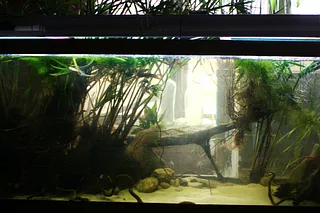
I like the suggestion os de-masoni, they won´t out grew 55 the way gold fish will, if properly taken care of.

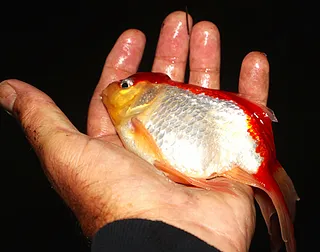
my goldfish went from 1" to this size in a year, and needed a much larger tank than a 55.
my goldfish went from 1" to this size in a year, and needed a much larger tank than a 55.

Ok well...I might be crazy (or practical idk) but I've been considering a smaller tank while I've been glorifying a 55 in my mind and while I'm still one for large tanks. I still want to pursue the fishkeeping hobby...but on a budget. I've been heavily inspired by all sorts of beautiful planted tanks and I'm really considering downsizing to something between 20-40 gallons. If I can find an unusual tank size that allows for more stock on a budget I will do that option but right now I'm really entertaining between 20-40 gallons.
The main reason I'm now heavily considering downsizing is I went to the pet store today and I saw the prices for the essentials that I will need for a 55 gallon and honestly, my heart sank at the prices of everything. I don't believe I can manage a thriving tank of that size with my current budget and lifestyle as I won't have hours a week to spend on maintenance...however with a 20 I won't have to do as much maintenance. Especially If I go a full planted route.
I don't intend to change much to my original stocking list or anything except stocking list. Do y'all have any recommendations for unique stocking options for a 20-30 gallon?
The main reason I'm now heavily considering downsizing is I went to the pet store today and I saw the prices for the essentials that I will need for a 55 gallon and honestly, my heart sank at the prices of everything. I don't believe I can manage a thriving tank of that size with my current budget and lifestyle as I won't have hours a week to spend on maintenance...however with a 20 I won't have to do as much maintenance. Especially If I go a full planted route.
I don't intend to change much to my original stocking list or anything except stocking list. Do y'all have any recommendations for unique stocking options for a 20-30 gallon?
Last edited:

Look at local sites like Craigslist or Facebook marketplace place if you have that. There are so many occasions tanks are free just to get rid of them or at the very least they’re substantially cheaper than new. I picked an almost new Marineland 90g reef with a black stained oak stand, canopy, and a huge sump for $300 and it was used for a few weeks, this guy spent $2k total. I didn’t even need another tank but the whole set up was gorgeous and now resides in my living room. Deals like that are very common. If you have space for a 55g than a 75/90g are just 6” deeper but allow for more fish possibilities and better scape options.Ok well...I might be crazy (or practical idk) but I've been considering a smaller tank while I've been glorifying a 55 in my mind and while I'm still one for large tanks. I still want to pursue the fishkeeping hobby...but on a budget. I've been heavily inspired by all sorts of beautiful planted tanks and I'm really considering downsizing to something between 20-40 gallons. If I can find an unusual tank size that allows for more stock on a budget I will do that option but right now I'm really entertaining between 20-40 gallons.
The main reason I'm now heavily considering downsizing is I went to the pet store today and I saw the prices for the essentials that I will need for a 55 gallon and honestly, my heart sank at the prices of everything. I don't believe I can manage a thriving tank of that size with my current budget and lifestyle as I won't have hours a week to spend on maintenance...however with a 20 I won't have to do as much maintenance. Especially If I go a full planted route.
I don't intend to change much to my original stocking list or anything except stocking list. Do y'all have any recommendations for unique stocking options for a 20-30 gallon?
