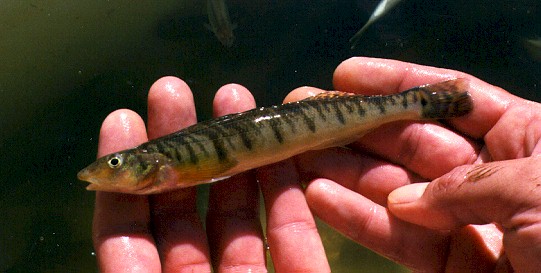
North American Fish Profiles

  • We are currently upgrading MFK. thanks! -neo
Status
Not open for further replies.

sandtiger

Captain Planet
MFK Member
Feb 14, 2005
3,563
4
0
41
NY
I decided to write up some profiles on various native fish. As some of you know I wrote one on bullhead, another on fatheads and the sunfish article that is now a sticky. Here I hope to share brief general information on various natives, not just gamefish but some of the lesser known species as well. I feel there is not a lot of information of natives on the web and with MFK being "one of the fastest growing online communitys dedicated to rare, exotic and predatory fish" figured this would be a good place to spread the word on native fish. I will try to post a profile a day but no promises, especially on the weekends.:D

Here is the first one.
_________________________________________________________________________

Tadpole Matom
Noturus gyrinus
Order: Siluriformes (Catfish)
Family: Ictaluridae (North American Freshwater Bullhead Catfish)
Genus: Noturus
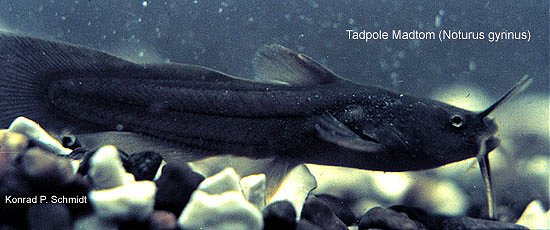
noturusgyrinus.jpg

Picture by Konrad P. Schmidt

mt1.jpg

Some of my own madtoms. Picture by Arthur Masloski

Identification: Rather chubby little fish with large anal fin connected to square shaped tail. They have a terminal mouth and have a dark line along their sides. Colors range between light brown to black.
Temperature: They range from Canada south to Florida, they can probably tolerate most temp ranges common in aquaria.
Size: 3- 5”
Lifespan: 3 years
Range:
The Tadpole Madtom is found in Atlantic and Gulf Slope drainages from New Hampshire to the Nueces River in Texas and in the St. Lawrence-Great Lakes, Hudson Bay (Red River), and Mississippi River basins from southern Quebec to southern Saskatchewan, and south to the Gulf of Mexico. The species has been introduced into the Snake River in Idaho and Oregon and may have been introduced into Massachusetts and New Hampshire. It is common over most of its range but avoids high-gradient streams and thus is absent from the Appalachian and Ozark Highlands.
Range information from http://www.flmnh.ufl.edu

Habitat: Quite still water, typically over soft bottoms in rivers, streams and lakes. Prefers vegetated areas with driftwood and similer structure.
Diet: Aquatic insect larvae, small fish and fish eggs, worms and other invertebrates. In captivity they will take most prepared food that sinks. They love frozen bloodworms, brine shrimp, mysis, krill and others. They will try to eat smaller tankmates. Best fed when lights are off.
Reproduction: Typically difficult to spawn as with other madtoms. In nature they spawn in caves or under rocks, even in empty bottles and cans. Provide them with structure in the form of raised flat rocks or PVC. Feed them frozen foods or live foods with a soft bottom of sand mixed with peat moss.
Notes: I personally have eight of these little fish and have had them since March 06’. They adapt quickly to captivity. They don’t seem to mind the company of their own species and are rather peaceful with fish they cannot eat. They mostly come out at night and hide most of the day but will venture out to feed once they get used to things. They have sharp spines with a mild venom and should be handled with care, no nets.

 
Since I probably won't post one later today (Sunday) I wrote up this one and am posting it early.

Rock Bass
Ambloplites rupestris
Order: Perciformes (Perch-like fishes)
Family:Centrarchidae (Sunfishes)
Genus: Ambloplites (Rock Basses)

Goggle-eye.JPG

Picture from the U.S. Forest Service

rocky3.jpg

My little rock bass in his grow out tank. Picture by Arthur Masloski

Identification: Red or orange eyes are a key mark, especially when combined with the laterally compressed body shape and mottled brown color. They are the largest member of their genus. They have 5 or 7 anal spines and 10 or 12 dorsal spines.
Temperature: Fishbase.org reports between 50 and 84 F. Seems to prefer cool well oxygenated water.
Length:8-16”
Lifespan:10 years
Range:
St. Lawrence River-Great Lakes, Hudson Bay (Red River), and Mississippi River basins from Quebec to Saskatchewan in Canada, and south to northern Georgia, northern Alabama and Missouri (native only to Meramec River) in the USA.
Range information from www.fishbase.org

Habitat: As their name would suggest these fish prefer rocky habitats but can also be found in vegetated areas in lakes, rivers and streams.
Diet: In the wild these fish feed on smaller fish and invertebrates such as crayfish. In captivity it can be difficult to convert these fish to dry foods, I have yet to convert mine but there are others that have. Supply with small live insects, fish, earthworms and frozen foods such as bloodworms, brine shrimp and others.
Reproduction: Breeding occurs in the spring in shallow water. Males fan out a depression in the gravel measuring between 8” and 2’ in diameter. Females will come in and spawn with the male, only to leave afterwards. The male guards the eggs and newborn fry until they swim off on their own. To induce spawning try putting them through a cold/warm temperature change and an increase in light level. Provide with plenty of live or frozen foods.
Notes: Due to the size of this fish and it’s messiness I would suggest something along the lines of a 55g to 75g. They are very oscar like in many ways and can be treated pretty much the same. They have a great personality like oscars as well. Aggression can be an issue with some individuals while others are more peaceful, it varies. Like with cichlids, undergravel filters are not recommended.
 
Logperch
Percina caprodus
Order: Perciformes (Perch-like Fishes)
Family: Perchidae (Perches)
Genus: Percina (Logperches)

logperch.jpg

Picture from www.NANFA.org

Identification: One of the largest daters found. Has 10-12 vertical bars along it's side with smaller bars between them. Long and thin with a subterminal mouth. There are three sub-species.
Temperature: Water rangeing in the 60's and 70's is best.
Length: 6“
Lifespan: 3-4 years
Range:
Found in North America as far north as the St. Lawrence-Great Lakes, Hudson Bay, and Mississippi river basin areas to as far south as Gulf of Mexico drainages. Logperch are found rarely in the Great Plains and areas west of the Mississippi, but extensively along Atlantic drainages in the U.S. (Page and Burr, 1991) (Page and Burr, 1991)
Range info from http://animaldiversity.ummz.umich.edu

Habitat: Found mostly in clear slow moving streams with rocky or sandy bottoms. Can sometimes be found in faster streams and rivers.
Diet: Smaller individuals eat micro-inverts. such as daphnia and copepods. As they age they eat larger prey such as aquatic insect larvae, snails, fish eggs, worms and leeches. I have never kept them but in captivity they would probably take frozen foods like other darter do. Will normally take flake foods.
Reproduction: A larger tank (55g) will work for several individuals. Provide them with trays of sand and little to no structure. Also provide them with a powerhead. Should be kept in cold conditions for about a month. Provide little food dureing this time. With a warmer temp introduce frozen foods such as bloodworms and shrimp. Also provide small live worms, crushed snails and other small live foods. Females grow large with eggs, about the size of a golfball, the males will attempt to attract them into the sand. The female will scatter eggs all over the place over the course of several days. Remove all adults after spawning. The trays of sand are best removed and put into outdoor kiddie pools. In a week or slightly over the eggs will hatch, feed the fry green water, infusoria and rotifers. As they grow feed them small frozen foods and crushed flakes. For further breeding info refer tothe book "American Aquarium Fishes" by Robert J. Goldstein.
Notes: Logperch like darters are fun to watch. Lacking a swim bladder they are not great swimmers and hop or "dart" around the tank, often finding a high perch and looking around. These particular fish will use their shovel-like snout to turn over rocks in search of food. Darters in general are great fish, they rival corydoras and loaches in thier almost playfull behavior. I have no personal experiance with logperch.
 
Mottled sculpin
Cottus bairdii
Order: Scorpaeniformes (scorpionfishes and flatheads)
Family: Cottidae (Sculpins)
Genus: Cottus

FI0252_1m.jpg

Picture from enature.com

Identification: Very similer to slimy sculpin (C. cognatus). Has two lage dark spots on first dorsal fin. Lateral line incomplete and dorsal fins joined at the base.
Temperature: Sculpins should be kept in cool water, I recommend a temp somwhere in the 60's. Also provide with plenty of oxygen with powerheads or airstones.
Length: 3-7" three inches is more typical.
Lifespan: 2-4 years
Range:
Mottled sculpin occurrence is discontinuous in its range. It is widespread from the Tennessee River north to Labrador, while separate populations are found in the Missouri River, the Columbia River system in southern Canada, and the Bonneville system of the Great Basin.
Range info from wikipedia.com

Habitat: Prefer rocky habitats in lakes, streams and rivers. They typically live in cool clean water. They hang out near the bottom near structure, normally in the form of rocks.
Diet: The mottled sculpin is a bottom feeder. They eat insects, larvae, daphnia, small fish and fish eggs and other small live prey. Be cautious with captive individuals, they will try to eat most fish that will fit down their mouths. Will eat frozen food and may eventually eat flakes.
Reproduction: They breed in April and May. Males make depressions under different structures,
logs, rocks, etc. The male attracts the female with different kinds of body communication includeing head shaking, gill flairing and head bobbing. They spawn upside down and stick the eggs to the bottom of the structure. Multiple females will spawn with one male. Males protect the nest and keep the eggs clean. The fry hatch in about a week and for awhile are also protected by the males. The young commonly eat eatch other.
Notes:If you want a native bottom feeder but are tired of catfish these fish provide an interesting alternative but can also be a challenge. Must be willing to keep the water cool and in high quality. May also have to feed frozen foods.
 
Grass and Redfin Pickerel
Esox americanus vermiculatus
Esox americanus americanus
Order: Esociformes (pikes and mudminnows)
Family: Esocidae (Pikes)
Genus: Esox

Grass Pickerel
Esox-americanus-vermiculatus-2.jpg

From www.nativefish.org

Redfin Pickerel
redfin.jpg

From www.cnr.vt.edu

Identification: Smallest member of the pike family. Fully scaled cheek and opercle.Black tear drop mark below eye. Redfins look the same except with red fins.
Temperature: A temp somewhere in the 70's will do fine for this species.
Length: 13-16"
Range:
Esox americanus is found throughout many large river drainages from the Midwest to the Atlantic coast of North America, and from southern Canada to the southern United States. Some of the large Rivers this species is found in are the Mississippi, Ohio, Brazos, and Tennessee Rivers. An Atlantic coast form of the species is found from New York to Georgia and in eastern drainages. Another group, which are intergrades of the two subspecies, are found in the Gulf Coast Drainages in Alabama, Florida and southwestern Georgia.
From http://animaldiversity.ummz.umich.edu
Habitat: Clear lakes and slow streams and rivers. They typically live in places with a lot of organic material and plenty of plants.
Diet: Eat's fish and other live prey such as amphibians, insects and crayfish, difficult to convert in captivity but not impossable. May eat dead fish, shrimp and worms. Stealth hunter who hides and ambushes in vegitation.
Reproduction: Takes place in late winter and early spring. Migrate from lakes into streams. One female will spawn with multiple males. Eggs scattered over live plants, leaves and similer material. No parental care is given and the eggs hatch in about 2 weeks give or take a couple days. Young live in schools but will eat smaller individuals of the speices, adults live alone.
Note: Pretty much the only pike species suited for the home aquaria, they adapt well to tank life and make for interesting fish, at least when feeding. When not feeding the fish is pretty inactive. Provide them with a planted environment. Choose tankmates carefully. They will eat smaller fish but are generally peacefull with larger fish. Some fish are actually too aggresive to be kept with them, most sunfish for example will harass a pickerel.
 
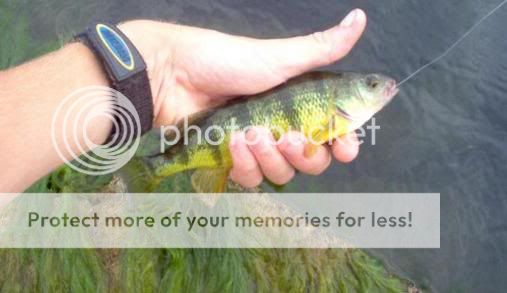
Yellow Perch
Perca flavescens
Oder: Perciformes (perch-like fishes)
Family: Percidae (Perches)
Genus: Perca

perch2.jpg

Picture by Arthur Masloski

Identification: Without a doubt one of the easier fish to identify. They have a deep body shape, similer to sunfish but more elongated and they have a rounded off tail. Around 6 or 9 dark bands along the body. Black spot at rear of spiny dorsal fin.
Temperature: Fishbase.org reports between 32 and 86 but I would try to keep them at room temp, somewhere in the 70's should do fine.
Length: 12-19"
Lifespan: 7-11 years, oldest recorded individual was 13 years old. Females typicaly live longer.
Range:
Yellow perch, Perca flavescens, are north temperate fish. They extend from west central Canada and the Hudson Bay area east to New Brunswick, down to South Carolina and west to Kansas (Clay 1975; Herman et al 1959).
From http://animaldiversity.ummz.umich.edu

Habitat: Most often found in lakes or in slow moving rivers. Seldom found in fast flowing streams but not unheard of. Usually lives in shoals near aquatic vegetation.
Diet: Young perch eat small crustaceans but as they grow so does their menu and small fish and insect larvae are added to the diet. As they grow they eventually eat all those and leeches, worms, crawdads and larger fish. In aquaria they will take frozen food and can normally be converted to dry foods as well.
Reproduction: Spawning starts in early spring, around April or May. There is no nest building or parental care involved. Males mature at 2-3 years old and females between 3 and 4. They spawn at night in plant matter. Eggs are laid in long strands similer to toad eggs. Eggs hatch in two weeks.
Notes: A very attractive, peaceful and easy to find fish. Pretty hardy once adjusted. A school of these in a very large tank would be an awsome site. Despite being called "pan-fish" by many these fish are not all that small and larger tanks are in order for them to thrive.
 
Smallmouth Bass
Micropterus dolomieu
Order: Perciformes (Perch-like fishes)
Family: Centrarchidae (Sunfish)
Genus: Micropterus (Black basses)

big_pic_smallmouth_bass.jpg

From www.enature.com

bass%20web.jpg

From http://dana.ucc.nau.edu

Identification: Color can range from brown, bronze, yellow or green often with a bit of a mottled look. Upper jaw does not extend past the eye. Both spoft and spiny dorsal fins are connected, unlike the largemouth bass. Body longer than deep and eyes typically red.
Temperature: These fish prefer cool water, a temp somewhere in the 60's or low 70's is best.
Length: 27" Typically smaller, rarely grows up to 20"
Lifespan: 7-15 years. Some have been reported to live 26 years.
Range:
Native to a wide area throughout eastern North America, encompassing the upper and middle Mississippi River basin, the Saint Lawrence River–Great Lakes system, and up into the Hudson Bay basin.
Range info from www.wikipedia.com

Habitat: Unlike the largemouth bass smallies prefer fast flowing cool habitats. Can be found in rocky areas in streams and rivers. May also be found in rocky cool lake habitats.
Diet: Feed mostly on aquatic insects and fish. Crayfish are a favorite food among smallmouths. In captivity converting them may be difficuly and you may have to use live foods. Worms will also be taken and so might frozen foods.
Reproduction: Spawning starts in May or June with the male digging a nest up to three feet. Unlike cichlids they do not dig with their mouth but with sweeps of their body and tail. Males will defend the nest against all others, even females who are not persistant. When done spawning (may have more than one partner) the female will leave and the male will continue to protect the nest. Males will often protect the fry as they start to free swim.
Notes: Not an easy species to keep. They are picky about what they will eat, require very large tanks, prefer cooler water and a high level of DO. If these things are met they can be great fish to keep and are highly interesting, long lived and beautiful to look at.
 
Sorry for the delay, I will try to do at least a few a week from here on out.

Golden Shiner
Notemigonus crysoleucas

GoldenShinerBBa.jpg

Photo by Bill Bryne http://www.assabetriver.org

Order: Cypriniformes (Carps)
Family: Cyprinidae (Minnows/Carps)
Identification: Laterally compressed with a lateral line that curves downward. Lowest point above pelvic fins. 11-15 anal rays and 8 dorsal rays.
Temperature: 32-95 Fahrenheit
Size: 9-12", typically smaller
Lifespan: 5 years
Range: Found over most of the U.S. east of the rocky mountains and introduced in other places in and out of the country.
Habitat: Commonly found in a variety of habitats but mostly in ponds or areas heavy in plant matter. Not as common in fast flowing water.
Diet: Mostly planktonic animals but will also eat insects and some algae. In captivity they will feed on flakes, frozen foods and most other fish foods.
Reproduction: They mature within three years and spawn between spring and fall (April-October). Eggs are scattered over vegetation, gravel or even the nests of other fish species.
Notes: I include this fish mostly so I can recommend it as a dither fish. Silver dollers, giant danios and tinfoil barbs are common dithers and all behave very similer to these shiners. If you are looking for a different kind of dither for your tank or have a native tank with aggresive fish and want only natives these make a good choice, they do grow large though so room is needed. They are extreamly easy to find and cheap, often sold at baitshops for bass and pike bait. They are also common in the wild and can be caught on worms and even corn.
 
Burbot
Lota lota
burbot_450x155.jpg

Photo by Ernest Keeley www.cbfishwildlife.org

Breeding burbot
fig08d.jpg

Photo by Dr. P. Mylechreest from www.naturewatch.ca

Another ball of spawning burbot
burbot_ball_450x318.jpg

Photo by Ernest Keeley www.cbfishwildlife.org


Minnesota state record burbot caught by John Galles
State_rec-burbot1.jpg

Photo from www.fishingminnesota.com


Order: Gadiformes (Cods)
Family: Lotidae (Hakes and burbots)
Identification: Easy to identify, they have a single barbel on their chin. They are long and slender with a rounded tail. They have two seperate dorsal fins, one short and the other very long, the anal fin is also long. Pelvic fins close to the throat.
Temperature: 39-64 Fahrenheit
Size: Up to two feet long, sometimes larger but typically smaller. They are slow growers, sometimes taking 6 years to reach 18".
Lifespan: 10-20 years
Range: They live in both North America and Europe but may be extinct in the UK. They live southward to 40 degrees across the country.
Habitat: Cold water habitats in lakes and rivers. Young fish in streams prefer shallow water with plant growth and undercuts. Adults are found in deep water, sometimes up to 300 feet when not breeding.
Diet: Their diet in the wild mostly consists of other fish but will also eat fish eggs, crayfish and other inverts.
Reproduction: They spawn in mid-winter often when there is ice still on the water, this occurs in shallow water over a rocky or sandy bottom. Several may gather in a group forming a ball-like mass. Females can lay up to 1 million eggs and the newly hatched fry are among the smallest fry of all freshwater fish (around 3mm). It is also one of the only species of freshwater fish that spawns in the winter. They typically spawn at night.
Notes: This close relative of the Altantic cod is not often fished for and usually discarded though it is supposed to taste good and is actually used as an ingrediant in some brands of fish sticks.They are the only freshwater member of the cod family in NA and are truely unique, truely oddball and truely monster. They are large and require cold water. A large tank and possably a chiller would be needed to keep them. I have no experiance in keeping them and I haven't heard of anyone doing it. It would present a great challenge and be a great fish to show off, I highly recommend more people attempt to keep these guys.
 
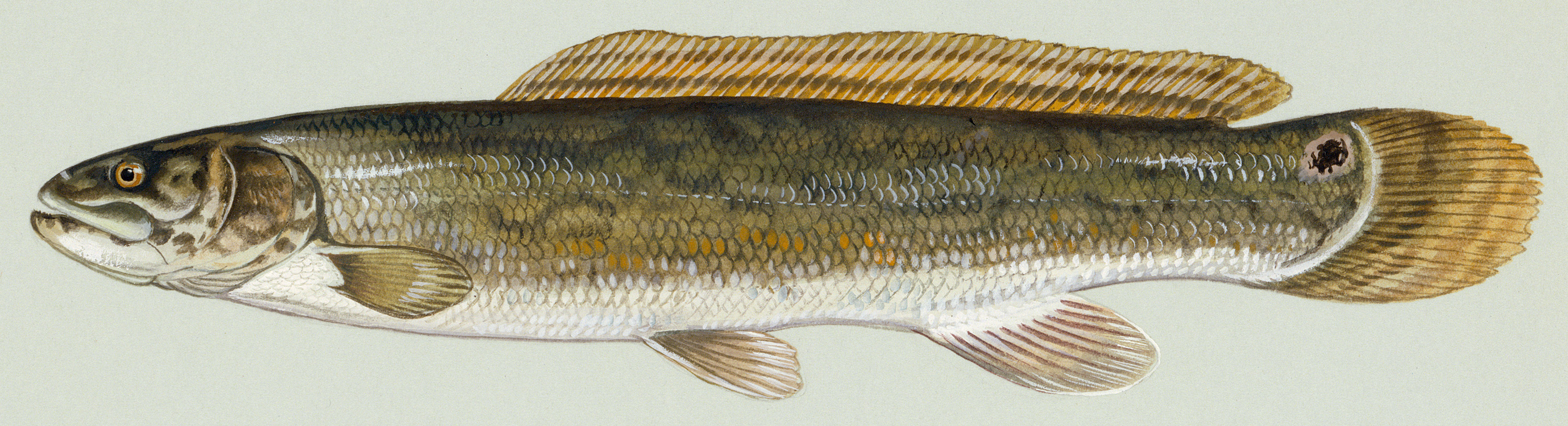
Bowfin
Amia calva

Amia_calva1.jpg

Artwork by Duane Raver

Shedd_Bowfin.gif

Photo from http://www.seagrant.wisc.edu

Order: Amiidae (Bowfins)
Family: Amiiformes (Bowfins)
Identification: Very similer to non-native snakeheads. THey have a long slender body, long dorsal fin, rounded tail and tube-like nostrils. The biggest give away is the gular plate on the underside of the lower jaw, no other fish found in the U.S. has this. It is the only species in it's family and for that matter it's order as well. They are an old order of fish with relatives dateing back into the Jurassic, Cretaceous and Eocene.
Temperature: 59-68 Fahrenheit according to fishbase but I have heard of them being kept in warmer water.
Size: Around 43"
Lifespan: 12 years, some specimens in captivity have lived for 30 years
Range:
North America: St. Lawrence River, Lake Champlain drainage of Quebec and Vermont west across southern Ontario to the Mississippi drainage in Minnesota.
Range info from www.fishbase.org

Habitat: Found in lakes and slow moving rivers. They typically live in clear water with vegetation.
Diet: They feed on almost anything alive includeing fish, frogs, reptiles and even mammals from time to time. In captivity they are known to take frozen foods such as bloodworms and live prey such as worms and crayfish.
Reproduction: Spawning occurs in the spring. The male constructs a nest of plant matter in a depression on the bottom. Females will lay in the nest while the male displays and eventually spawn. Multiple females may spawn with a single male. Males guard the nest and when they hatch the fry as well. The fry form a tight ball-like school. The male will watch over then until they grow up to 4" then they scatter and head for deeper waters. Males gain a blueish or greenish color when ready to spawn.
Notes: They can breath by gulping air useing their swim bladder like a lung. They can also use their gills. These fish make a great alternative to the non-native and illegal snakeheads. They seem to adapt well to captivity but they do grow very large so keep that in mind. I don't have any experiance in keeping them but they are interesting fish and worth a try...someday I will give them a go.
 
Status
Not open for further replies.
MonsterFishKeepers.com