Polystyrene Tank

  • We are currently upgrading MFK. thanks! -neo

Jack Daniels

Gambusia
MFK Member
Jun 10, 2017
19
4
18
Has anyone here ever built a Polystyrene tank (EPS) ?

Seems it could be an interesting method of building a tank - think composite foam sandwich construction. Foam composite construction has been used for many years building boat/yachts etc. Why not in aquariums ?
 
Have used polystyrene blocks for monolithic poured concrete tanks and used polystyrene sheet to insulate permanent PVC formwork concrete tanks.

Don't use EPS (expanded), use XPS (extruded) for heavier densities.

I've seen polystyrene sheet painted with multiple coats of acrylic paint to barrier seal which can then be safely fiberglassed without the polystyrene getting dissolved. I'm not a fan of fiberglass though so didn't go that way.

Very hard to beat concrete for decent sized tanks, especially over 1.5m water depth. Concrete mix can easily be customised.
 
  • Like
Reactions: tlindsey
Yes XPS is probably a better way to go with the weight of the water on it. I wonder if EPS foam would compress with the water weight on it? XPS is quite a bit more here then EPS.

Plan would be to use epoxy resin and glass fabric to coat the sheet of foam. Usual box shape that a plywood tank would be except use a 2 to 3" thick foam with a 400 gram biaxial glass cloth each side - the foam panel then becomes a composite panel - same idea as an I beam in terms of how the strength works. Make no mistake a foam substrate with an epoxy glass layup on each side of the foam is immensely strong.

I dont know if this would work or not. If the tank had a euro brace - again made of foam/epoxy - and laminated into the side panels while the chemical bonding window is still open then I think the entire structure would be quite robust. The key here for strength is to get each layer of glass/epoxy layup as far apart from each other as possible - again, the I beam principle. Hence I would think a 2" foam as a minimum and probably a 3" foam would be better.

Then just silicone a glass plate to the front from the inside and you have an aquarium. Added bonus here *if it works* is the insulation value achieved.
 
Another thought on this.......

A way to add a lot of strength and to stiffen the panels up considerably would be to imbed rebar into the EPS/XPS sheet.

Something like a grid of 8mm rebar - cut a series of grooves into the EPS sheet and then mix up an epoxy/filler paste (talc or micro fibre filler mixed with epoxy) and then lay down some epoxy paste into the groove then lay the 8mm rebar into the paste then fill the groove with the epoxy paste. Once that sets up it would add immense tension strength the EPS sheet. Much the same concept as steel in concrete - the concrete has a lot of compression strength and the steel adds a lot of tension strength. In this case the foam composite panel has compression strength and the imbedded rebar adds a lot of tension strength to resist deformation.

Further, if that rebar imbedded into the EPS was joined to rebar going up into the side panels and across into the euro brace then everything is tied together and set in epoxy.

If still more strength was needed then a 3 or 4mm sheet of plywood could be laminated onto each side of the EPS sheet in the layup. Its all classic composite foam panel construction.

Benefits to this construction approach is that the EPS foam can be sealed against water ingress by thinning the epoxy down by about 10-20% and brush that onto the EPS sheet so that the EPS sheet "drinks" the epoxy. When the epoxy sets the myriad of tiny channels around the EPS beads that the sheet is made up of are then filled and sealed with epoxy. It adds strength to the EPS and makes the EPS water proof as the Epoxy has now bound up all the channels/ micro voids in the EPS sheet. Unlike Plywood, this will never rot and/or soak up water. Much much much lighter Vs plywood.

if you think about it, all a plywood aquarium is, is a box built of plywood as a stay in place form that is then laminated with a resin (or some other type or water proofing medium). The absolute best resin for plywood is Epoxy. Polyester resin is just not a great resin for wood in general as the adhesion is not that great. You can get loads of insight into this topic by reading yachting forums. Many home builders of yachts have tested everything out there.

So if we can make the EPS sheets stiff enough and with enough strength by various ways (thick foam core to keep the epoxy glass layups on either side further apart, ie, the I beam principle and imbedding rebar into the EPS sheet, ie, the steel in concrete principal) and then join the panels with an epoxy glass layup within the chemical bonding window you would have a light weight box of immense strength that cant absorb water and will never rot and gives a pretty impressive amount of insulation.

I have been thinking about this for some time. I cant see why it wouldnt work. I am sure others would see it differently, so please tell me why you think it will not work ?


 
Last edited:
You don't need steel rebar, standard fiberglass construction principles apply. So polystyrene base fillets and support ribs for strength etc. Build a 90 degree lip to allow people sitting on, stop fish jumpers, prevent side bow etc.

Usually fiberglassers use a special blend of foam that resists the chemical solvents. You might as well use that.

As mentioned, I hate fibreglass to work with and to use. So I've nothing more to suggest.
 
You don't need steel rebar, standard fiberglass construction principles apply. So polystyrene base fillets and support ribs for strength etc. Build a 90 degree lip to allow people sitting on, stop fish jumpers, prevent side bow etc.

Usually fiberglassers use a special blend of foam that resists the chemical solvents. You might as well use that.

As mentioned, I hate fibreglass to work with and to use. So I've nothing more to suggest.

At this point it nothing but thinking about it all. I am going to push ahead and do trials as I think the construction method could be quite special for aquariums. In one sense I agree about "standard fiberglass construction methods" - I think it *should* be strong enough with a 3" core of foam. But adding the rebar or even a 6mm round bar or even a "conforce" concrete reinforcing mesh would not hurt. It may be overkill but it surely wouldnt hurt things apart from a bit more cost.

I came up with all this because I am struggling with the weight of tanks I want to build to go on a steel stand that will sit on burnt clay bricks. I am looking for a way to get the weight of the tanks themselves down. If I build a tank 2000mm long x 600mm wide x 500mm high then the bottom panel is 1.2 sqm, the back panel is 1 sqm and the side panels are .3 sqm each end. I am not sure what the front panel would be as it would have to have a lip top and bottom to bed the glass onto with silicone. But all up if we call it 3 sqm then using a 400gsm biaxial glass cloth would be around 3Kg of glass cloth and the epoxy the same weight since epoxy resin is 1:1 in weight to the glass cloth (excess epoxy resin is not your friend). Add some more weight for the epoxy that soaks into the EPS (you want this to bind up all the micro crevice's in the EPS panel to make sure the EPS panel cannot soak up any water over time if for some reason water got through to the foam substrate) All up and being generous it would not go over 10Kg for glass and epoxy. Weight of the EPS depends on the density. I would go for about 30Kg M3 density of the EPS. Or use XPS. Lets assume a panel of 2000mm x 600mm 75mm thick weighs , rough guess...5kg ?? the whole tank (without steel reinforcing) should weight less then 25Kg? Then add the wieght of the front glass panel. Its a light weight tank that is heavily insulated.

Add the steel, because why not - safety factor ? then I would think the steel would not add more then 20Kg to the overall weight and it would be as strong and stiff as can be.

I am really thinking quite deeply about this and I cant come up with a reason it wont work. The foam is water proof vs Plywood, its lighter vs plywood, its waaay cheaper then Plywood, the EPS gives huge insulation value at 3" thick and in the end the same epoxy is used regardless of if the box is made of plywood or EPS.

It *seems* like a better idea then plywood. It *might* work. If it does its a killer of a way to build a tank.


  • Like
Reactions: FJB
For concrete tanks, water depth is 1.5m ~ 3m deep. I've built several between 12m to 8m long. (Circa 150 - 100 tonne water)

For fibreglass tanks, most are 1m deep, sometimes 1 2m deep. Already tried and proven in unforgiving commercial applications.

For a tank your size, I would use all glass. Not that difficult to cut and easy to build - repair. You can easily join several glass panes if you can't afford or find big sheets.

I would not worry about the weight of tanks if you will be using a steel frame. I use a hydraulic car jack to lift racked tanks which would weight 2 tonne empty all the time. Slight lift, slip wheels under and can push or pull one handed .
 
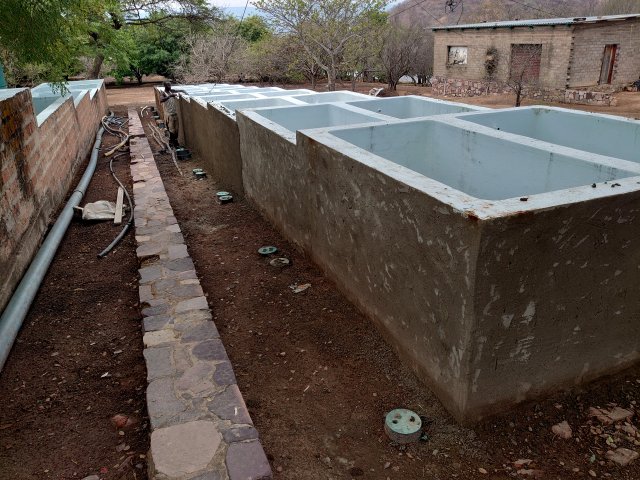
Hi Fishdance - I dont know why you keep referring to concrete tanks since that is not what the discussion is about. However for the record I have also built tanks using concrete and bricks. The tanks were built out of local burnt bricks and plastered with cement. Stuart Grant put me onto this way of building. I dont know how Stuart made it work but mine did nothing but leak within a few months of construction. In the end I had to fibreglass the tanks and to this day they are water tight.

DSC_1647.JPG


You can see in the photo to the left that the tanks are made from burnt bricks. You can clearly see ALL the tanks are then fibre glassed. Fibre glass is a wonderful material and I love working with it. As you go on working with fibre glass you realise there are lots of different fibre glass materials out there to work with. I have now moved onto Epoxy as its a far superior resin to polyester resin. Epoxy is water proof - polyester isn't. A Polyester resin / Chopped strand matt layup has to be coated in a topcoat to make it water proof. An Epoxy layup is waterproof once it cures - however it does need an overcoat of paint of some type to protect it from UV as it yellows in UV exposure.

The tanks in the picture above are built on a concrete slab and then have locally made burnt bricks laid on top of the slab then fibre glassed. The burnt brick tank and the concrete base are simply stay in place forms to hold the fibre glass. In this case it was a 400 GSM layup - with a top coat finish (the blue colour).

One could make a solid fibre glass tank (as you have referred too) and that works perfectly fine. However a standalone fibre glass tank is a very heavy fibre glass layup and very expensive. This is NOT the type of tank I am interested in , although it would work.

Re all glass tanks. The tried and tested time honoured way of building a tank. The problem with this for me is I am in the middle of Africa and I simply cant get a lot of materials unless I import them and that is an expensive and time consuming thing. There is no 10mm (or thicker) glass in this country. The thickest I can find in the capital city is 6mm. I can get 4mm laminated with another 4mm to make 8mm. However I think that 8mm laminated like that is weaker then straight 8mm glass - at least that is what I have been told. I was going to import a container load of large sheets of float glass from China. I can still do that but then there is considerable investment in the glass handling equipment. I will always need a front glass viewing panel so will be importing glass one way or another but an all glass tank has quite a few issues attached to it for me (particular to my circumstances/location).

I need to put glass tanks above my brick/fibreglass tanks on the ground. I have bought the steel for it (all 18k's worth ! - damm steel is expensive these days). So I have two basic choices - all glass, which is heavy and full of issues for me, OR, plywood. Plywood coated in a epoxy/glass cloth layup works just fine. However plywood is crazy expensive here and the other HUGE issue for me locally is termites! Termites get into every dammed thing here sooner or later if it is made of wood.

So all of this has me searching for alternatives. I've always found this forum a great resource, hence reaching out to ask if anyone has ever made a polystyrene tank. I get its different and out in left field but if one thinks it all through - for all the reasons I have mentioned about polystyrene above, I think it could work.

So what i am wondering is has anyone tried this construction method ? I am interested in opinions about why it will/will not work so that I can further think through how to get around problems that may come up with this approach.
 
  • Like
Reactions: deeda
Hello Jack,

For shallow tanks your size, I'm sure polystyrene will work as I've used painted polystyrene fish transport boxes for cheap fish tanks with acrylic paint.

Bricks are a terrible material for ponds/tanks. Any ground movement from moisture will create cracks, every mortar joint is potential failure point. I keep referring to concrete because I've 15 years experience larger tank building from multiple materials including sheet metal on light guage steel frame under tension stress. HDPE sheets can be plastic welded with low tech tools but availability sounds difficult for you.

In a similar situation to yours, I used megabins (800L) over ponds. Very easy to add small view panels - https://mgplastics.com.au/nally-bins-nally-megabin-solid-780-litre-in-beige.html . These are widely available as used for transport containers.

Yes, I've played with fiberglass and know it's not for me. I'm sure others will offer ideas. Feel free to message me privately if you want suggestions /photos on other materials. Good luck with the fibreglass.

I'm a member of Sarnissia (African aquaculture) group. You should join if you haven't already.
 
Hi Fishdance,

Yes I would agree that bricks are a really TERRIBLE idea. Stuart swore by them and a lot of his tanks were built that way. I would never do it again - at least with burnt bricks. Concrete blocks are fine though. I built those tanks in the photo above in 1999/2000 and finally fiberglassed them in 2002. They have held up fine ever since, so fibre glass over the bricks and all on top of a well built concrete slab does work. In fact the bare burnt bricks were exposed to a rainy season every year from 2000 till end of 2021 when I finally plastered the outside wall of the tanks to protect the burnt bricks from the heavy rain we get here.

There is no easy way to do most things out here. But as the saying goes, problems are nothing more then opportunities in work clothes.

where is Sarnissia found ? website? FB group ?
 
MonsterFishKeepers.com