

Show your Red Devil
- Thread starter smokeythebair
- Start date
You are using an out of date browser. It may not display this or other websites correctly.
You should upgrade or use an alternative browser.
You should upgrade or use an alternative browser.

heres a few pics of my male at 8"


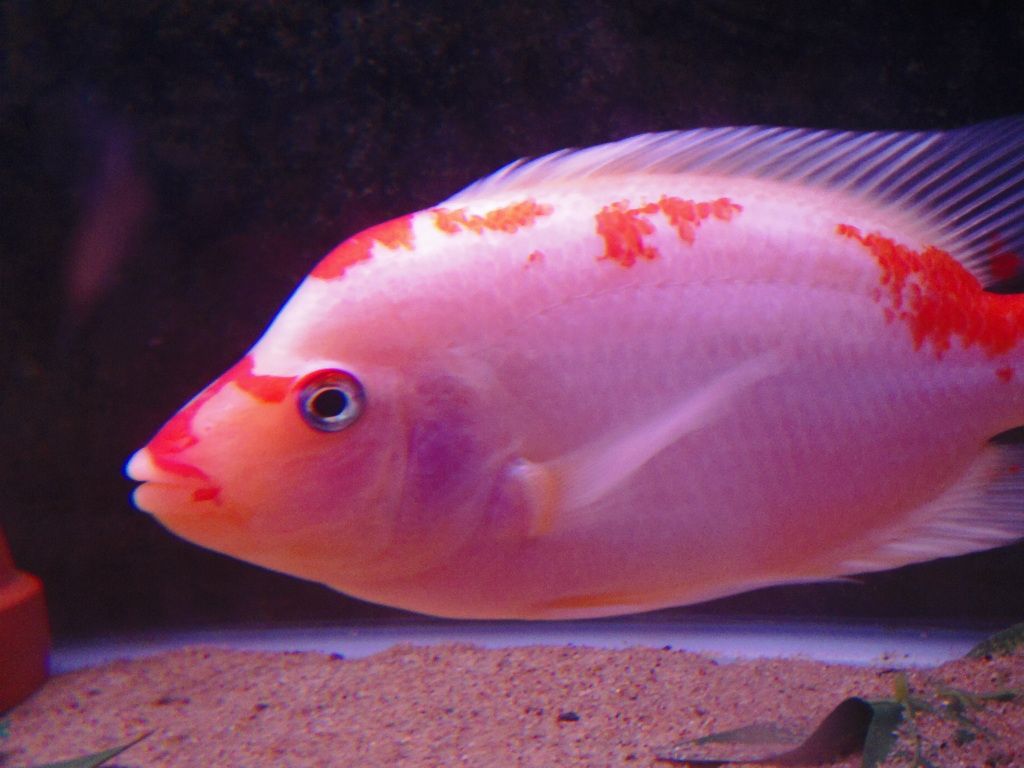

Forrest, that guy is looking amazing, and Im not saying that cause I personally know his father.
 Im working on getting another spawn with a different female, he is just being a real pill to the female. Really thinking about ordering a couple females and grow them out.
Forrest, that guy is looking amazing, and Im not saying that cause I personally know his father.
Well now i know where he gets it from. My male recently looked like he paired up with one of the smaller devils in the 240 and starting causing trouble in there but with the two in a 75 he didnt let her do hardly anything before chasing her like crazy so i pulled her and now hes alone but Hes turning out really awesome as are all my fish from you. Cant wait for them all to grow
Sent from my LS670 using MonsterAquariaNetwork App
@fishman09 very nice specimen!
Thank you

Sent from my LS670 using MonsterAquariaNetwork App

I dont mean to derail the thread, cause there are some really nice looking Devils on here.
But a lot of you are showing pictures of what you call a Red Devil, and clearly from your pics you have something else in them. Red Devils have a V shaped nose and mouth. If you look from directly over head the shape of your Devils mouth/nose should be a V. Mind you, this still doesnt mean you have a 100% Devil if not sure of its origin. If the mouth/nose on your Devil is more blunt or shaped like a (, than your Devil definitely has some midas in it.
I just wanted to clarify this, because a lot of you have probably purchased your Devil from the LFS that sold it as Devil, and it isnt. Just look at your fish, if the mouth/nose is ( and not V than you do not have a Devil.
If you are going to correct people, you should at least use the correct scientific names, not trade names from 40 years ago.
40 or so years ago there were only three species of Amphilophus recognized, A citrinellus, A. labiatus, and A. zaliosus, with the zaliosus still being considered by many experts as a labiatus with normal lips.
In the 1990's Jay Stauffer & Ken McKaye described 3 more new Amphilophus species, A. amarillo, A. xilaoensis, and A. sagittae. In 2008 came 3 more newly described species of Amphilophus by Stauffer, McCrary & Black. A. astorquii, A. chancho, and A. flaveolus.
Today some experts feel that there may be as many as 20-30 (or more) yet to be decribed Amphilophus species found within the various crater lakes of Nicaragua. Fish such as Amphilophus sp. "fatlips" (shown below) have still not been properly described.

The shape of the mouth/snout is typically based on the diet of the fish, which can vary even within the same species. I have explained all of this in great detail in the past discussion.
http://www.monsterfishkeepers.com/f...f-citrinellus-A-potential-case-of-F1-Midevils
Two different types of pharyngeal jaws have been described in A. citrinellus: papilliform and molariform. For both A. labiatus and A. zaliosus only papilliform pharyngeal jaws have been described previously in the literature (Meyer 1989, 1990a,b). All A. citrinellus individuals sampled in L. Managua, Tisma Pond and L. Masaya had papilliform pharyngeal jaws (see also Meyer 1990a). All A. citrinellus individuals collected in Ometepe in L. Nicaragua had molariform pharyngeal jaws. Among samples of A. citrinellus that were collected from L. Xiloá, L. Apoyo (A. zaliosus) and Isletas, L. Nicaragua both trophic morphs were found in sympatry. This study provides the first evidence of molariform pharyngeal jaws on fish from Lake Apoyo.
Molariform morphs have blunter, shorter snouts, larger eyes, wider heads, and deeper shorter bodies than papilliform morphs. ............ but that does NOT equate to all fish found within the midas complex having blunt snouts, or that all Amphilophus species with V shaped snouts, and/or fleshy lips are necessarily labiatus. This is not my opinion, these are facts based on the most current data collected from the Amphilophus found within the crater lakes.
The bottom line is, when someone buys a "Red Devil" from the LFS, that's exactly what it is, an aquarium strain "Red Devil", what it may not end up being is a pure A. labiatus.
Hopefully that clears that up & we can get back to sharing photos of "Red Devils".
Here's some of my RD the two smaller ones are mine the huge boy is my friends
Sent from my iPhone using MonsterAquariaNetwork app


Sent from my iPhone using MonsterAquariaNetwork app
If you are going to correct people, you should at least use the correct scientific names, not trade names from 40 years ago.
40 or so years ago there were only three species of Amphilophus recognized, A citrinellus, A. labiatus, and A. zaliosus, with the zaliosus still being considered by many experts as a labiatus with normal lips.
In the 1990's Jay Stauffer & Ken McKaye described 3 more new Amphilophus species, A. amarillo, A. xilaoensis, and A. sagittae. In 2008 came 3 more newly described species of Amphilophus by Stauffer, McCrary & Black. A. astorquii, A. chancho, and A. flaveolus.
Today some experts feel that there may be as many as 20-30 (or more) yet to be decribed Amphilophus species found within the various crater lakes of Nicaragua. Fish such as Amphilophus sp. "fatlips" (shown below) have still not been properly described.
The shape of the mouth/snout is typically based on the diet of the fish, which can vary even within the same species. I have explained all of this in great detail in the past discussion.
http://www.monsterfishkeepers.com/f...f-citrinellus-A-potential-case-of-F1-Midevils
Molariform morphs have blunter, shorter snouts, larger eyes, wider heads, and deeper shorter bodies than papilliform morphs. ............ but that does NOT equate to all fish found within the midas complex having blunt snouts, or that all Amphilophus species with V shaped snouts, and/or fleshy lips are necessarily labiatus. This is not my opinion, these are facts based on the most current data collected from the Amphilophus found within the crater lakes.
The bottom line is, when someone buys a "Red Devil" from the LFS, that's exactly what it is, an aquarium strain "Red Devil", what it may not end up being is a pure A. labiatus.
Hopefully that clears that up & we can get back to sharing photos of "Red Devils".
I appreciate your wonderful expertise, again, and again it means nothing to me, and again you cant wait to chime in to correct, and again I really dont care what you have to say, and again you are one of the main reasons I haven't been here. Enjoy being a no-it-all, because you do, I will agree to that.
Have fun.Oh and before you chime in and flex your brain muscles again, dont bother, cause I am done on here again, Im not going to read it, and I dont care.
Bring on those pictures of Devils.
I guess some people prefer to remain ignorant & live in the 1970's, others like myself prefer to move forward & stay current with what's taking place within the Amphilophus genus. I don't see any benefit in repeating old outdated info over & over again, as though by doing so it will somehow make it become true. If you are going to get on a genetic soap box you should at least have some kind of idea as to what you are talking about. Nice Blue Devil!
Come on you two, I consider both of you friends and I know if you guys were hanging out in person you'd get along just fine.
Sent from my iPhone using MonsterAquariaNetwork app
Sent from my iPhone using MonsterAquariaNetwork app
