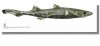
smallest free-swimming shark

  • We are currently upgrading MFK. thanks! -neo

ae2359

Gambusia
MFK Member
Feb 3, 2006
162
0
16
39
michigan
what is the smallest free-swimming shark and what would be a good sized pond or tank that could house this animal comfortably for life.

i was thinking along the lines of some of the smoothhound sp. but wasn't really sure how well they dod in captivity

 
so is that what you have rottbo? i saw a shark egg i believe was yours:naughty:
 
rottbo said:
banded cat shark are the easiest IMO
banded cat sharks arnt free swiming hes talking like always moving never resting lol
 
rottbo said:
ah i see and no i b=never had a sharkegg pic on here
o, well someone had a vid of a bamboo shark or something in its egg, not for sale just to show
 
The smallest known extant shark species appears to be Etmopterus perryi, males of which mature at 16 to 17.5 cm TL and gravid females have been found at 19 to 20 cm TL (Springer & Burgess 1985). One 19-cm TL specimen of E. perryi was found to contain three 6-cm embryos, each bearing external gill filaments. In comparison, the smallest mature male E. hillianus examined by Schofield & Burgess (1997) was 20 cm TL. Until the discovery of E. perryi, the smallest living shark was widely considered to be Squaliolus laticaudus, males of which mature at about 15 cm TL and females at about 17 to 20 cm TL (Compagno 1984). This and other tiny squaloids are closely rivaled by the carcharhinoid Eridacnis radcliffei, males of which mature by 18 to 19 cm TL, females possibly mature at 15 to 16 cm TL.

All these diminutive sharks seem to mature at roughly the same length. Given the difficulties in determining reproductive maturity in elasmobranchs, caution is warranted in determining one species the final, absolute winner for the title of World's Smallest Living Shark. Most of the length at maturity numbers presented in the literature are estimates based on gross (superficial) examination of the urogenital tract. Due largely to energetic differences in parental investment, male elasamobranchs typically mature at a smaller size than females of the same species. Size at maturity of females is generally regarded to be more significant in limiting clutch size and in determining the likelihood of pup survival than size at maturity of males. Thus, size at maturity of female sharks seems an expedient index for comparison among species.

smshark.jpg
 
MonsterFishKeepers.com