Tell me about Andinoacara Stahlbergi

  • We are currently upgrading MFK. thanks! -neo

TigerTalon1

Jack Dempsey
MFK Member
Jan 7, 2019
142
71
31
54
So my LFS told me they can order some A.Stahlbergi. The only problem is I cant find much information on these guys. I've seen people say they have over 10in specimens. What would be a proper tank size minimum for a single male? How big is their max size? What is their temperament like and how fast do they grow? Also I saw a website said that this is the "Real Green Terror". Ill link it, not sure how accurate that is because I'm pretty sure that this quote on quote "True Green Terror" thing comes from white saums and gold saums in the species rivulatus. Where the white saum is reffered to as a true green terror because of the favorable recessive gene white stripes along the top of the dorsal fin, compared to the gold saums orangish gold stripes. Educate me please. Here is the website: https://andinoacara.com/species/stalsbergi/
 
A. stahlsbergi- is often referred to as the real green terror, perhaps it was the original one collected with the first festae.
Very rare fish, trynfor a pair and breed them. They color on their scales is opposite colors of a. Rivulatus

You just exposed the problem with common names- they are neither specific. Nor accurate.
Not sure about tank size but for an adult pair you are probably looking at 4x2 120 or 72X18 125
 
A. stahlsbergi- is often referred to as the real green terror, perhaps it was the original one collected with the first festae.
Very rare fish, trynfor a pair and breed them. They color on their scales is opposite colors of a. Rivulatus

You just exposed the problem with common names- they are neither specific. Nor accurate.
Not sure about tank size but for an adult pair you are probably looking at 4x2 120 or 72X18 125[/

That’s a really large tank for just two fish. Would rather do a smaller species Central American community if I had a 125. What about their size compared to Rivulatus?
 
Stahlsbergi is a very close relative to Rivulatus. Look very similar but as mentioned by P PhishMon84 there scales are reversed in comparison. As far as I know they all have white seams on fins, and I have heard through the web that they are typically more aggressive than A. Riv. Harder to find but still obtainable. Good luck breeding, I have read many threads about males killing females so beware.

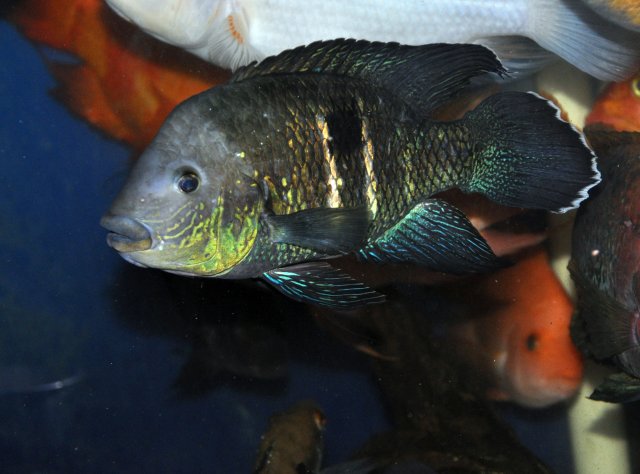
They come from Peru and Rivulatus come from Ecuador. Usually show the two vertical white lines more prominently than A. Riv and just look a little different, just enough to know they are different species.

Sthalsbergi 2.jpg Stahlsbergi 1.JPG
 
“That’s a really large tank for just two fish. Would rather do a smaller species Central American community if I had a 125. What about their size compared to Rivulatus?“


I believe their size is comparable, but a tad smaller generally. However require the same size tank as rivs.
I *think* you could possibly do 2-3 females and a male in a 125 footprint.
There are a couple people here who have stals that hopefully will chime in to give personal experience advise.
 
  • Like
Reactions: PhishMon84
Realistically, insistence on a "true" green terror is mostly a manufactured notion on the part of hobbyists and it depends which country you're in or who you're listening to. In any case, the fact is in the US stalsbergi have been rare to non-existent until quite recently, imo those here who think stalzbergi is the 'true' green terror are either confused by the fact the real debate used to be over which is the true rivulatus (at one time some people claimed what is now stalzbergi was rivulatus-- it's not) or are part of the tree of influence of Alf Stalsberg. Alf is not a biologist, but he has spent much time collecting and observing fish in SA, including stalsbergi, which is why they were named for him. For years Stalsberg insisted stalsbergi was the true rivulatus. He had to back off when biologists like S. Kullander determined it was not and Musilova (and associates) officially described stalsbergi as another fish, but Stalsberg has apparently not given up on stalsbergi as the 'true green terror'.

However, at least in the US, (and, apparently, Germany, where a 1982 article called what is now stalsbergi the 'green terror that isn't'), rivulatus was the original and common fish the hobby has called 'green terror'. As I say, stalsbergi was practically non-existent among hobbyists until recently. Here's an article with the history by cichlid writer and biologist Wayne Leibel: link

I don't know, maybe some countries consider stalsbergi to be their 'true' green terror, maybe Norway where Stalsberg lives. However, in other countries neither fish is called a green terror. If anything, if you wanted to say something is official, taxonomic registries associate "green terror" with rivulatus, not stalsbergi. Compare:

Rivulatus -- Stalsbergi
 
neutrino neutrino

I agree man, I think we talked abut this recently in another thread. IMO its much easier to say either "rivulatus" or "stahlsberg" and that pretty much makes it impossible to confuse these species.

The next best thing (if one insists on using "green terror" hobby name) would be to say either Peruvian, or Ecuadorian.

I commonly use "GT" when I talk about Rivulatus on this forum though
 
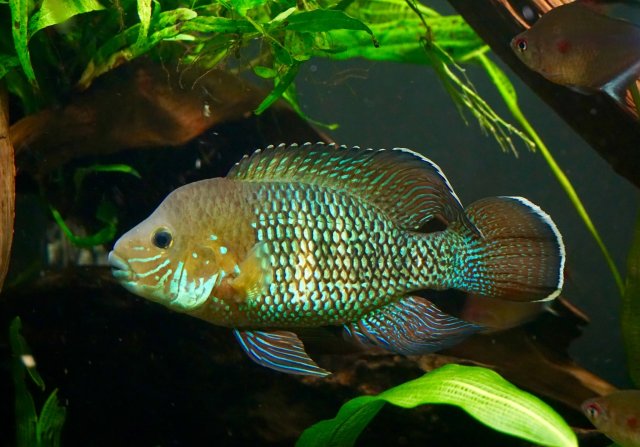
Ecuador lies directly above Peru on the Pacific coast, rivulatus' range is in Ecuador and just a small corner of northern Peru. Stalsbergi is in Peru. Both fish consistently have their own typical scale patterns, rivulatus with rows of black markings formed from the center of their scales and stalsbergi with light centers and dark edges on the scales as in the photos above. Rivulatus can have either white or gold to orange edges on their fins, stalsbergi have white edged fins, so while individuals of each species may differ slightly from one another in color or how wide the fin edge markings are, the scale pattern is always an obvious difference between the species.

You might notice in the Wayne Leibel article, despite hobbyist 'experts' who insist white edge rivulatus and gold edge rivulatus are the same species (and to this point they haven't been separated, so officially they're one species and I'm not saying different), Leibel, a scientist and biology professor with impressive credentials, leaves this open to further study. So I say wait and see, hobbyist 'experts' have been wrong before. Even expert experts, like Ad Konings, have had opinions or conclusions later found wrong after further study was done. Stalsberg's a collector, not a scientist, but he says the range of white edged and gold edged rivulatus overlaps and he considers them color morphs of the same species. I don't disagree, I'm just saying time will tell.

There's another similar looking fish, A. blombergi, also in Ecuador, with white edged fins and black centers in the scales like rivulatus. The white on blombergi fins is thinner than rivulatus and there are other subtle differences, scale counts, etc. Blombergi is rare, almost nonexistent in the US, other than the possibility some came in as rivulatus in the past.

 
  • Like
Reactions: astrocreep
Ecuador lies directly above Peru on the Pacific coast, rivulatus' range is in Ecuador and just a small corner of northern Peru. Stalsbergi is in Peru. Both fish consistently have their own typical scale patterns, rivulatus with rows of black markings formed from the center of their scales and stalsbergi with light centers and dark edges on the scales as in the photos above. Rivulatus can have either white or gold to orange edges on their fins, stalsbergi have white edged fins, so while individuals of each species may differ slightly from one another in color or how wide the fin edge markings are, the scale pattern is always an obvious difference between the species.

You might notice in the Wayne Leibel article, despite hobbyist 'experts' who insist white edge rivulatus and gold edge rivulatus are the same species (and to this point they haven't been separated, so officially they're one species and I'm not saying different), Leibel, a scientist and biology professor with impressive credentials, leaves this open to further study. So I say wait and see, hobbyist 'experts' have been wrong before. Even expert experts, like Ad Konings, have had opinions or conclusions later found wrong after further study was done. Stalsberg's a collector, not a scientist, but he says the range of white edged and gold edged rivulatus overlaps and he considers them color morphs of the same species. I don't disagree, I'm just saying time will tell.

There's another similar looking fish, A. blombergi, also in Ecuador, with white edged fins and black centers in the scales like rivulatus. The white on blombergi fins is thinner than rivulatus and there are other subtle differences, scale counts, etc. Blombergi is rare, almost nonexistent in the US, other than the possibility some came in as rivulatus in the past.


Nice information. What Andinocara species would you reccomend would work best in a 40B?
 
MonsterFishKeepers.com