Temperature: How low can you *really* go? (Whoops, I made a mistake)

  • We are currently upgrading MFK. thanks! -neo
Most of us heat a room in our house w/ tank heaters.

Although it's true that resistive electric heaters are 100% efficient it's also true that efficient and cost effective are not synonymous terms. For many of us it could easily be more cost effective to heat the room than to heat the tank.

Years ago I placed 2" thick foam insulation atop my tanks and along the outside of the back wall of the tank as well. In a room that I keep at 70*f I have an 800 US gallon glass tank and I heat it with a 200W heater and whatever frictional losses come off of a half dozen FX6's.

The insulation board doesn't cover the entire top as I have lighting and other access above plus the tank needs air intrusion or there would be no O2 exchange at the riffle. Be that as it may the difference us huge with regard to the amount of power req'd to maintain temp. That would change immediately if the temp in the room were to drop significantly but that would mean I had another, bigger problem.

And yeah, you're right. It's not pretty but it does work.

The 6 fx 6’s are heating ur tank more than u think… i run 4 fx5 on a 650gal, and a mag24 pump… no insulation, no other heat source and it stays at 72-76 year round. Tank has cold water auto drip that gets as low as 40 degrees in winter also. With a full lid u could probably remove ur heater all together 🤙💀
 
I unplug my heaters in the summer and all my tanks maintain about 75F. I did a large water change on my rack of 29g aquariums recently and the temp dropped down to 60F from 78F with no issues. The tanks hold F1 C eques and duplicarius, G pyro redhead growouts, woodcats and harlequin rasboras. I will admit I did panic at first. I will be lowering winter heated temps in my tanks after reading this thread.
 
  • Like
Reactions: Fishman Dave
From a past discussion on this same topic. I think that there is a big difference between ideal temps for a fish, vs what that fish can tolerate.

Are we keeping our cichlids too warm! | MonsterFishKeepers.com


Perhaps I'm missing the message, are we lowering temps to save on the power bill, or are we lowering temps to create a healthier environment for our fish? In some cases we clearly can't have both.

Some members apparently liked the quoted post above by Keith, yet from my perspective this is exactly what one should NOT be doing. Chromobotia macracanthus, is a tropical species of fish that originates from inland swamps, streams, and rivers in Indonesia on the islands of Sumatra and Borneo. Using info gleaned from studies conducted on the Musi River in Sumatra (Legendre et al 2012) prior to the rainy season the average river temperature is 86-89.6 F. Optimum temperature for egg incubation (during the rainy season) is 78.8 F. (Baras et al 2012) Colder than 75.2, or warmer than 82.4 dramatically lowers hatching rates, and increases the rate of deformities. Clown loach eggs have a narrow thermal tolerance range in comparison to other tropical and temperate fishes. How well this species can adapt or tolerate less than ideal temperatures (or temps outside their normal range) as adults found in the wild, are no doubt wider than eggs and larvae, but still.....

So 68-72 is certainly not ideal, or the norm in the wild for this species, and may in fact be stressful to the fish. I would definitely not lower the temp to the mid 60's.


I'm all for creating a healthy environment for our fish, and I think that everyone should take the time to research the species that they keep, and what their normal seasonal temperature ranges are in the wild. If while a person is creating that environment they get lucky and can save on the hydro bill at the same time, it should be considered a bonus.
 
Just wanted to add this as well….

I keep my adult male at 77-78F, which seems to work best for him. I tried low 70's when I had a heater fail, and he became a LOT less active, went off his feed, and his nuchal hump shrunk down. I kept him at 70-72 for 2-3 months (over summer), and then finally replaced the heater. Within a few days he was back to his old self. He clearly appears to be more comfortable at 78.

The following is from a past post of mine on this subject........

I personally don't think that a fish suffers, if kept at a middle ground temp, somewhere between what would be found in winter, vs summer. That is typically how I run my tanks, and this seems to work best especially if the tanks are mixed species (gasp), or mixed continents (double gasp). I recalled an old thread on cichlidae on Herichthys, and the temp that one individual kept his carpintis male. https://www.cichlidae.com/forum/viewtopic.php?t=5919

I don't agree with that, anymore than I agree with keeping that species at 80F year round. A fish kept in cooler water, fed less, and that lives longer does not necessarily equate to a healthier, or happier (fill in the anthropomorphic blank) life.
 
  • Like
Reactions: Fishman Dave
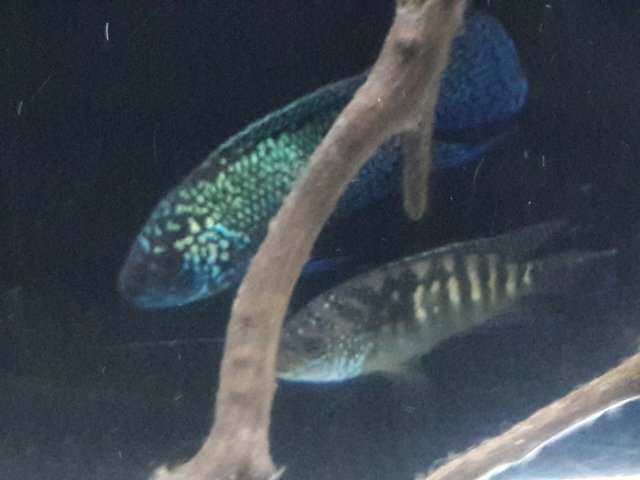
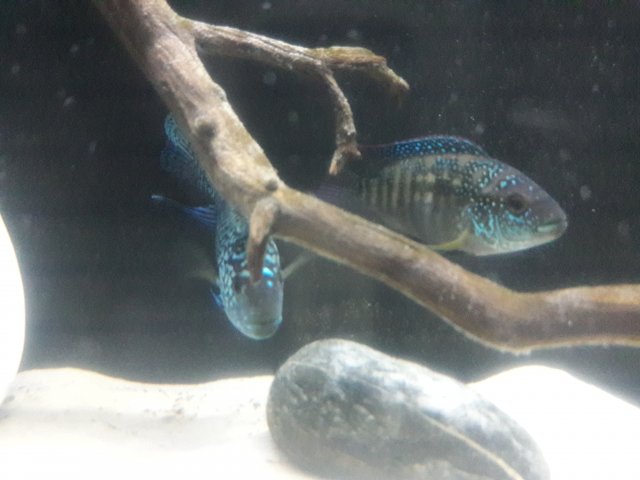
A few years back I had a heater quit on me. Mid winter in an unheated basement. Temps dropped to 68/66 range with no I'll effects on a Jack Dempsey pair and group of bloodfin tetras. Ever since I have kept my tanks right around the 75 range with no issues.
20171203_172004.jpg20180110_150905.jpg
 
South south American stuff can overwinter in the US and Europe, so like 50F give or take, I think that's somewhere around like 10C? Panama/Costa Rica/Mexico area stuff can go into the 60s, except for the stuff in the Rio terraba/puntarenas region with Costa Rica, I've had sajica get seizures from cold water changes.
 
  • Like
Reactions: Fishman Dave
A couple times I've forgotten to plug heaters back in after water changes over winter and they've dropped down into the 15c range for weeks with no apparently issues other than they just were moving slower than usual. One must have been getting down into the 10c range. About 60F and 50F respectively. Last one was a tank full of pearl gourami fry in a sleepout. No noticeable losses in that one but there were still a hundred other fry.
 
I agree that there is a big difference between a fish being able to tolerate a specific low temperature versus being able to thrive long term. Like many or most others, I have had a few frightening incidents related to power outages or other problems, which resulted in tank temperatures dropping far below what is normally recommended. In most cases these blips only lasted a day or so, and I was lucky enough not to suffer any losses or really any issues at all as a result.

But surviving a day or a couple days or even a couple weeks of low temps is not the same as living longterm (i.e. for years) in those conditions. I will be moving cautiously down the temperature scale; a bit of research into the conditions that any given species regularly experiences in its natural state is critical, IMHO. Bear in mind that an extreme temperature or other weather event in the wild may happen occasionally, and while the species as a whole survives it, many or most individuals may perish...so it's imperative to look at normal temperatures and conditions.

We frequently see threads on MFK asking about keeping this or that species outdoors in a pond; consulting a map or globe shows that the poster is located at a vastly higher latitude than the species' natural range, with no other mitigating geographical features making the idea feasible. The rationale often seems to be "I wanna try!" There is rarely a follow-up to these posts describing the first winter's success or lack thereof.
 
I heat few tanks in my fish room, maybe 4 out of 30 something tanks. This is mainly for truly tropical fish from places like Indonesia and the Kimberly. A lot of ‘tropical’ fish i’ve had survive outdoors all year for many generations. Melanotaenia duboulayi from central coast Queensland, various locals of Rhadinocentrous ornatus, Pseudomugil mellis. These are some species that I’ve bred for many years, they are all from southeast Queensland. But I was surprised when I had Melanotaenia mucculochi survive and breed, Danio Choprae (a more tropical danio) as well as some Pseudomugil furcatus. Many species of rainbows can do fine room temperature, at least in Sydney. many desert fish experience extremely low temperatures at night. I know a guy who keeps Desert gobies outside on the NSW/VIC border, which gets quite cold where he is
 
need some level of scale here. What I call cold may not match what someone from Australia calls cold which certainly may not match what jjohnwm jjohnwm calls cold or indeed same for room temperature.

Also worth noting that I agree with jjohnwm jjohnwm and my posts on here are talking about having seasonal lows - not keeping tropical fish at constant low temperatures (which I would struggle to do as my fish house gets towards 80 degrees even here in the uk during summer).
 
Last edited:
MonsterFishKeepers.com