If I remember correctly, these were all collected from Surinam. Just for the sake of discussion, I need to start by saying that there a 6 species in the Gulf/Atlantic and 6 species in the Pacific. At times, some of the species make it through the Panama Canal, however this is very rare as the Pacific species have grown accustomed to the slightly cooler water temps and deeper water. Looking at a map and seeing how far that Surinam is from the Panama canal, I find it to be illogical that a Pacific species of snook would find it's way that far and even harder to believe either a juvenile or spawning adult to do so. These quick thoughts have led me to the following conclusions:
Pic #1 - Definitely a fat snook, C. parallelus. Notice the compressed head length, large eye and anal spine pretty long long but not reaching the caudal peduncle. Here's some pictures of adult fish for comparison:

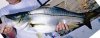
Pic #2 - I agree 100% with your ID on this one as well. Common snook, C. undecimalis. I've caught many of these while fishing here in FL and it is the easiest to ID. Pics for comparison:


Pic #3 - This is the species that I believe has caused the ID dilema and is the hardest to ID. It does resemble a black snook in body and head shape. The Black Snook has two well separated dorsal fins and all of the fins are dark. Characteristically the first long dorsal spine is shorter than the second dorsal spine, and the second and third short anal spines are of equal length. Even though the dorsal is not extended, it is apparent that the first long dorsal spine is as long or longer than the spines that come after it as it almost conceals them while laying down even though it is further forward and would not conceal even if it was the same length. Here is a pic of a black snook for comparison...please note the dorsal spines and the anal spines as previously stated.

This leaves only 2 possible ID's: C. Poeyi and C. mexicanus because it is definitely not C. pectinatus. The tarpon snook has an upturned mouth very similar to the tarpon giving it it's common name. I'm sorry, but the only pic I could find of a true tarpon snook was after a cold spell in FL:

I don't think it's C. mexicanus because the first spine in the anal fin is too long. In C. mexicanus, the first 2 spines are shorter that than the 3rd on the anal fin like in this picture:

This leaves my selection for ID being C. poeyi, or Mexican snook. Pic for comparison:

Pic #4 - This is the fish in my Avatar and the fish I purchased from you, Wes. As in my Avatar, the anal spine was straight. As it grew, the spine started a bend. It still surpasses the caudal peduncle making this fish the obvious C. ensiferus or swordspine.


The Pacific side snooks are even harder to properly ID. If they ever become available in the hobby I'll do some more research and post about proper IDing them as well.




