The Significance of pH for cichlds

  • We are currently upgrading MFK. thanks! -neo
Each 10th,”lower” in the pH scale, it is 10 times more acidic than the previous tenth.
Not to take away from your overall point, which I agree with within reason, as I mentioned earlier. But I've seen people say this before and it's a common notion in the hobby. But it's an apparent misunderstanding, mistaking 10ths for integers (whole numbers).
https://chem.libretexts.org/Bookshelves/Physical_and_Theoretical_Chemistry_Textbook_Maps/Supplemental_Modules_(Physical_and_Theoretical_Chemistry)/Acids_and_Bases/Acids_and_Bases_in_Aqueous_Solutions/The_pH_Scale#:~:text=The pH scale is logarithmic,than a pH of 10.
"The pH scale is logarithmic, meaning that an increase or decrease of an integer value changes the concentration by a tenfold. For example, a pH of 3 is ten times more acidic than a pH of 4. Likewise, a pH of 3 is one hundred times more acidic than a pH of 5. Similarly a pH of 11 is ten times more basic than a pH of 10."

"Since pH can be affected by chemicals in the water, pH is an important indicator of water that is changing chemically. pH is reported in "logarithmic units". Each number represents a 10-fold change in the acidity/basicness of the water. Water with a pH of five is ten times more acidic than water having a pH of six."

"By this, for every one decrease (due to the negative sign) in the pH, the acidity increases by a factor of ten (A pH of 3 is 10 times more acidic than a pH of 4, and is 100 times more acidic than a pH of 5)."

"Logarithmic Scale: It's essential to note that the pH scale is logarithmic, meaning each unit change represents a tenfold difference in the acidity or alkalinity. For example, a solution with a pH of 4 is ten times more acidic than a solution with a pH of 5."

--So the ten times difference (or ten times ten, ten times ten times ten, etc.) is between whole numbers, not between each tenth. This is a MASSIVE distinction-- the difference between pH 7.5 and 6.5 is 10, not 10 billion (ten to the tenth power).
 
Last edited:
One of my points in this soliloquy.
Is that there are always resonable alternatives availble for waterever water parameters we are dealt with.
One of the species I always liked were Heros severus, but with my high pH, hard water, keeping them was always a bit futile.
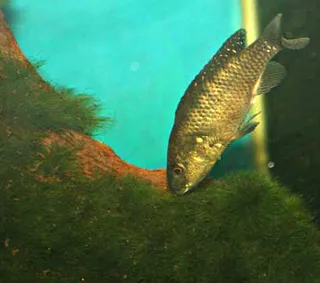
So instead, I kept these,

View attachment 1561264View attachment 1561265
Having the experience that you do, would you say a ph difference of 0.7-1 from their normal habitat is too much, or is that within the range of what most would deem "acceptable"?
 
Having the experience that you do, would you say a ph difference of 0.7-1 from their normal habitat is too much, or is that within the range of what most would deem "acceptable"?
I realize you didn't direct this at me, but the answer is you can't put a blanket rule on it because it depends on species or type of fish. For one thing, people tend to make assumptions about natural habitat that aren't necessarily true.

I'll give you just one example, discus. Conventional wisdom is they come from very warm, acidic water. However, this depends on the type of discus, and one type (considered S. haraldi by Bleher; however, discus nomenclature isn't agreed upon by all sources, which is a whole other subject) is found in pH anywhere from 6.0 to 7.8 (look at Symphysodon haraldi in the article below), telling you S. haraldi is an adaptable species and explaining why some people can keep them in pH 8 without any issues. This doesn't mean you should keep (pure) heckel or green discus this way and illustrates my point that you can't make blanket rules. Another thing this illustrates is the common idea that Amazon region waters are always either acidic or neutral pH is incorrect.
 
Last edited:
  • Like
Reactions: RD. and jjohnwm
A pH of 7, (or some where around there, ( 6.8 to 7.2)) is considered almost magical, in that a tons of fish species will adapt to it,
as long as other extremes soups concentrations are avoided.
What this means, extreme water hardness, elevated nitrate concentration, etc etc can be significant factors,
but even they can be circumvented with time, and experience of some aquarists.

In the 1960s, 6 adult Cichla species were inadvertantly releaved into lake Gatun, a high pH (sometime reaching pH 9, hard water lake in Panama.
This species, normally come from the soft, low pH waters (average 6.5 pH) of the Amazon.
It has taken the progeny from those 6 to populate, and adapt to the lake. (although they are normally a bit smaller than those from Amazonia)

Does this mean any Cichla fry tossed in Gatun lakes waters, directly taken from the Amazon will thrive?

Over the 60+ years since their release, it means a few adaptable fry, have been able to pass on the adaptable genes to survive. 60 + years.

Another example of adaptaion

There is a shallow soda lake in the rift called Natron, estimated to be 1.5 million years old, the average pH is normally between 9 to above 10,
and its average water temps are in the 90s'F (31'C +)
At some point in the lakes evolution, ancestors of a Tilapine cichlid entered the lake, and have evolved into the genus Alcolapia..
It is a Genus of small cichlids (the only genus of fish living within the lake) and has evolved to live on only certain algae that grows in its extreme conditions. Flamingos also inhabit the lake.
I have kept, and spawned this cichlid in my tanks, to keep it, I added soda like minerals to raise pH and kept heaters on max, ad nausium.

1746204049265.png1746204024009.png1746204091040.png
That million years have allowed it, to adapt, while no other genera have.

My point being, just because we buy a certain fish, and toss it into any tank, with any pH, or hardness does not mean it will make thrive,
If you give it and its spawns, 60 years (or a million) of course.

Most GTs come from a pH 7, in rivers west of the Andes,
but there is a certain lake west of the Andes, where pH is in the 8+range, and with a mineral contents that is much highe than the norm,
does that mean that pH is tolerable for all GTs you may buy?
It may mean the are more adaptable than some cichlids, but to you want to experiment?

To me with having a pH around 7 you may have a ton of possibilies,
but one fits all, may be an understatement, depending on water hardness, and your regime of water changes.


Some of the latest research on nitrate below,
The recommended freshwater nitrate toxicity guidelines are:
Guideline Type Grading Nitrate concentration
(mg NO3-N /L)


Surveillance
Nitrate
(mg NO3-N /L)
Description of Management Class


Chronic – high
conservation value
systems (99% protection)
Chronic – slightly to
moderately disturbed
systems (95%protection)


Pristine environment with high
biodiversity and conservation values.
1.0 1.5
2.4 3.5

Environments which are subject to a
range of disturbances from human
activities, but with minor effects.


Chronic – highly
disturbed systems (90%protection)
3.8 5.6
Environments which have naturally
seasonally elevated concentrations
for significant periods of the year (1-3 months).


Chronic – highly disturbed systems (80% protection)
6.9 9.8

Environment which are measurably
degraded and which have seasonally
elevated concentrations for significant periods of the year (1-3 months).


Acute 20 30 Environments which are significantly
degraded. Probable chronic effects
on multiple species.

Method of comparison Annual median Annual 95th percentile
 
Last edited:
  • Like
Reactions: tlindsey
Yep. The fish are adaptable, and this also seems to me to be a testament to just how unrealistically and unnecessarily many aquarists cling to the notion that there is a "perfect" temperature, "perfect" pH level, "perfect" hardness level, etc. for their fish.

These critters didn't evolve in laboratory conditions. Their natural environment shows seasonal and even daily variations in many parameters, like temperature and pH. Fretting about how many days one should take to change the water temperature half a degree, or how to pre-treat new water to match the old pH to a tenth of a point, seems silly.

Are there fish species that in nature experience absolutely no changes in any of these parameters in the course of a day, or a year? Maybe, but they are the exception if they exist at all.

I don't chase parameters; I try to keep fish that have already done all the work for me, i.e. they have evolved to live and thrive in the kind of water that comes out of my tap, straight from my well. And even then...I put lots of fish outdoors for the summer, where the temperatures swing sometimes wildly over the course of a single day, and leaves and other crap...I think the fanboys who like to buy unnecessary junk call the stuff "botanicals" :)...drop in and stain the water and add...well, who knows what they add? I certainly don't. And I really don't care; the simple fact is that virtually every fish species that lives outdoors for the summer comes inside in the fall having grown bigger, with brighter colours and greater overall vitality than any of their siblings kept indoors year-round by friends who worry about and strive to prevent every little change.

Hmmm...almost implies that reasonable, naturalistic fluctuations in water parameters result in bigger, stronger, better fish specimens. Who'd have thunk?
 
These critters didn't evolve in laboratory conditions. Their natural environment shows seasonal and even daily variations in many parameters, like temperature and pH. Fretting about how many days one should take to change the water temperature half a degree, or how to pre-treat new water to match the old pH to a tenth of a point, seems silly.
That was basically my point, similar to S. haraldi discus being found in pH 6.0-7.8. To be fair, the high pH sand bar measurement came after a rainstorm, implying transient conditions, so even if Heros notatus were found there I wouldn't keep them long term at pH 8.3. But my point was some locations having pH 5 or under doesn't mean they must be kept in similar conditions.

My current stock, including geos, severums, wild descended angelfish, L14, L200, and L91 plecos see large water changes, typically 80%, 6.4-ish out of the tap, settling at 7.2-7.4, depending on which tank and what's in it in the way of wood, leaves, etc.. There are daily temperature fluctuations as tanks warm up during the day and cool off at night. I haven't had a sick fish in 6 years and that one was wild and came in with issues I had to cure. I've had problem free stretches up to 10 years or more, but you never know, no one's immune to getting a weak or sick fish now and then, and all fish eventually get old.

I have nothing at all against being something of a purist regarding water chemistry, there's a certain appealing aesthetic in keeping soft water natives in soft water tanks, black water natives in black water tanks, or whatever the case may be. Some discus, S. heckel, for example, are soft water, lower pH species. Some severums, Heros sp. inirida, for example, don't do well in harder water, but others, sp. rotkeil, for example are much more adaptable. Know your fish, do your research, and don't ignore proven experience one way OR the other.
 
Hi all,


In my humble opinion, the key to success in this hobby is moderation and watching your fish closely—how they behave, how easily they spook, how they eat, etc. And most of all, understanding what might actually happen when you tweak something in your tank.

Me and my wife Kasia have been in the hobby for about 20 years. We've gone through a lot of different setups—African cichlids from Malawi and Tanganyika, a saltwater reef that we ran for 8 years, and even a well-balanced planted tank in the style of Takashi Amano. That doesn’t make us experts by any means—but it does mean we’ve built up a lot of patience and we love observing what’s going on beneath the surface.

When it comes to pH, our experience has been pretty straightforward. Whether it was Malawi or Tanganyika, the fish were perfectly happy at around pH 8.0—eating like beasts, super active, and breeding like crazy (seriously, we had fry coming out of our ears).

Now we've finally built our dream tank—200x80x60cm (around 250 gallons). It's stocked with 2 Cichla kelberi, 3 Astronotus ocellatus (Oscars), and 2 Megalodoras uranoscopus. The pH sits at about 6.8. We're being extra cautious with this one—it’s our first South/Central American setup. I’m planning to add two more fish, but only one of each species, just to avoid potential breeding and all the aggression that can come with it. I'm only worried the Cichla or Oscars might start pairing off... but honestly, I love these fish so much, I kinda lost my mind when I bought them 😅

Anyway, here are two real-world examples from our tanks that taught me a lot about how pH interacts with everything else:

1. The “uh-oh” moment with high pH and ammonia
In our old African cichlid setups, we had to be super patient. High pH water is risky if your tank isn’t fully cycled, because ammonia (NH₃) becomes way more toxic at high pH levels. I didn’t know that at first, but a friend warned me just in time. We delayed introducing fish by a full month, and it probably saved us from a disaster. Here’s an article that really helped me understand what was going on:
👉 http://www.aquaworldaquarium.com/articles/Ammonia.html

2. Our current South American tank and the pH spike
This tank has a DIY trickle filter and a Fluval FX6. I’m also running two old wavemakers from our reef setup to keep the surface moving. I hadn’t cleaned the FX6 in months, so I finally gave it a rinse—and bam, the pH jumped from 6.8 to 7.2 in no time. The fish instantly became restless and jumpy.

Turns out the “dirty” FX6 was full of organic material that gently acidified the water over time. Once I cleaned it, that buffering effect was gone, and pH shot up. I turned off one of the wavemakers and added some pH control (Seachem Acid Buffer) to help things settle. The pH slowly dropped to 7.0 and now it’s gradually drifting back toward 6.8 on its own.

Bottom line?
Knowing what your pH is matters—but knowing what can change it matters even more. And above all, stability is what really counts. Whether you're at 6.8 or 7.0 doesn’t matter much, as long as it stays steady.

Just my personal take.
Thanks for reading—and sorry for the long post!
 
  • Like
Reactions: Roger Mcfish
Good discussion on this thread. In my experience (mostly with cichlids) the adaptability of fish to different parameters and the importance of mimicking their natural environment varies pretty widely depending the species, and a number of other factors. The water parameter discussion is more convoluted than many realize, which neutrino explained above much better than I can.

Overall, I believe that usually fish which are not far removed from wild caught generations, will be much more picky about water parameters than fish which have been tank-bred for generations. I have a particularly tough time with South American dwarf cichlids like apistogramma. They seem to be very sensitive to fluctuations or "improper" conditions, and do much better when the aquarist puts lots of research into at least matching the basic pH and hardness. Many of these less-common species are only a few generations away from a WC fish. Then there are other species hailing from SA like oscars, which have been tank bred and raised for decades, and have changed into "aquarium strains" over time, altering even their outward appearance pretty drastically. I would imagine they have also evolved to be more adaptable to water parameters over those generations, and I have seen many people keep these fish in all sorts of water with success. So, I basically think it is too broad of a blanket statement that matching parameters to a fish's wild habitat is incredibly important. Sometimes it is, and sometimes probably not so much. I don't have a scientific journal to quote here, just my opinion.
 
MonsterFishKeepers.com