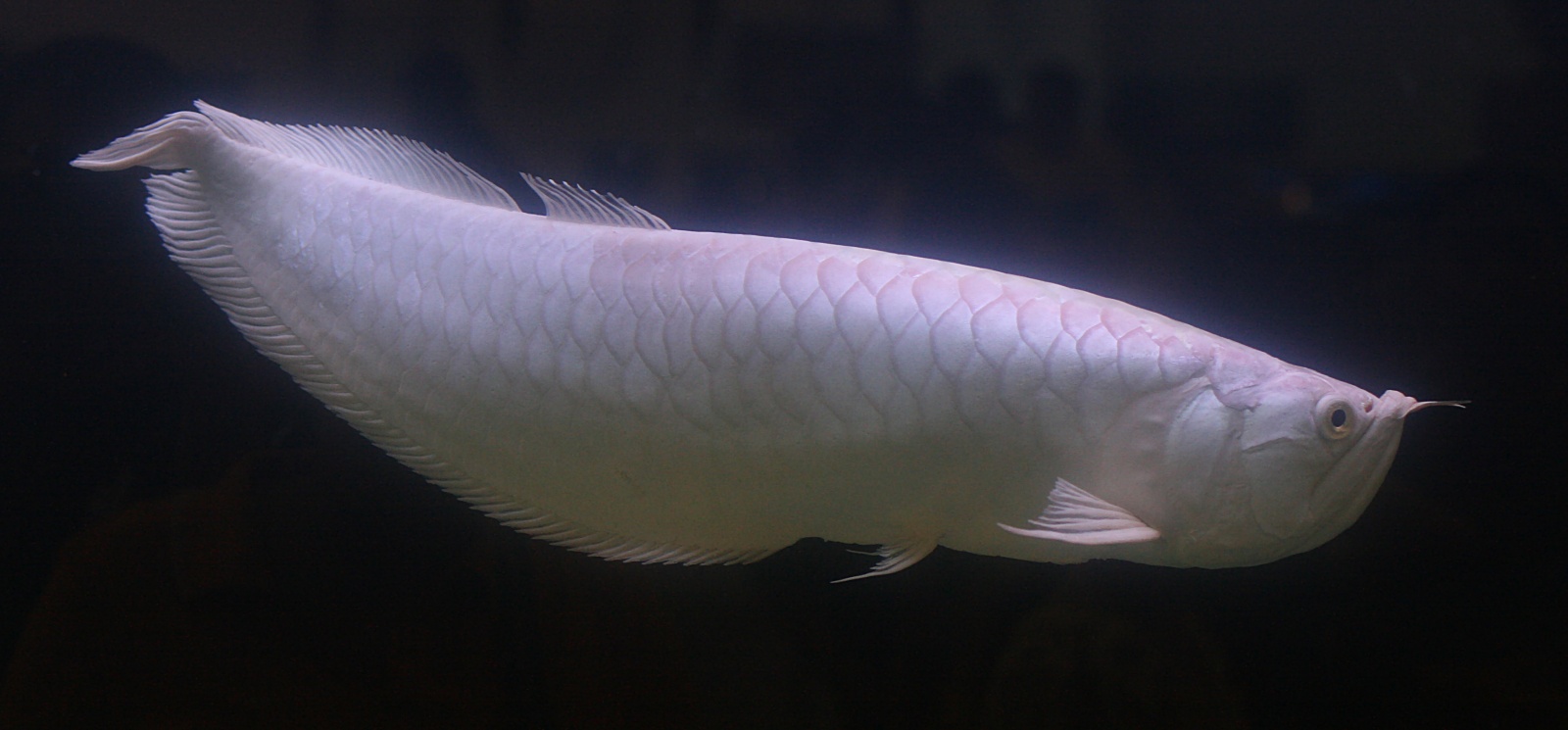
Educating MFK on the Silver Arowana (REVISED)
created by Delgado
Hopefully i nailed all of the errors
some new added stuff too

---------------------------------------------------------------------------------
Scientific Name: Osteoglossum bicirrhosum
General:
Osteoglossum bicirrhosum a.k.a silver arowana is the most common and inexpensive of all the arowana species, and yet is one of the largest growing up to 4 feet (3 being average) and in some extremely rare cases in the wild, grow almost 5FT IN LENGTH!!!!

The Silver is more elongated and has longer fins than its Asian and Australian cousins. As with all Arowanas, it has barbel-like extensions protruding from the mouth. The body can range in color from a flat silver to a rich aray of blues, reds, and pinks. The fins can carry the same variations in color as the body but can also display striping to the point where they resemble tiger markings, which is most apparent on juveniles. If raised properly, this fish can break beyond the boundaries of being just a "plain old Silver" and become a top quality fish that demands just as much attention as their Asian counterparts. A very common deformity that is striking more and more Silver Arowanas kept in captivity today is drop eye, a condition where the eye(s) constantly look down. It is of great debate of what actually causes this conditioned, but a few of the theory can be ruled out or severely questioned, such as a fatty diet. A majority of owners have raised there fish on a low fat diet and consequently they still acquire it. The genetics theory has flaws of its own, Some hobbyist claim that its the captive bred silvers that acquire the drop eye due to inbreeding causing a weak gene pool, but how can this be when the majority of the countrys silvers are coming out of wild from south America? According to some (consider them semi-unreliable sources) that it is the captive bred silver arowana that are less prone to drop eye, if this is in fact true then is inbreeding really responsible for causing weak genes in fish in general or is it the wild strains of fish that are less hardy than there captive bred counterparts??? . Getting back on topic, some say that reflection from the bottom of the tank causes the fish to look down.
To answer this I did
a lil investigation. and this is done on an acrylic tank bottom, not a glass one but I think the result on the glass would be the same. (feel free to question this experiment)
See the reflections??? Thats from our point of view

Now I took some saran wrap, wrapped up my carema in it, tied it off and made it water proof. The second time, well
..now my camera is drying in front of a fan
Lets take a look under water from a fishes point of view (I zoomed out as far as I could, the figure at the top of the pic is my aros head)

its the wooden bottom, but Wheres the reflection????? If theres is no reflection then what are they looking down at/for???
You might be thinking that the fish would probably be looking down at the tankmates swimming at the bottom level of the tank, but wait
.. what if the arowana has no tankmates???...and theres No reflection???? Then what the heck would the fish looking down for????
Until science (or some hobbiyst with a pay load of cash) steps up, the true cause(s) may remain unknown leaving us to dwell on theorys.
Habitat/distribution:
Silver Arowana are found naturally in white and black water floodplains and forests of South America in the freshwaters of the Amazon River Basin and maybe in the Rupununi and Oyapock Rivers, and in some still waters of Guyana as well. There is indication that they dont go through rapids, as they havent promulgated further upstream. Most of the Silver Arowana are found in the swamp and flooded areas in the shallower water.
care:
Silver arowanas will adapt to most water supplys with ease, though they do need exellent water quality as in 0 ammonia & nitrite. Nitrates should be kept as low as possible, 20ppm of nitrate being ideal but lower is better. 50-75% water changes should be done at least once a week for these are large producers of high protein waste, more water changes are even better. Temperature should be between 80 and 84 degrees F. slightly higher will not harm them. Minimum tanks size for this fish (though very debatable) should be no less than 270 (6ftx3ftx2ft) gallons for a single arowana. For this fish to live comfortably, grow and live to its FULL potential however, A 478 gal (8ft x 4ft x2ft ) would be the ideal tank size for LIFE (this is of great debate as well). Silver Arowanas are known to be quite "skittish" as far as fish go. They get scared very easily so a heavy tight fitting lid is a nessesity, and these fish are powerful jumpers, a sturdy lid made of materials such as acrylic should be used as arowana have been know to smash straight through glass lids, also a heavy object should be place over the lid as a large silver can knock a lid clear off the tank (as i have experienced)
as for tank mates it all comes down to the fishs personality itself. As rule of thumb, no tankmate should be kept with this fish that can fit in its mouth. Anything smaller and its at your own risk. ( i have successfully kept small fish with a silver arowana, smallest being 2.5 inches and not a single attempt to eat it or any other of my fish for that matter). Again it all comes down to the personality of the individual fish
Feeding:
the Silver Arowana is a pure carnivorous fish and will take a variety of meaty foods.
The most important thing is to get your fish on a high quality commercial diet of pellets or food sticks, This should be the staple of the fishes diet, avoid goldfish as they have a high fat content, contain an enyme that inhibits the absorbtion of thiamin and can carry diseases & parasites.
Live feeders are a good food source given that they are quarantined and gut loaded, now when I say "gut load" I dont mean buy them stuff the heck out of them and then feed them. To get the best out of your feeders, instead of feeding them prior to feeding your predators, wait a little while, let the feeders grow and bulk up. Feed a high quality commercial food and keep the water as pristine as possible, you increase the nutrient potency of the fish by letting them fatten up, not nessesarily making them higher in fat content, but make the fish grow leaner, stronger and healthier, once they reach this point you are ready to feed them out, also a healthy feeder will be full of energy and give your arowana literally an run for there money or should I say exercise
. Silver Arowanas can eat a wide variety of foods: pellets, grocery store shrimp, krill, night crawlers, superworms, earth worms, scallop's, blood worms, tubefix worms (NO LIVE: these are collected from contaminated areas), rosie red minnows, various live fish such as guppies, sunnies (sunfish), mollies, crickets, various fish fillet (catfish, tilapia, halibut, etc) , squid, grasshopper (for larger arowanas).frogs, specifically bullfrogs, centipedes, crayfish and even pinky mice. Sometimes a little patients is required to get this fish to eat certain food items such as for example pellets. This can be accomplishes by periods of fasting until they accept the food item.
THIS ONLY APPLIES TO HEALTHY SILVER AROWANAS. Sick or malnurished fish may get worse or may not survive from fasting, a suppliment of garlic extract or other food enticer may get this fish to accept it's food. The idea is to keep the diet as varied as your possibly can (or afford), the purpose of a varied diet is make sure the fish is getting all the nutrients it needs that its not getting from a single type of food.
Tip: if you want the full potential color out of your Silver Arowana, start at a young age. Feed a high quality color enhancing food such as hikari carnivorous food sticks, cichlid gold, or a new life spectrum formula, omega one is a good brand also. Another way is to purchase crickets of the correct size, and gut load them on the commercial food (soak first) and add baby carrot to the diet( the carrots also provide moisture for the crickets), once your crickets are done eating you are ready to serve them out to your young silver. The carrots should greatly enhance the pink and reds in the fish.
Special note: a vitamin supplement should be added to the diet daily for extra health benefits. Very good for conditioning a silver before breeding. It also restores the nutrient value of defrosted frozen foods as many nutrients are lost in the defrosting process.
breeding:
Silver arowanas aren't that hard to breed as some may think, provided the tank/pond is big enough and you have a pair. A pair is obtained by raising a group together and watching them pair off. If you live in a warmer climate successful breeding will be more easily accomplished if you have an outdoor pond. Arowanas are mouth brooders, meaning the eggs are hatched in the parent's mouths specifically the males mouth. The growing fry will also be raised in this location till they are about 42 days old.
noted observation: from my experience the female seems to stop eating 3-4 week before she lays her eggs. And becomes very agressive in that time.
Longevity:
The average lifespan of a silver arowana in captivity is between 15-20 years. However with optimal care throughout its whole life, this fish is said to up to 50 years (possibly more).