


The varied current of natural habitat
- Thread starter neutrino
- Start date
You are using an out of date browser. It may not display this or other websites correctly.
You should upgrade or use an alternative browser.
You should upgrade or use an alternative browser.


ONe of the first things I do if a new species I am keeping starts looking less that happy is adjust flow. Either up or down depending on research on that species. It is often long, constant stress of the environment that leads to ill-effects.
And observation of the fish and the tank as a whole, is needed. Not just look to enjoy the colors of the fish. Sit still and don't move for a few mins and the fish stop the usually begging for food or glass riding. After 10 mins you start seeing what is going on. After 20 mins when all fish think they are alone and get back to antics that happen when you are not around, you find out what is really happening. It needs time, patience and a willingness to do it.
it also gets me when people say the fish has issues, be it sick, hiding, etc., and describe what they have done to combat it. it is often the case that so many variables were changed that it is nigh on impossible to ascertain which one made a difference. Or, sit and wonder out loud what it could be. Not thinking the 7 changes made this week in the tank, in conjunction with new noises and vibrations, or whatever is going on around it all affect the fish.
Quarantine and time in the QT gives you the opportunity to study that/those fish and see how to best add them or adjust the tank before they go in so later less changes have to be made.
This is so important with high oxygen needs, or any other niche environment our fish come from.
Back to flow. I have spent the better part of the last 7 years keeping rheophilic fish in high flow tanks. It is very nuanced by species, size of fish and area fish inhabits. Even the most streamlines, torpedo shaped, water-rocket fish will find areas to rest. And not for a little while, for hours at night and non-feeding times.
I believe, as touched on before, there are differences in high flow and large water turnover. High flow aquarists use is often 2-3 circulation pumps pointing in different directions to blow mulm off the substate and keep the tank clean. When in fact, that same mulm should be collecting in quieter spots where fish can rest. A high volume turnover helps with DO but is not the always the best indicator that tank and water currents are set up properly.
Unidirectional flow, though harder to setup initially, has proven in my experiences to be the way forward. The fish seem happiest and harmonious as flow is predictable and almost every piece of hardscape has a lee side.
And observation of the fish and the tank as a whole, is needed. Not just look to enjoy the colors of the fish. Sit still and don't move for a few mins and the fish stop the usually begging for food or glass riding. After 10 mins you start seeing what is going on. After 20 mins when all fish think they are alone and get back to antics that happen when you are not around, you find out what is really happening. It needs time, patience and a willingness to do it.
it also gets me when people say the fish has issues, be it sick, hiding, etc., and describe what they have done to combat it. it is often the case that so many variables were changed that it is nigh on impossible to ascertain which one made a difference. Or, sit and wonder out loud what it could be. Not thinking the 7 changes made this week in the tank, in conjunction with new noises and vibrations, or whatever is going on around it all affect the fish.
Quarantine and time in the QT gives you the opportunity to study that/those fish and see how to best add them or adjust the tank before they go in so later less changes have to be made.
This is so important with high oxygen needs, or any other niche environment our fish come from.
Back to flow. I have spent the better part of the last 7 years keeping rheophilic fish in high flow tanks. It is very nuanced by species, size of fish and area fish inhabits. Even the most streamlines, torpedo shaped, water-rocket fish will find areas to rest. And not for a little while, for hours at night and non-feeding times.
I believe, as touched on before, there are differences in high flow and large water turnover. High flow aquarists use is often 2-3 circulation pumps pointing in different directions to blow mulm off the substate and keep the tank clean. When in fact, that same mulm should be collecting in quieter spots where fish can rest. A high volume turnover helps with DO but is not the always the best indicator that tank and water currents are set up properly.
Unidirectional flow, though harder to setup initially, has proven in my experiences to be the way forward. The fish seem happiest and harmonious as flow is predictable and almost every piece of hardscape has a lee side.


Woof!Yeah...we're in an alternate dimension...or at least I am...or maybe you are...or...or........


The average fish keeper goes into a Pet smart depot, or mom and pop shop to spend $16 to $19f or a pretty fish, and it might live in an average 50 to 75 gal tank, in local tap water, throws it in with a couple gouramis an angelfish, and some rasboras, and is satisfied.
And many old time keepers , those who stay in the hobyy longer than a year) have developed stratgies to to maintain that and a little more
And there may be quite a number of those aquarists here on MFK.
I don´t consider ar tailor my answers only for them, I am sometimes aiming at those niche aquarists who will spend $!00 to $200 on a single Panda Uaru, or Alcolapia alcolicus, all the while thinking their average tap water, a HOB, will do (and if they are lucky, just might) but....
most of u jaded old timers realize, there´s only less than a 50% chance those (and other niche species) may last a month or 2, and then call the vendor complianig they was robbed.
If an aquarist buys a panda uaru, and drops it in pH 7, average hardness, tap water, I can almost quarantee it will not last more than 6 months.
If that same aquarist adjust pH down to 5, inundates the tank with tannins, mixing with RO, no problem.
If an aquarist buys an few Alcolapia for $200, drops tehm into 7 pH water, at a normal aquarium temp of 75¨or 78 F, they might last less tha a year.
If that same aquarist raises pH to 8, cranks the heater above 82´F, adds a lb of epsom, and 3 lbs of table salt to that 75 gal tank, those same fish might last 3 years, and breed.
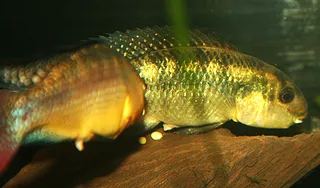
If one of those aquarists with a fixation for pike cichlids, tosses a wild caught Orinoci Crenicichla zebrina
in pH 7 tap water, in a 75 gal, with a 25% water change, once per week,
that $200 pike might last 2 months.
but If again pH is acidified down to 4 or 5, in a 100 gal +, hardness is dropped with RO, and given 50% water changes twice per week, it may enjoy a decade, and grow beyond 12¨.
If an aquaraist wants Geophagus harriri, the same above water parameters apply, but also this species prefers to live in a shoal, and needs a strongly moving current to control intraspecies aggression,
but if current is not strong enough to use up that excess energy they born with to cope with that strongly moving, natural wall of water, that´s when aggression becomes problematic.
Too constricting, or nitpicky, buy a betta, a goldfish, or an aquarium strain angel, lemon yellow african from a mixed mutt cichllid tank, or even a mass produced color corodinated discus to go with the decor.
Now on to a rant about pseudo cichlid frankenfish like BPs, FHs and electric blue something of others.
And many old time keepers , those who stay in the hobyy longer than a year) have developed stratgies to to maintain that and a little more
And there may be quite a number of those aquarists here on MFK.
I don´t consider ar tailor my answers only for them, I am sometimes aiming at those niche aquarists who will spend $!00 to $200 on a single Panda Uaru, or Alcolapia alcolicus, all the while thinking their average tap water, a HOB, will do (and if they are lucky, just might) but....
most of u jaded old timers realize, there´s only less than a 50% chance those (and other niche species) may last a month or 2, and then call the vendor complianig they was robbed.
If an aquarist buys a panda uaru, and drops it in pH 7, average hardness, tap water, I can almost quarantee it will not last more than 6 months.
If that same aquarist adjust pH down to 5, inundates the tank with tannins, mixing with RO, no problem.
If an aquarist buys an few Alcolapia for $200, drops tehm into 7 pH water, at a normal aquarium temp of 75¨or 78 F, they might last less tha a year.
If that same aquarist raises pH to 8, cranks the heater above 82´F, adds a lb of epsom, and 3 lbs of table salt to that 75 gal tank, those same fish might last 3 years, and breed.
If one of those aquarists with a fixation for pike cichlids, tosses a wild caught Orinoci Crenicichla zebrina
in pH 7 tap water, in a 75 gal, with a 25% water change, once per week,
that $200 pike might last 2 months.
but If again pH is acidified down to 4 or 5, in a 100 gal +, hardness is dropped with RO, and given 50% water changes twice per week, it may enjoy a decade, and grow beyond 12¨.
If an aquaraist wants Geophagus harriri, the same above water parameters apply, but also this species prefers to live in a shoal, and needs a strongly moving current to control intraspecies aggression,
but if current is not strong enough to use up that excess energy they born with to cope with that strongly moving, natural wall of water, that´s when aggression becomes problematic.
Too constricting, or nitpicky, buy a betta, a goldfish, or an aquarium strain angel, lemon yellow african from a mixed mutt cichllid tank, or even a mass produced color corodinated discus to go with the decor.
Now on to a rant about pseudo cichlid frankenfish like BPs, FHs and electric blue something of others.
Last edited:

Some of the things you describe do happen. There are always some with more money than sense, some who think they're smarter than the rest of us by doing something stupid and calling it 'thinking outside the box,' some for whom their tank is little more than a piece of furniture, etc. But a lot of these types will never go to the trouble of reading anything or getting on a forum or Facebook group to learn-- and to those who like to dismiss FB groups, they're no different than forums like this, some are junk and some are high quality and frequented or hosted by very knowledgeable aquarists.
So, I hate to say this, because I respect your experience and you do a lot for this forum, but I'm not sure what you accomplish by continually preaching to a pet stereotype of 'the average fish keeper' on points other experienced aquarists either already know or know enough to know aren't such hard and fast rules as you can make them out to be-- while in other ways you can give sound advice. You're right, there absolutely are some fish that require specialized conditions and care, the friction comes when you apply the same reasoning to fish that don't require the narrow conditions you sometimes suggest, because they're naturally more adaptable than these sensitive species or the characteristics of their natural habitat, like current or chemistry, aren't so narrow in the real world of nature as some think-- or the fish in question wasn't collected in the main river but a smaller tributary with different conditions. What's more helpful to 'the average aquarist' is to learn which species really do need special care, as distinguished from those which will be perfectly content and healthy in a wider range of conditions, or which species really should be kept alone or in species tanks or only certain other species vs which are compatible in a suitably sized tank and, in fact, may often be found together in nature. That and, since fish are not machines, some of this will never be an exact science. One population, or even an individual, of a species may be calmer or more aggressive than another. So what works in one tank doesn't work in another or what doesn't work in one tank does work in another.
On the other hand that's life in any discussion group like this-- different approaches, different opinions, and relatively few cosmic truths. So this, too, is just an opinion.
So, I hate to say this, because I respect your experience and you do a lot for this forum, but I'm not sure what you accomplish by continually preaching to a pet stereotype of 'the average fish keeper' on points other experienced aquarists either already know or know enough to know aren't such hard and fast rules as you can make them out to be-- while in other ways you can give sound advice. You're right, there absolutely are some fish that require specialized conditions and care, the friction comes when you apply the same reasoning to fish that don't require the narrow conditions you sometimes suggest, because they're naturally more adaptable than these sensitive species or the characteristics of their natural habitat, like current or chemistry, aren't so narrow in the real world of nature as some think-- or the fish in question wasn't collected in the main river but a smaller tributary with different conditions. What's more helpful to 'the average aquarist' is to learn which species really do need special care, as distinguished from those which will be perfectly content and healthy in a wider range of conditions, or which species really should be kept alone or in species tanks or only certain other species vs which are compatible in a suitably sized tank and, in fact, may often be found together in nature. That and, since fish are not machines, some of this will never be an exact science. One population, or even an individual, of a species may be calmer or more aggressive than another. So what works in one tank doesn't work in another or what doesn't work in one tank does work in another.
On the other hand that's life in any discussion group like this-- different approaches, different opinions, and relatively few cosmic truths. So this, too, is just an opinion.
I agree, I don´t think anything I ever say will sway anyone, because most (even a few semi-experienced fish keepers) think
water is just water,
pH is an abstract concept to fluff off,
or flow from an airstone accounts for adequate flow for trout , as it does for bettas.
Or just because they are from S America, a cichlid from Agrentina where it snows,
belong in the same heated tank as one that comes from tropical Guiana
And that doing even a modicum of research into the needs of the fish kept matter is too much bother.
See, there I go ramblin again, I just can´t help myself
water is just water,
pH is an abstract concept to fluff off,
or flow from an airstone accounts for adequate flow for trout , as it does for bettas.
Or just because they are from S America, a cichlid from Agrentina where it snows,
belong in the same heated tank as one that comes from tropical Guiana
And that doing even a modicum of research into the needs of the fish kept matter is too much bother.
See, there I go ramblin again, I just can´t help myself
