To Styro or Not to Styro?

  • We are currently upgrading MFK. thanks! -neo

What do you this of using styro on GLASS tanks?

  • I refuse to use foam on my tanks

    Votes: 29 18.4%
  • I might use foam in certain instances, but generally no.

    Votes: 59 37.3%
  • I have heard that foam might be good, so I would lean towards yes.

    Votes: 30 19.0%
  • Foam actually makes a difference. I use it every time.

    Votes: 40 25.3%

  • Total voters
    158
Pharaoh;2997792; said:
Time for a bump ladies and gentlemen. If you haven't read through this read, please do.


Glad to see I could be the cause of resparking a hot topic, ha! I posted the pic you asked for on the thread I started... see what you can make from it, if you could.
 
So I just got done reading 13 pages on this fascinating topic to me and now it's my turn to put in 3 cents worth.

I personally believe that with information being so readily available on the internet there is a lot of misinformation out there. The one thing that my sister's uncle's brother did to level his tank that time turns in to the word of lord. I have seen many times on this site where people complain about an unlevel fish tank and the instant answer is "Put Styrofoam under it". Never does anyone explain why or what type to use. I have even seen alot of people suggest the cheap stuff at Home Depot which is wrong on many levels. One is which was explained earlier that it does not rebound once compressed and the other is it is not the high denisity foam that is more sutied for this application. Plus every good hobbiest knows you should always shop at Lowe's.

If you are setting up an unlevel stand STOP something is wrong and that issue needs to be addressed. If over time your stand becomes un level it is time to break down the tank and relevel the stand and tank properly. It sucks but that is the proper fix. I also don't know who it is out there that is setting up tanks in quarrys but why is everyone so worried about gravel and pieces of rock becoming lodged between the stand and tank? Hopefully some one can explain this to me.

Well these are my opnions on the subject and I have more I just need to make some drawing to show my point so off to paint I go.
 
thats sort of what I was getting at. foam is not the quick fix most people make it out to be.

if you use foam on an unlevel stand, your tank is still unlevel.

it just has settled into the foam, which is now itself unlevel because it rests on the stand which is unlevel in the first place..

and then you have a problem still..
 
So here is my 30 second paint image to describe one of the major flaws of using foam. I over exaggerated the image but it shows supporting a tank that is unlevel and bowed in the middle.

So Styrofoam is basically foam with a bunch of air pockets in it. the density of the foam is based on the compression of the air pockets. The more compressed the foam the more dense it is giving it more support.

So if you are using foam the support an uneven or bowing tank or stand you are not actually supporting the tank properly because the more dense area of the foam is offering more support than the less dense less compressed areas of the foam.

foam.JPG
 
So here is my OPINION on why it is bad to put foam under a braced tank that has a floating bottom. I am not talking about flat bottom glass tanks or acrylic tanks. This is why I believe it could cause a bottom to break.

In the image the floor has begun to settle on the left side or was constructed uneven. so someone whats to find an easy way to level it. Uses the power of Google to search leveling uneven tank. Presto a bunch of people saying use foam. Trusting the advise of complete strangers on the internet the individual in question goes to Home Depot (which we all know was his first mistake) and buys a sheet of pink foam (not the high density foam) and throws it under the tank instead of taking the time to cut it and put it only under the bracing. As I discussed before the density of the foam is directly related to its compression ration. So in this scenario you could end up with foam that is touching the bottom of the glass (because the foam was purchased to thick and is low density) but on the right side it is compressed more than it is on the left. The downward pressure from the water is equal but the upward pressure from the foam is higher on one side than it is on the other. Which is why I believe foam under a glass tank could fix the immediate problem of being unlevel giving you a warm fuzzy while actually creating a much greater problem of causing the bottom to crack.

I just don't think it is worth the risk.

In the end I don't use foam because I believe you should fix the root of the problem not just try and bandage a bullet wound. If you are worried because your tank it not level than level the stand. Of course I to live in So Cal so when I set up my 180 and my 270 they will be on slab floors and I own a welder so I make steel stands with adjustable feet for my big tanks.

foam 2.JPG
 
You guys are hung up on incorrectly thinking foam is used to level the tank. It is NOT!

The foam is there only to protect the tank from twisting forces that causes seams to split and glass to crack.
 
but with a properly set up level and flat stand there shouldn't be any significant twisting forces.

even on a normal floor.

if the tank is set up properly on a proper stand (planar and level), once a tank has "settled" in (which happens very quickly) the floor directly under the tank doesn't move that much, unless you live in California..

if it was such an issue, tanks would be breaking all the time any time someone sets them up on a second or higher residential floor.

the only way you should get a twisting force is if your stand is not planar and one corner in the front is higher/lower than a corner in the back.

this puts a torque or twist on the tank.

if the floor is really sagging over time, then the tank is too large/heavy for that particular floor and should be on ground level with 'the world' directly underneath it.


I am just putting down my thoughts as they come to me. feel free to correct things if I am wrong.
 
why it is bad to put foam under a braced tank that has a floating bottom.

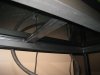
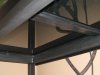
since this is a discussion, I took some pics of my 150 gallon that has a 'floating bottom' (made my Aqueon aka All-glass) just so everyone is clear as to what it is:

the tank manufacturers tell us that foam is NOT recommended for these types of tanks (made of glass).

however, some hobbyists chose not to take this recommendation and use the foam anyway.

it is my understanding that acrylic tanks must be fully supported on the bottom as they, unlike glass, sag. and foam IS recommended for acrylic tanks.

IMG_1540.JPG

IMG_1542.JPG
 
In the image the floor has begun to settle on the left side or was constructed uneven. so someone whats to find an easy way to level it. Uses the power of Google to search leveling uneven tank. Presto a bunch of people saying use foam. Trusting the advise of complete strangers on the internet the individual in question goes to Home Depot (which we all know was his first mistake) and buys a sheet of pink foam (not the high density foam) and throws it under the tank instead of taking the time to cut it and put it only under the bracing. As I discussed before the density of the foam is directly related to its compression ration. So in this scenario you could end up with foam that is touching the bottom of the glass (because the foam was purchased to thick and is low density) but on the right side it is compressed more than it is on the left. The downward pressure from the water is equal but the upward pressure from the foam is higher on one side than it is on the other. Which is why I believe foam under a glass tank could fix the immediate problem of being unlevel giving you a warm fuzzy while actually creating a much greater problem of causing the bottom to crack.

from what I understand, this is the exact reason that the manufacturers do not recommend the use of foam.

if you create a situtation where you are getting pressure forcing back up on the bottom pane of glass you can lead to a cracked bottom.

tanks with floating bottoms (like mine with two braces) were not designed to withstand upward pressure on the bottom pane of glass. thats why the bottom panel is "floating"
 
vfc;3002876; said:
12 Volt Man,
You can shim your stand and make it perfectly flat, but that evenness only last a short time. A wooden stand and wooden floor will always (and continually) sag and twist over time. A foam mat is one way to maintain a relatively even force on the tank bottom.

Think of it this way; adjust the springs & shocks on a car to make the car sit perfectly flat. Then weld them in place to lock in that perfect alignment. Now start driving the car over pot holes and speed bumps. The car frame will be under stress. The top of a stand is like a changing road surface.

A foam mat is like free floating shock absorbers; moving up and down to minimize stress on any one part of the frame.


but the problem is, that once you put the foam mat under a heavy tank, the foam compresses down pack, and you probably don't get any shock absorption at all.

if I put foam under the weight of my 150 gallon for example, that weighs about 1800 pounds full (perimeter supported) the foam around the perimeter is going to be so compessed its not going to move a bit if the tank/stand moves. it will move along with the tank/stand because it would be so compressed there would be no 'give' to it.

the foam wouldn't stay fluid and free moving under the weight of such a big tank.

so I don't think the foam would work the same as shock abosorbers on a car, that are sort of springy.
 
MonsterFishKeepers.com