To Styro or Not to Styro?

  • We are currently upgrading MFK. thanks! -neo

What do you this of using styro on GLASS tanks?

  • I refuse to use foam on my tanks

    Votes: 29 18.4%
  • I might use foam in certain instances, but generally no.

    Votes: 59 37.3%
  • I have heard that foam might be good, so I would lean towards yes.

    Votes: 30 19.0%
  • Foam actually makes a difference. I use it every time.

    Votes: 40 25.3%

  • Total voters
    158
steverothery;2305956; said:
You are wrong about your last point - you don't understand it.

Pressure = force / Area Pressure on high points increases MASSIVELY and thats when foam or styro interfaces work.

What I am getting at is still being missed. The amount of pressure exerted at the specific points varies. But you also have to look at the properties of the foam in itself. The foam will have a certain compression point. Once that foam compresses, you have support. But when certain points of the tank are higher, there will be less compression. Less compression does not equal support. It may serve to fill in a gap or two, btu I do not believe that there is any "extra" support given.

BTW, let's keep the finger pointing to a minimum here. I opened this to be a discussion. I do not claim to be right, nor do I claim to understand the situation. Hence, why I asked for discussion and factual data. Opinions are better left to the poll itself. If you would like to prove your point. Please show us a demonstration other than saying P=F/A. Not everyone here is a physics major, but I'm sure we would all like to see supportive information in this argument.

 
I think it is time Zen & I post a few pics for topical discussion.

Off to MS Paint I go!.
 
ghengis;2309634; said:
I use Styrofoam. I don't have any ]v[onster tanks though, the largest (so far) being 70L (18gal). I use it for similar reasons to those that have been mentioned; inconsistencies in stand surface, thermal barrier and vibration resistance. To hide the fact, I took the time to paint it the same colour as the stand, prior to filling. Thus...

IMG_0979_2.jpg
I'm thinking water change here, and maybe some serious gravel vac'ing...
 
I will first thank you for your applause at my wonderful photos. No need for a standing ovation. :D

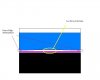
Now, as you can see in the first picture, the tank has a slight bow in the center. Because the ends are lower than the center, there will be more force exerted on the corners than at the center. Foam will compress at a certain rate per pound of force that is exerted on it. The the force is less, then the compression will be less. This does not mean that the bow is corrected nor supported. It would show that the foam is merely reacting to the force palced on it.

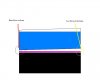
In the second picture, you can see that the tank is definitely unlevel, thus creating a higher amount of force on one end of the tank than the other. If the foam compresses at a consistent rate, the the tank will still remain unlevel.

Thoughts?
 

Attachments

My take on the whole thing is this...

If you take the footprint of the tank
glass or acrylic
and figure out the square area and divide the overall weight by it...you'll get P.S.I. or Pounds per square inch...

Glass with a plastic rim will have a greater PSI on it's footprint than an Acrylic tank where it's footprint is much larger, and the PSI is way lower.

Flat is good, level is not as important, within reason...1 inch left to right is no big deal, unsightly but not critical for tank strength.

The styro will average the PSI in slight uneveness, effective on large flat areas like Acrylic tanks, Rim supported tanks, because the PSI is so high is going to compress further so the shimming effect is reduced...
 
Thanks Pharaoh… I stood up to give you a standing ovation and now everyone in my office thinks I’m on drugs… ;)

In regards to pic #1... I agree with your base concept… if the bottom of the aquarium is bowed then the styro will not remove this bowing in any way… but (as drawn) it will “absorb” the bow allowing the flat stand to meet the bowed tank without any conflict…

In regards to the second pic… I do not think that the difference in downward force (PSI) will be much different from one end to the other. If this is a 75 gal tank which is 21” high… the low end will have the weight of 21” of water and the high end will have the weight of 20” of water… which isn’t very much of a difference… although it is technically a difference so you are technically right… but I highly doubt it would be enough of a difference to see.

Also in pic #2, the way gravity works everywhere I’ve been… the stro will not help “level” the tank in any way. The stro will compress a given amount based on the weight of the aquarium on it. In the pic given, we see the higher end has shallower water, therefore weights less, therefore the stro compresses less, thus making the tank just a teeny tiny bit less level (it would have to compress more to make the tank level). This illustrates the fact that styro does NOT “level” a tank…

But I still feel you need to make a #3 drawing showing a stand that is not perfectly flat. It’s “levelness” is not a factor in this point and this point will hold true whether the tank is level or not. What I’m looking for is a very slight step where two different boards meet… or a upward/downward bowed board will give the same effect. As this is the only situation I feel that styro is critical.

PS - To be the guy asking questions you seem to have a better understanding of this than most others here :P
 
As requested from my loyal art loving fans...picture #3..:D:ROFL:

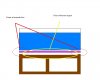
In this picture, you can see that the lengthwise board was positioned below that of the widthwise boards. This will create an uneven support across the front of the tank. The main force of the tank will be supported by the corners in which the foam will compress under the load of the tank. Yes, there will be compression on the lengthwise portion of the tank/foam, but the compression will not be as much because the force will not be as high. This is due to the corners holding more of the load. The faom in the center will not compress as much because the load on the foam in this area is not as high. Just because the foam in the center has not compressed as much as the sides does not prove that the tank is truly more supported than before. You might be looking at a tiny bit more support due to the foam's resistance to compression, but not much.

I also just thought of one more pic to draw. I will post it shortly.

Thoughts?

FOAM3.JPG
 
I express to everyone that my pictures are more than likely blown out of proportion just to make the point obvious. Obvioulsy, 1" difference fro end-to-end will not hurt a tank. The issue is, whether the styro does anything to help or correct the situation, which it seems it does not.

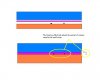
The last picture that I will post for now will give one example of the usefulness of styro. Once again, blown up for imagination purposes. With minor imperfections, the sheer weight of the tank would cause the styro to compress around the pebble in lieu of sitting directly on it. Although as shown, this would swork part of the time and not work the other part. It would all depend on the size of the pebble/imperfection. Minor flaws can be somewhat covered by styro, butnot to the extent to which most would believe.

FOAM4.JPG
 
MonsterFishKeepers.com