Urgent Help needed for RTC - Bloated belly, won't eat, black worms in filter media

  • We are currently upgrading MFK. thanks! -neo

jaytech33

Feeder Fish
MFK Member
Jan 10, 2008
186
0
0
51
Northern NJ
Hello All,

I am in desperate need of help. My RTC has not eaten in over 12 days. His belly is bloated, he won't eat. The LFS sold me some medicated frozen food but he refuses to eat it.

I noticed tonight that there are small black worms (2-3 cm) in the filter floss. 99% are dead,but after staring for a while I saw one move which made me realize they are worms and not little poop.

He's 3 years old, always healthy, raw shrimp is his staple diet. Water parameters are perfect, and yes he's in a large 2000g tank/pond

Since he won't eat, what should I do? At first I thought he was just constipated but now that I see the worms I think he has an internal parasite??? I have no idea what the exact problem/disease is and what medication I need to save him.

We love this guy and don'y want to see him die!!!!!!

Thanks
Jay

 
Could the worms be some innocuous insect larva or the type of black worms that live in the substrate and are a good food for fish?

12 days is nothing. Don't worry about that much. Bloat is worrisome. If I had to guess, I'd say your fish could be deprived of vitamin B1. Shrimp is loaded with thiaminase (the enzyme that decomposes thiamine = vitamin B1) and when one uses it as a staple, it needs to be balanced by, e.g., a vitamin soak (like Vita-Chem) or by foods containing B1. Thiaminase is decomposed in cooked shrimp by heat.

Epson salt bath (short-term, high concentration or long term low concentration/in-tank) is one common remedy for a bloat as well as many/most internal parasites. Praziquantel is an excellent de-wormer. Metronidazole is another one. A combination of both is quite powerful. Both can be administered via food or via the tank water/bath.
 
Have you tested your water? Do you have numbers on ammonia, nitrites, nitrates and Ph? How big is this fish, is and epsom salt bath pratcial? 1 tablespoon per gallon is the recomended dosage for a bath, this is short term and can be done in a large plastic rubbermaid container if the fish is big. The fish should be placed in the container filled with tank water and disolved epsom salt leave the fish 15-20 mins and then remove to the main tank. The fish should be monitored during the bath and if it shows any signs of stress remove it immediatly. Another option is a longer term soak of 1 tablespoon per 10 gallons of water added to the tank itself, fish can stay in this concentration for up to 24 hours then a 50% water change is required.

I would clean the filter in tank water and do a 25% water change while vacuming as much of the substrate as possibile. If the fish passes the blockage or IPs which ever the case may be I would also treat the tank for IPs since it's not eating this is your only option unless you soak some food and force feed it using API general cure (metro/prazi combination) or at least Praziquantel as mentioned above as it is very mild but effective. As for the diet I agree shrimp alone is not a great diet and should be at least be stuffed with a high qualty pellet and eventually converted to a high quality pellet diet as the staple and then fed with shrimp as an occasional treat if you want.

Edit: I see you are in NJ if you need help with this and if your not to far north maybe I can take a ride up and do this with you if you need a hand. I hate to see a member loose a great fish like this. I can come up tomarrow after work if you're within a reasonable distance. I'm in South Brunswick.
 
Have you tested your water? Do you have numbers on ammonia, nitrites, nitrates and Ph? How big is this fish, is and epsom salt bath pratcial? 1 tablespoon per gallon is the recomended dosage for a bath, this is short term and can be done in a large plastic rubbermaid container if the fish is big. The fish should be placed in the container filled with tank water and disolved epsom salt leave the fish 15-20 mins and then remove to the main tank. The fish should be monitored during the bath and if it shows any signs of stress remove it immediatly. Another option is a longer term soak of 1 tablespoon per 10 gallons of water added to the tank itself, fish can stay in this concentration for up to 24 hours then a 50% water change is required.

I would clean the filter in tank water and do a 25% water change while vacuming as much of the substrate as possibile. If the fish passes the blockage or IPs which ever the case may be I would also treat the tank for IPs since it's not eating this is your only option unless you soak some food and force feed it using API general cure (metro/prazi combination) or at least Praziquantel as mentioned above as it is very mild but effective. As for the diet I agree shrimp alone is not a great diet and should be at least be stuffed with a high qualty pellet and eventually converted to a high quality pellet diet as the staple and then fed with shrimp as an occasional treat if you want.

Edit: I see you are in NJ if you need help with this and if your not to far north maybe I can take a ride up and do this with you if you need a hand. I hate to see a member loose a great fish like this. I can come up tomarrow after work if you're within a reasonable distance. I'm in South Brunswick.

You're awesome.

Sent from my SCH-M828C using MonsterAquariaNetwork App
 
Thanks for the informative reply's everyone. The water parameters are as follows: Ammonia 0, Nitrite 0, Nitrate 80, ph 7. Temps are 78-80 degrees. There is no substrate, it's a bare bottom pond. The RTC is around the 30" mark.

I noticed the (what I now know are worms) in the filter floss a few months ago, but in very small amounts. I just assumed that he was getting older and now he was passing little black feces. Three days ago I took the filter floss out of the filter and rinsed it out. Now it is covered in worms again. Like I mentioned in the previous post I now know they are some type of worm/parasite because I watched closely last night and saw one moving on it's own.

I'm going to drain as much water as possible tonight, refill with 25-50% normal water level and try a de-wormer. I'm going to do some research today but can anyone tell me if all of these de-wormers kill the benifical bacteria in the filter?

@Aquanero... Thanks for the offer, I'll give it another shot and see if he improves in a few days. If not, maybe 2 heads are better than one :) I'm in Clifton, Passaic County. I'd venture to say a 45 min drive from you.
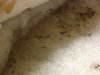
I'll post some pictures tonight of the RTC and what I see in the filter media. Maybe that will give a better indication of what is going on.
 
The parasite meds will not harm your BB. Clifton's not too far if you need help let me know, I'll come up.


Edit: Nitrates at 80ppm are on the high side this will cause low level stress and contribute to compromising the immine system over extended exposure. This leads to issues where the fish is less able to cope with infection or fight IPs, etc. Do more frequent water changes to keep the nitrates down around or below the 20ppm level. Test your tap water so you can get a base line and let the numbers dictate the frequency and amout of water to change.
 
You're awesome.

Sent from my SCH-M828C using MonsterAquariaNetwork App

Thanks, I'll have to show this to my kids they're not always convinced. ;)
 
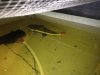
So I just got home with a big bottle of Prazipro. I'm doing a huge water change now. In the pictures you can see what the worms look like in the filter and a picture of the RTC(he's being a bit camera shy right now)
Thanks again for all the advise, I hope this works...


Sent from my iPhone using MonsterAquariaNetwork app

ImageUploadedByMonsterAquariaNetwork1378415858.740283.jpg

ImageUploadedByMonsterAquariaNetwork1378415919.809697.jpg
 
MonsterFishKeepers.com