What I have learned.

  • We are currently upgrading MFK. thanks! -neo

FINWIN

Alligator Gar
MFK Member
Dec 21, 2018
5,920
9,329
188
Washington DC
Following the aftermath of Brick I continued to do research. Before I get to that a few notes:

Boss the bp was affected. He refused to come out of his hide for nearly 2 days, only leaving to eat once. He has since returned to normal.

The other fish in the fishroom stayed in the far corner of their tanks for about a day. They also have returned to normal.

Syno catfish Spot is unaffected by all appearances. The hrps came out cautiously into the open, inspected the tank then returned to their areas. They are in normal mode now.

I've rescaped the tank which looks weirdly empty now especially with all the fish staying in their hides most of the day. Boss comes out and patrols. Any squabbles he crushes. His animosity to hrp Tank is at the point where I'll be moving him (and later Hulk) to the 125. The parrot body slams the big hrp and keeps him pinned in specific areas. Tank retaliates only to get banged around.

The parrot's bond with smaller hrp Buddy is stronger. Boss and rainbow Salt have always been simpatico. No issues there. They've become the three musketeers.

Hrp hive Queen Pip is a mature female now with no apparent interest in breeding or play. She keeps to herself for the most part, coming out on occasion to scope out things. If one of her large sons annoys her by pressing close she shakes and flares. If they persist she charges them head on. Daughter Bella is a non factor and stays on the other side for the most part.

Boss tolerates Hulk. They don't knock heads too much. However, the huge brothers will face off at times (Hulk, Tank). Boss establishes order. Once things cool down he goes into his log.

The babies from hrp Mica will be donated, along with the fry from Blackbeard and Brutus. Blackbeard, Neet and Ace will eventually go in the 125. I will keep a male or two from each group.

After seeing enough online pictures of oscars with lumps, I did more digging to find out what the hell is going on. From what I've found Brick most likely died from kidney failure. More astounding to discover that it is COMMON in oscars dating back to fish caught and examined in 1996.

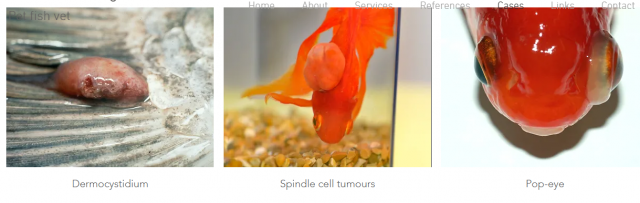
There is an excellent website with x-ray images, pictures and scientific data collected. Here it is: Kidney tumours in oscars | WHWildgoose fish vet hit the link for the paper excerpt

There is a whole library of images, papers and disease information on many types of fish. From the homepage. I'm sharing this in the hope that it will help fishkeepers in the future. All I know is I'm damn sick of learning stuff after some of my best fish die. Later I will post about future plans for the 225 and yes, it includes another oscar.

1710981704492.png

1710981771492.png
1710981866251.png
1710981925420.png
1710982071641.png
1710982131623.png
 
Impressive research and a good find with this article. Of course, I read it primarily to see if they identified a cause. Although MNNG, Formalin and malachite green were cited as being a chemical induced cause of these kidney problems in trout and other species, it seems like the opinion of the authors is that Oscars may have a genetic predisposition to this condition. Not what I hoped to hear, since that essentially means there isn't anything that can be done to prevent it.
 
Oscars may have a genetic predisposition to this condition. Not what I hoped to hear, since that essentially means there isn't anything that can be done to prevent it.

You may be right but I think there may be cause to wonder. An example of genetic predisposition would be Silver Arowana and drop eye. Yeah... it's a genetic predisposition fault knowingly reproduced by Asian Arowana breeders that care more about harvesting prolific pairs than about the health of the fish they sell. Ever seen a Black Arowana w/ the same condition? Nooop. That's because the Asian breeders haven't botched them yet.

Can't help but wonder if wild stock is genetically more robust and the heavily color bred variants are where the problem resides. Or more accurately, the problem may be an anomaly associated w/ Oscars bred for color.
 
You may be right but I think there may be cause to wonder. An example of genetic predisposition would be Silver Arowana and drop eye. Yeah... it's a genetic predisposition fault knowingly reproduced by Asian Arowana breeders that care more about harvesting prolific pairs than about the health of the fish they sell. Ever seen a Black Arowana w/ the same condition? Nooop. That's because the Asian breeders haven't botched them yet.

Can't help but wonder if wild stock is genetically more robust and the heavily color bred variants are where the problem resides. Or more accurately, the problem may be an anomaly associated w/ Oscars bred for color.

The fish were wild caught in 1996 through the 2000s so line breeding wasn't a factor. Sometimes there are naturally occuring genetic factors that create problems. And because the disposition never shows up in juvies there's no way to know if your oscar has that in its ancestry. It strikes fast, suddenly, and has a 100 percent mortality rate. Almost like a genetic ticking time bomb. Some get hit at 2, some in the 3-6 range. So from young adulthood to full prime maturity.

Even if accounting for current line bred strains it still doesn't really explain why. The fish aren't prone to any other specific diseases nor are they frail. A vet could diagnose but not operate because of location even in the early stages.

I would tell oscar keepers to give them great care and hope that predisposition is not in their lineage. But genetics isn't so simple...in a batch of sibling fish some won't get it, some will be carriers of the trait and some will succumb. Didn't Ulu Ulu lose his oscar suddenly? He was a little older than Brick but still prime.
 
Cancer/tumours in fish, is comparable to humans as far as attempting to guess the cause. Many wild fish succumb to the same types of tumours, as fish found in captivity.
 
  • Like
Reactions: FINWIN and jjohnwm
Can't help but wonder if wild stock is genetically more robust and the heavily color bred variants are where the problem resides. Or more accurately, the problem may be an anomaly associated w/ Oscars bred for color.

I think this is very likely. New genetic information can't be created. Selective breeding must work with the DNA that is already present and results in less, not more, genetic information as recessive traits are selected for. This allows faults to express themselves. Look at dogs, heavy selective breeding over so many years. Think of all the breeds that have a weakness associated with them,
- Burnese Mt. Dog - short lifespan, cancer​
- Weimaraner - blood clotting problems, hip dysplasia, spinal problems​
- Cocker Spaniel - glaucoma, patellar luxation, chronic hepatitis, intervertebral disc disease​
- Doberman - cancer, gastric torsion, hip dysplasia, hepatitis​
- Toy Poodles - bladder stones (Cushings disease) and skin cancer​
- Goldendoodle - heart condition called Subvalvular Aortic Stenosis​
The list could go on.
 
Yep, people and animals get cancer all the time, and we pretend that we "know" in many cases what caused it or contributed to it. And we talk about cancer in animals that are living in a wild state in nature, but "nature" today isn't what it once was. Human activity over the past century or two has affected the planet not only in terms of weather, but also by adding significant amounts of numerous non-naturally-occurring chemicals and substances into the Earth's biosphere. Nobody can possibly state with certainty what caused this or that cancer, or how much the occurence of that cancer has increased in the past century or two.

And don't forget that evolution works to create animals that survive in their environment and continue to reproduce and perpetuate the bloodline. As long as they survive to sexual maturity and spawn/breed successfully enough to maintain the population...there's no particular evolutionary benefit to the species for individuals to live long afterwards. If every Oscar ever hatched died of this or that cancer or other genetic predisposition to some other disease...well, it's not fun for fishkeepers, or likely for the fish themselves, but as long as they lived long enough to reproduce, the species is still "successful" in an evolutionary sense. Mother Nature is not soft of heart.

Just look at the numerous insect species that may take years as larvae to grow and mature...and then die within a few weeks or days after achieving maturity. Breed...and then, having done their duty to the species, quickly die.
 
….It strikes fast, suddenly, and has a 100 percent mortality rate. Almost like a genetic ticking time bomb....in a batch of sibling fish some won't get it, some will be carriers of the trait and some will succumb. Didn't Ulu Ulu lose his oscar suddenly? He was a little older than Brick but still prime.

Yes, Felix was six years old. He was recovered from his cauliflower lesions and seem to be healthy and happy, and eating regularly for several months.

But for no apparent reason he quit eating. No bloating ot pinecone scales. No spinning or floating upside down or anything weird like that. He just laid down in the corner of his tank. *sniff* It still hurts.

So I bought 3 new ones, (different pet store) but they are strictly cheap commercial fish.

Still, I may have gotten lucky. One appears to be a dwarf or a runt, while two appear to be a strong, healthy breeding pair. Still juveniles of perhaps 6 mos, yet they are loving each other up already.
322B2E9B-067C-4FCE-AC9E-C0DDA7513359.jpeg

Baby Bear is the dwarf, and I had to move him outside so the other fish wouldn’t eat him.
DD72ECC6-ABC7-410A-B653-F4CB0C3D0B5B.jpeg
 
  • Like
Reactions: FINWIN and jjohnwm
My Yellow Lab in the 240g system was removed after growing a small tumor. It doesn’t show in this photograph.
583B1611-E49A-4592-8105-029FFA38A02C.jpeg
It eventually grew to this huge mass before he died.
C142A00C-C378-411B-99D7-AB005EF22BA3.jpeg
 
  • Sad
Reactions: FINWIN
….Just look at the numerous insect species that may take years as larvae to grow and mature...and then die within a few weeks or days after achieving maturity. Breed...and then, having done their duty to the species, quickly die.

Imagine if humans were like that. Juveniles until 65 or 70, then one year we suddenly get old, mate, deliver, and die.
 
  • Like
  • Haha
Reactions: FINWIN and jjohnwm
MonsterFishKeepers.com