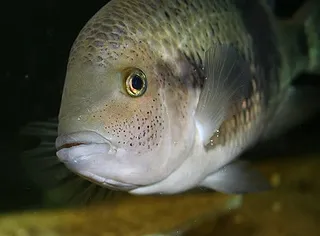
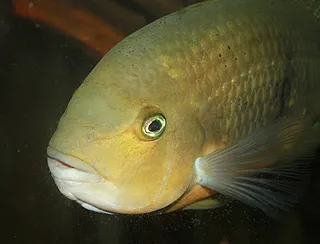
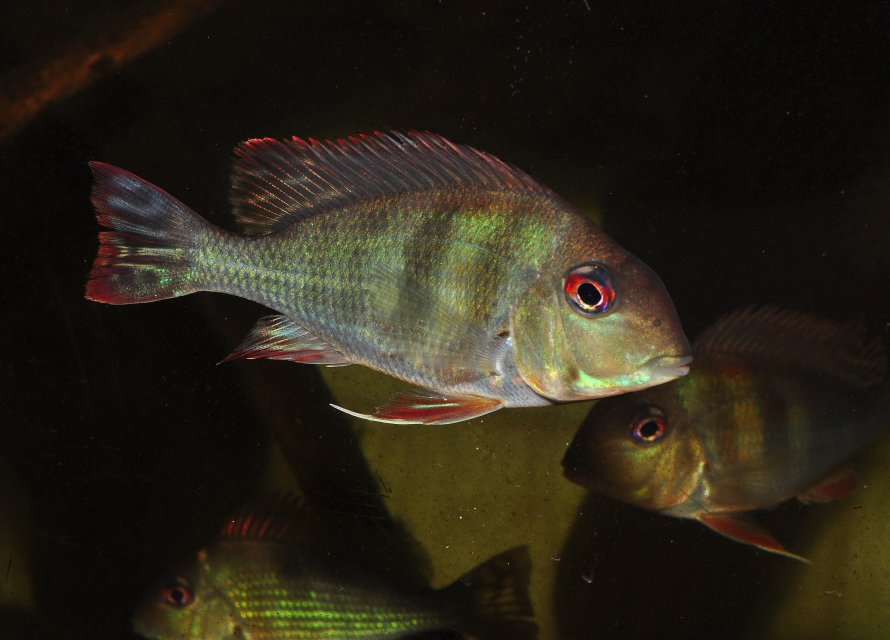
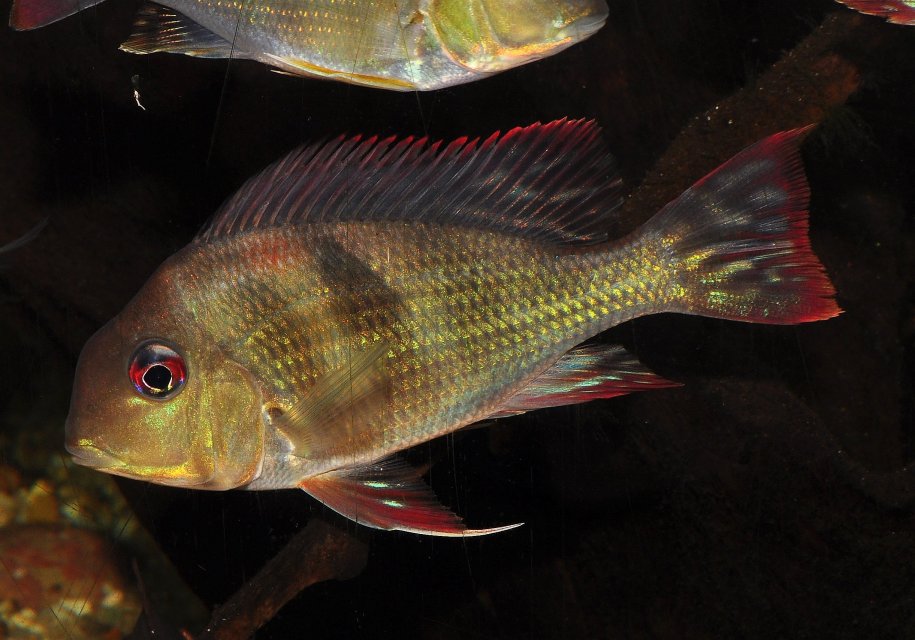
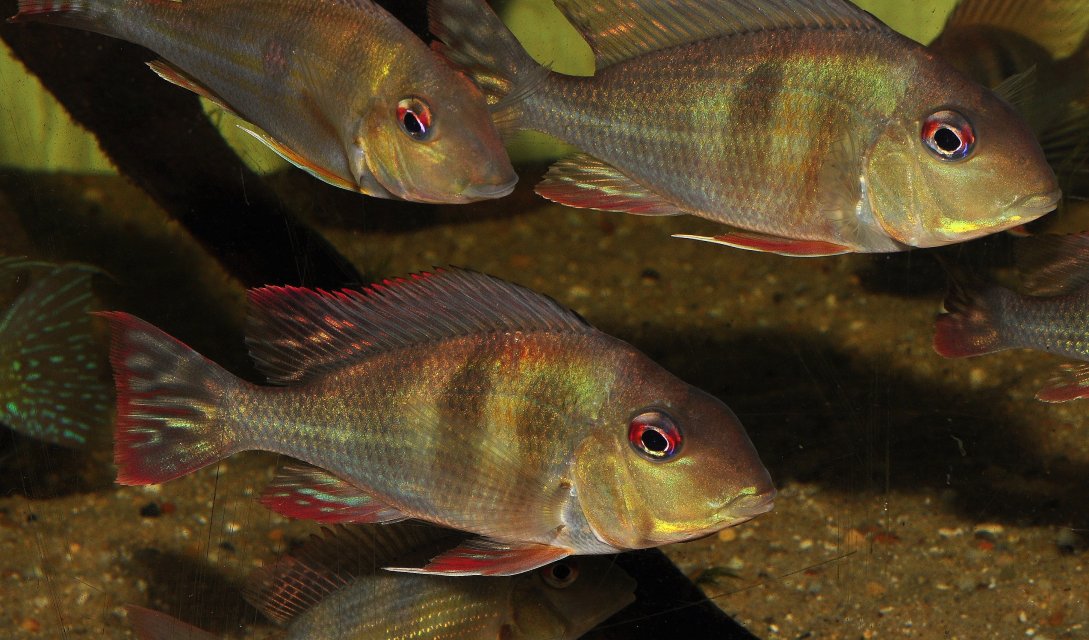
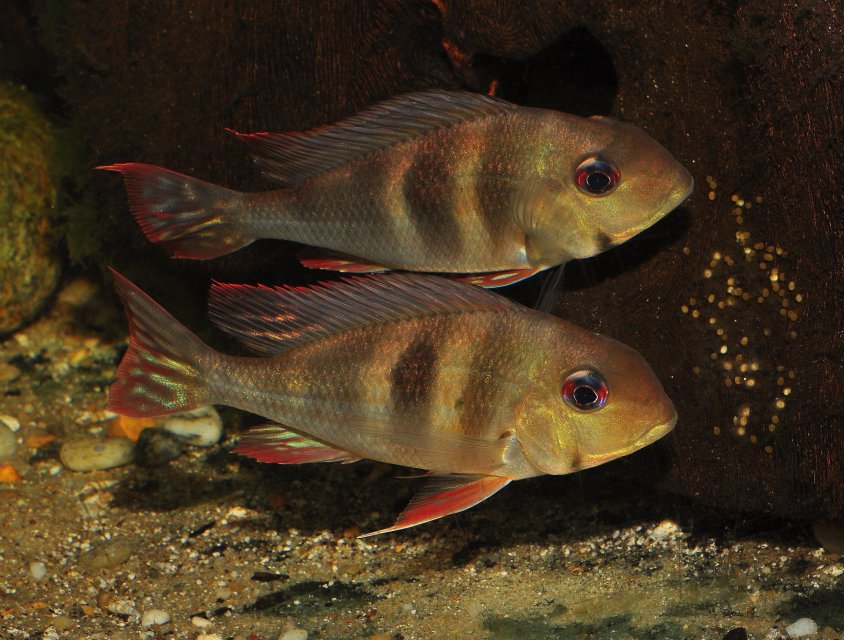
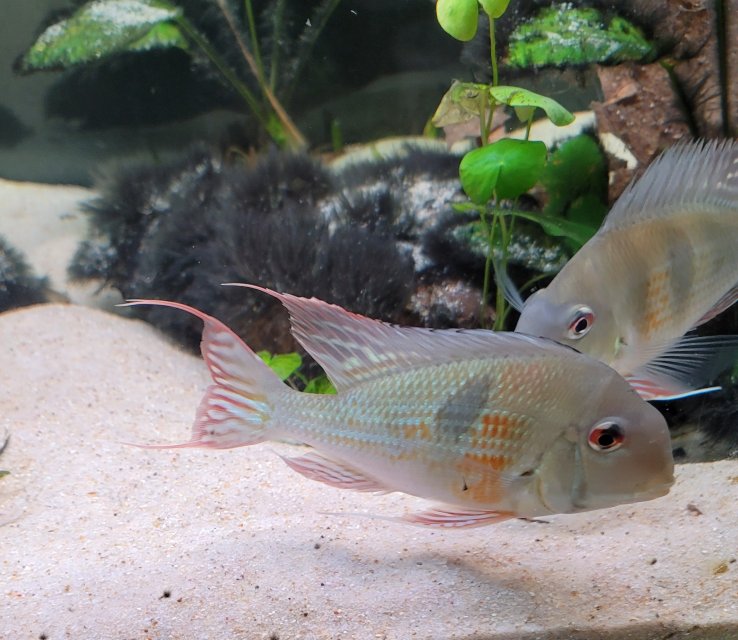
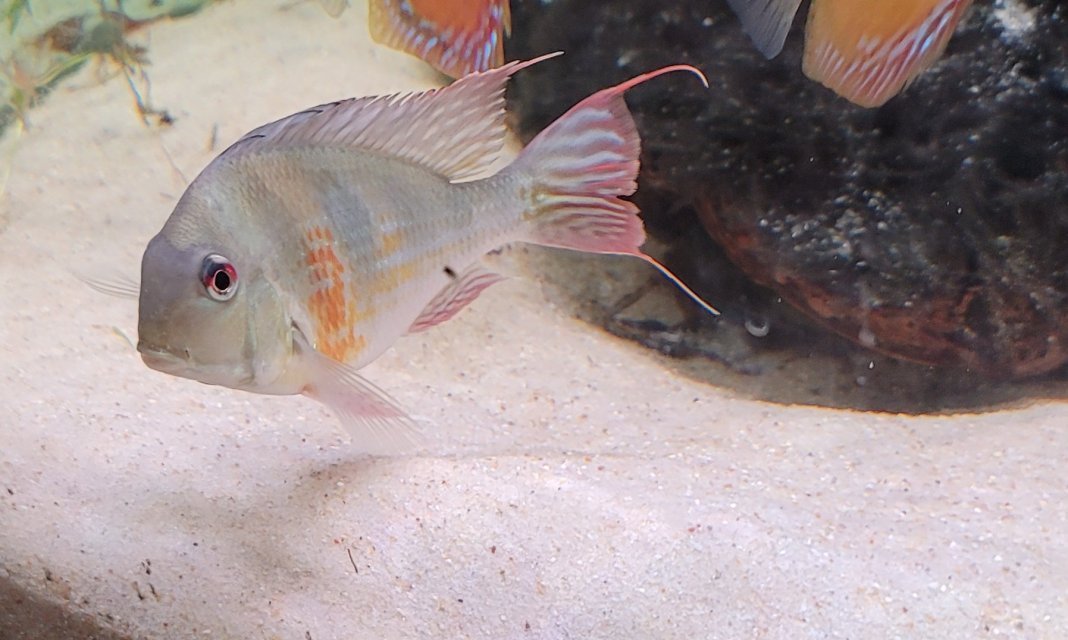
What kind of geophagus is this ?

  • We are currently upgrading MFK. thanks! -neo

jake37

Polypterus
MFK Member
Mar 6, 2021
475
377
87
Wetspot is selling a fish they received from the Caqueta region of Colombia under the name cf winemilleri:
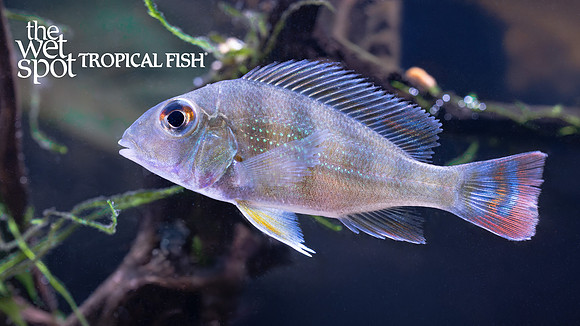

They have a 5th stripe at the base of the tail unlike winemilleri; the other thing (and more to my concern) the region they come from has cooler temperature - i'm presuming perhaps incorrectly that this fish prefer 75-76 degree water which is 5 or so degree less for winemilleri and who knows what size they grow to....

 
Does Wetspot have anything more on catch location? I'd expect cooler native temperatures only if it's from the upper Caqueta-Japura river, not the middle or lower sections. There's a Geophagus sp caqueta-- not that fish, which has different barring-- with typical recommended geo temperatures of 75-82. So even if this fish did come from slightly cooler water than most 'suriname type' geos, I'd expect staying in the 70s would be safe. I generally keep mine under 80, anyway, but during hot spells in the summer they can get about 84 and winter nights down to about 74 (back to upper 70s during the day), none of it a problem for geos I've kept-- I haven't personally found that fish need dead-on, unvarying temperatures, which is unlikely in most wild habitats.

As a potentially new or uncommon type I'd be pretty tempted, but at the moment I have other plans.
 
The use of cf. in a scientific name means that the person using the name is saying the fish should be compared to a given species, as it might not be exactly the same species.
Great info. I have seen “cf” numerous times over the years and wondered what it meant 🤗🤙🏼
 
Does Wetspot have anything more on catch location? I'd expect cooler native temperatures only if it's from the upper Caqueta-Japura river, not the middle or lower sections. There's a Geophagus sp caqueta-- not that fish, which has different barring-- with typical recommended geo temperatures of 75-82. So even if this fish did come from slightly cooler water than most 'suriname type' geos, I'd expect staying in the 70s would be safe. I generally keep mine under 80, anyway, but during hot spells in the summer they can get about 84 and winter nights down to about 74 (back to upper 70s during the day), none of it a problem for geos I've kept-- I haven't personally found that fish need dead-on, unvarying temperatures, which is unlikely in most wild habitats.

As a potentially new or uncommon type I'd be pretty tempted, but at the moment I have other plans.
Bit late to reply - they had no addiitonal information and i did ask; someone said the river in question likely is in the 82-84 range so i put them in the discus aquarium which i keep between 82 and 84 (it has ph 4.9 and ec 19); i know they kept them in their warehouse at 72 (they told me that) so maybe the fish is quite flexible or maybe 72 was ok for a short period of time. I ended up with 6 and they are around 2 inches in length. They behave somewhat similar to my other geo in that they are active and have no problem running up to my fingers to eat when i feed them (i.e, they show no fear). One slight difference is they like to group up though that might be an age thing - my other geo were never much into forming packs.

So i still have an open question of what would be a good temperature and perhaps they aren't that sensitive. I'll see how they grow out - my guess is it will take 2 years for them to reach full size IF they are of similar size of other geo in the genus (8 to 12 inches).

As for the name they chose (cf winemilleri); they had posted a picture on their facebook page and a geo expert contact them and note they were clearly not winemilleri having a 5th stripe but were likely very simlar. They had not ordered this fish but another known as geo cf Caqueta which has a clearly different pattern of stripes.

What amuses me is after all this time how many new fishes are constantly being found not just in geo but dwarf cichild which i spend more time with - of course the sad thing is the huge number going extinct as brazil continues to clear land.
 
Its interesting how small variations in color can be deceiving.
All it takes are a stripe here or there to bring on the "cf" designation (confer to).
Yet some scientific examiniation reveals just the opposite.
Take Vieja synspinlum and melanurus once thought to be different species, now they both are melanurus.
1756996289466.png1756996555652.png
Both the above are Chuco interneium, but each from a different river, yet only a few miles apart..
I am running a similar scenario collecting the Rio Uni, compared to rivers only a few miles away.
Thread a few topics down.
 
  • Like
Reactions: jake37
Its interesting how small variations in color can be deceiving.
All it takes are a stripe here or there to bring on the "cf" designation (confer to).
Yet some scientific examiniation reveals just the opposite.
Take Vieja synspinlum and melanurus once thought to be different species, now they both are melanurus.
View attachment 1566289View attachment 1566290
Both the above are Chuco interneium, but each from a different river, yet only a few miles apart..
I am running a similar scenario collecting the Rio Uni, compared to rivers only a few miles away.
Thread a few topics down.
Hey if you are down i columbia or peru collecting fishes i'd love it if you could get me some a. lineta or d37 indria ;) Or better a. d52....

But yea - i think at one point all the large geo (winemilleri, abilos, ...) were thought to be the same fish with variation and genetic testing prove otherwise. In the case of the fish i purchased it could be very close or very far from that group - for one thing the people making the guess are looking at a 2 inch fish which might change quite a bit as it matures so in that sense it really is an unknown.
 
Wetspot is selling a fish they received from the Caqueta region of Colombia under the name cf winemilleri:


They have a 5th stripe at the base of the tail unlike winemilleri; the other thing (and more to my concern) the region they come from has cooler temperature - i'm presuming perhaps incorrectly that this fish prefer 75-76 degree water which is 5 or so degree less for winemilleri and who knows what size they grow to....
Hi,
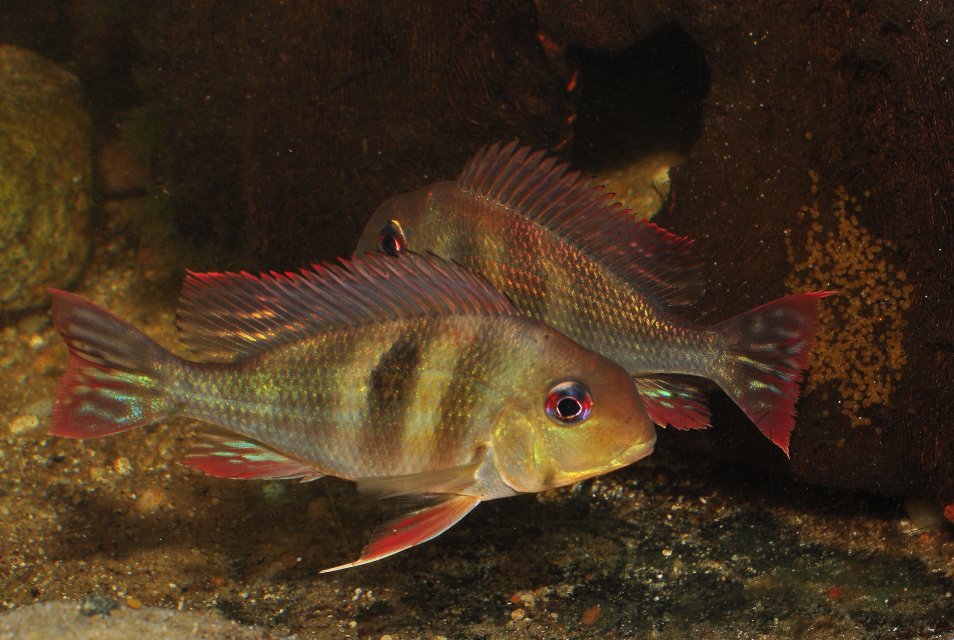
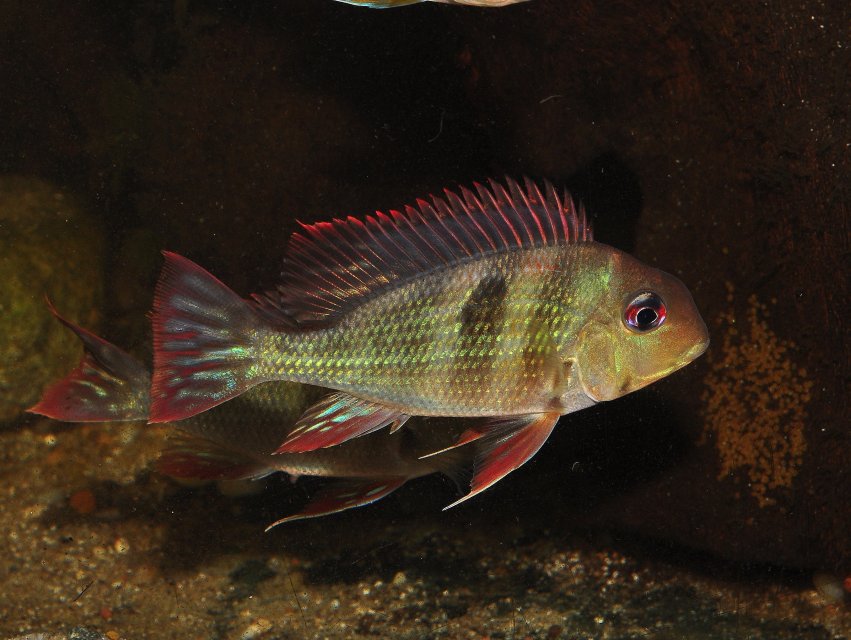
that species has also been imported to germany too, under the trade name G. spec Caqueta by Glaser and sold by Aquahaus Gaus. I got 8 from there and it turned out that they are a very interesting, new species. I call them G. spec Caqueta II, since they are clearly different from G. spec Caqueta.

At first glance, they resemble G. proximus (Castelnau, 1855) and G. winemilleri (Lopez-Fernandez, 2004). However, they cannot belong to either of these two species because G. winemilleri has a much smaller lateral spot below the lateral line organ (in G. spec. Caqueta, this very large spot is halved by the lateral line); G. proximus is an ovophilic mouthbrooder, as proven by numerous observations of animals from various locations (Ucayali, Peru; Lago Tefe, Rio Negro, Santarem, Brazil). As of today, photos and videos prove that G. spec. Caqueta II is a larvophilic mouthbrooder.
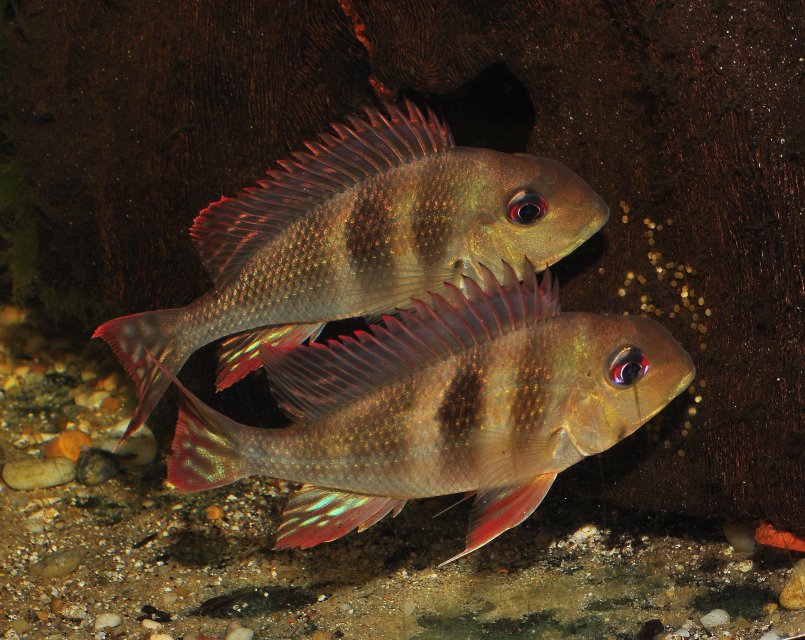
As can be seen in the photos, in addition to the very large lateral spot, striped caudal fin and a clearly pronounced preopercular stripe, this species also has a band pattern that I have not yet observed in any other Geophagus: the front two bands are extremely wide and end well below the dorsal fin and above the ventral line.

The pair shown here has laid a relatively large clutch of eggs, considering the size of the young fish (approx. 9-10 cm), on a piece of wood standing vertically. The eggs are amber-coloured and most of them were fertilised. After approx. 50 hours at a water temperature of 27 °C (15 °GH, 11 °KH, pH 7.6, 550 microS/cm), both parents freed the larvae from the egg's chorion that remained on the substrate and took them into their mouths. This is the first brood for this pair and it remains to be seen whether the larvae will make it to free swimming or whether the parents will eat them first or lose them to other fish in the aquarium. Fingers crossed... :)

The first 3 photos show G. spec Caqueta II in normal coloration, 4-7 show them while breeding. I keep 8 wc G. spec Caqueta and 8 wc G. spec. Caqueta II, 6 G. spec. Araca F1 and a pair of G. spec. Panta Rhei in a grow out tank of about 600 L.

Caq_II_normal.jpg

caq_II_5.jpg

caq_II_6.jpg

caqbrood_1.jpg

caqbrood_3.jpg

caqbrood_6.jpg

caqbrood_8.jpg
 
Hi,
that species has also been imported to germany too, under the trade name G. spec Caqueta by Glaser and sold by Aquahaus Gaus. I got 8 from there and it turned out that they are a very interesting, new species. I call them G. spec Caqueta II, since they are clearly different from G. spec Caqueta.

At first glance, they resemble G. proximus (Castelnau, 1855) and G. winemilleri (Lopez-Fernandez, 2004). However, they cannot belong to either of these two species because G. winemilleri has a much smaller lateral spot below the lateral line organ (in G. spec. Caqueta, this very large spot is halved by the lateral line); G. proximus is an ovophilic mouthbrooder, as proven by numerous observations of animals from various locations (Ucayali, Peru; Lago Tefe, Rio Negro, Santarem, Brazil). As of today, photos and videos prove that G. spec. Caqueta II is a larvophilic mouthbrooder.
As can be seen in the photos, in addition to the very large lateral spot, striped caudal fin and a clearly pronounced preopercular stripe, this species also has a band pattern that I have not yet observed in any other Geophagus: the front two bands are extremely wide and end well below the dorsal fin and above the ventral line.

The pair shown here has laid a relatively large clutch of eggs, considering the size of the young fish (approx. 9-10 cm), on a piece of wood standing vertically. The eggs are amber-coloured and most of them were fertilised. After approx. 50 hours at a water temperature of 27 °C (15 °GH, 11 °KH, pH 7.6, 550 microS/cm), both parents freed the larvae from the egg's chorion that remained on the substrate and took them into their mouths. This is the first brood for this pair and it remains to be seen whether the larvae will make it to free swimming or whether the parents will eat them first or lose them to other fish in the aquarium. Fingers crossed... :)

The first 3 photos show G. spec Caqueta II in normal coloration, 4-7 show them while breeding. I keep 8 wc G. spec Caqueta and 8 wc G. spec. Caqueta II, 6 G. spec. Araca F1 and a pair of G. spec. Panta Rhei in a grow out tank of about 600 L.

View attachment 1573863

View attachment 1573864

View attachment 1573865

View attachment 1573866

View attachment 1573867

View attachment 1573868

View attachment 1573869
I'm not sure - the ones i have look very different then your posted pictures - i posted these in the geo thread about 2 weeks ago - and even with the lighting difference and possibly age difference they look unlike yours - mine are currently 4 1/2 to nearly 6 inches large with one distinctly larger - i presume they have another year to grow till they reach maturity. I keep them at 83 ec 22-24 and ph 4.7 (blackwater condition - the higher temp is because they are with my wc discus) - here are some pictures for comparison:
ga4.jpgga5.jpg

First even at this young age they have developed much longer filaments which your lack; the red splotches in the body is a bit of unknown long term - wetspot thinks it is an age thing that will change but i'm not sure; and the stirpe pattern looks more exensive though that might be due to lighting. Still even the dorsal fins are showing long filament which your fish lacks
 
I'm not sure - the ones i have look very different then your posted pictures - i posted these in the geo thread about 2 weeks ago - and even with the lighting difference and possibly age difference they look unlike yours - mine are currently 4 1/2 to nearly 6 inches large with one distinctly larger - i presume they have another year to grow till they reach maturity. I keep them at 83 ec 22-24 and ph 4.7 (blackwater condition - the higher temp is because they are with my wc discus) - here are some pictures for comparison:
View attachment 1573904View attachment 1573905

First even at this young age they have developed much longer filaments which your lack; the red splotches in the body is a bit of unknown long term - wetspot thinks it is an age thing that will change but i'm not sure; and the stirpe pattern looks more exensive though that might be due to lighting. Still even the dorsal fins are showing long filament which your fish lacks

btw - you mentioned another G. spec Caqueta in your original post - I assume you mean this Geophagus species? They share the tank with G. spec Caqueta II :))

38e59b8e-3f71-4d3d-88af-6830bf37c0db.jpeg

0f3f0a90-0ed9-4efd-9cf1-9e487c4eb204.jpeg

890d94ce-de36-41f7-90ed-630d6f784966.jpeg

fa6c3b69-b4ec-4100-93a3-9751636f10a5.jpeg
 
MonsterFishKeepers.com