What's the difference between Nandopsis dovii &. Parachromis Dovii?

  • We are currently upgrading MFK. thanks! -neo
The advancement of DNA testing in the last 10 years, is probably going to turn a lot of traditional thought about species upside down.
Back 20 or even 10 years ago, deferent species were determined by the differences of the shape of teeth, or certain scale placement, among other things, whereas DNA shows much more subtle, and in depth differences and similarities.
Take the now defunct name (Vieja) synspilum, it was thought because of outward appearance that it was a separate species from Vieja melanura, but DNA sequencing shows they are actually one and the same species (just color variants).
So the species name synsilum was dropped because it was described in the early 1900s, whereas the name melenura preceded it in the late 1800s. The accepted scientific rule is....name of earliest (first) description takes precedence.
 
[...]
So the species name synsilum was dropped because it was described in the early 1900s, whereas the name melenura preceded it in the late 1800s. The accepted scientific rule is....name of earliest (first) description takes precedence.
To be correct it was described as "melanurus". Melanurus is an undeclinable noun. So it cannot be changed to melanura. It stays as melanurus no matter what the genus is.
 
  • Like
Reactions: Toiletcar
Not from my search. All I can find is forums suggesting it’s multifasciatus. I couldn’t even find anything suggesting they are synonyms, which is what I originally thought..
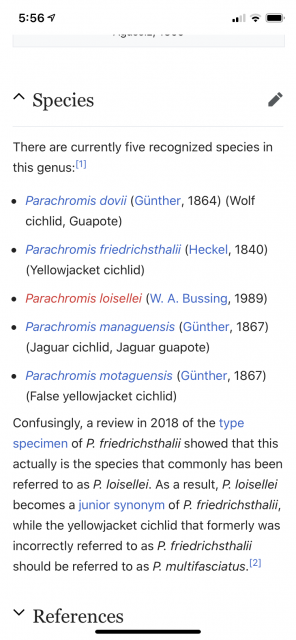
My understanding of the paper is Parachromis friedrichsthalii are from the southern end of central America and what used to be p loisellei a variant of that.
Parachromis multifasciatus from Mexico and part of Guatemala is now a separate species. So you still have two distinct species, multifasciatus and friedrichsthalii.
 
My understanding of the paper is Parachromis friedrichsthalii are from the southern end of central America and what used to be p loisellei a variant of that.
Parachromis multifasciatus from Mexico and part of Guatemala is now a separate species. So you still have two distinct species, multifasciatus and friedrichsthalii.

This is where it gets confusing, not listed as a distinct species, but says it should..

3CC61363-B910-49AD-B099-30359E1DAF4A.png
 
  • Like
Reactions: Rid_Ether
It will take some time.
It is listed in the CAS which is normally enough for me.

multifasciatum, Cichlosoma Regan [C. T.] 1905:335 [Annals and Magazine of Natural History (Series 7) v. 16 (nos 91-94); ref. 3622] Lake Petén [Lago Petén Itzá], Guatemala. Syntypes: BMNH 1864.1.26.65-66 (2). Additional material: BMNH 1890.9.8.12 (1). Original genus should have been Cichlasoma. •Synonym of Cichlasoma friedrichsthalii (Heckel 1840) -- (Conkel 1993:118 [ref. 22949]). •Synonym of Parachromis friedrichsthalii (Heckel 1840) -- (Kullander in Reis et al. 2003:640 [ref. 27061]). •Valid as Parachromis multifasciatus (Regan 1905) -- (Morgenstern 2018:259 [ref. 36331]). Current status: Valid as Parachromis multifasciatus (Regan 1905). Cichlidae: Cichlinae. Distribution: Atlantic drainages of Central America: southern Mexico, Guatemala and Belize. Habitat: freshwater.
 
  • Like
Reactions: dan518
MonsterFishKeepers.com