

wood not straight
- Thread starter bathawk
- Start date
You are using an out of date browser. It may not display this or other websites correctly.
You should upgrade or use an alternative browser.
You should upgrade or use an alternative browser.




Well, if you actually got perfectly straight planks and boards...congrats, you are the first person ever to do so!  But really, what little can be seen in those pics seems to look like pretty nice lumber.
Wood is a natural material, each and every piece is unique with its own internal grain structure, and all of it wants to warp. The best you can do is take pains to choose wood carefully at the lumber yard. You won't be making any friends by doing this, but personally inspect each piece, sighting down the length of it to check for straightness in both dimensions. Also watch out for pieces that are twisting along their length. The dryer the better.
When building the stand, use wood glue and screws, and always clamp the pieces together to ensure perfect alignment (the clamp in your picture is the perfect type). You can also get a specialized clamp that makes perfect corners easier to achieve.
Also, the fact that you are using a mitre saw is a plus, but that doesn't guarantee that your cuts are perfect and square. If the saw is adjusted even slightly off 90 degrees then it will produce identically imperfect cuts all day long. And an inexpensive saw can have a notoriously unreliable and inaccurate gauge indicating the exact angle of the cuts. Since you are essentially looking for nothing but perfect 90 degree cuts, check one with an accurate T-square to make sure that's what you are getting. If you need to slightly nudge the saw adjustment this way or that to achieve perfection, do so...and then crank it down tight to keep that setting from changing due to vibration, etc.
Edited to add: Forgot to mention this, but if you bring home a dozen pieces of nice, straight, clear wood...and then lay it down on your basement floor or in the garage for a couple weeks before you use it...you may be in for a shock. A change in humidity, or laying in contact with a concrete floor that transmits water, can quickly warp a nice piece of wood into a pretzel. Buying wood that is as dry as possible and then using it up quickly is the easiest course of action to prevent this. Once it is assembled into the three-dimensional stand it should...should...dry out without contorting itself.
But really, what little can be seen in those pics seems to look like pretty nice lumber.Wood is a natural material, each and every piece is unique with its own internal grain structure, and all of it wants to warp. The best you can do is take pains to choose wood carefully at the lumber yard. You won't be making any friends by doing this, but personally inspect each piece, sighting down the length of it to check for straightness in both dimensions. Also watch out for pieces that are twisting along their length. The dryer the better.
When building the stand, use wood glue and screws, and always clamp the pieces together to ensure perfect alignment (the clamp in your picture is the perfect type). You can also get a specialized clamp that makes perfect corners easier to achieve.
Also, the fact that you are using a mitre saw is a plus, but that doesn't guarantee that your cuts are perfect and square. If the saw is adjusted even slightly off 90 degrees then it will produce identically imperfect cuts all day long. And an inexpensive saw can have a notoriously unreliable and inaccurate gauge indicating the exact angle of the cuts. Since you are essentially looking for nothing but perfect 90 degree cuts, check one with an accurate T-square to make sure that's what you are getting. If you need to slightly nudge the saw adjustment this way or that to achieve perfection, do so...and then crank it down tight to keep that setting from changing due to vibration, etc.
Edited to add: Forgot to mention this, but if you bring home a dozen pieces of nice, straight, clear wood...and then lay it down on your basement floor or in the garage for a couple weeks before you use it...you may be in for a shock. A change in humidity, or laying in contact with a concrete floor that transmits water, can quickly warp a nice piece of wood into a pretzel. Buying wood that is as dry as possible and then using it up quickly is the easiest course of action to prevent this. Once it is assembled into the three-dimensional stand it should...should...dry out without contorting itself.
Last edited:

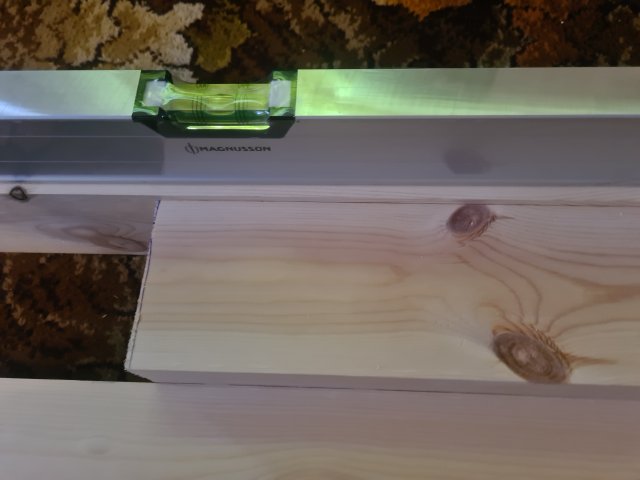
yes it was me started again and all good the planks are actually dead stright I bought more wood than I need to make way for mistakes on the way. Using glue along with the screws. I kept the wood in my house as my garage always cold the wife wasn't happy about it ha ha ha


I was looking at the stand diagram where the purple planks support and take the weight was wondering why the green ones don't go all the way up to be level with the red bits


I was looking at the stand diagram where the purple planks support and take the weight was wondering why the green ones don't go all the way up to be level with the red bits
View attachment 1489658
Idk ?
 I always build mine flush to the top. Seems stronger my way, unless I'm missing some kind of pro carpenters trick.
The green ones are just guides, they aren't load bearing. It's the red and yellow top horizontals resting on the purple verticals resting on the bottom brown and blue horizontals that are the key element of this design.
But to be honest with you, and as
Backfromthedead
stated, I don't think it really matters, especially if you're throwing ply on top.
But to be honest with you, and as
Backfromthedead
stated, I don't think it really matters, especially if you're throwing ply on top.
yes it was me started again and all good the planks are actually dead stright I bought more wood than I need to make way for mistakes on the way. Using glue along with the screws. I kept the wood in my house as my garage always cold the wife wasn't happy about it ha ha ha
View attachment 1489452
View attachment 1489453
View attachment 1489454
Will you be drilling diagonally from one piece to the other 90degree piece?

As mentioned the green ones are guides to glue and screw into.
The reasoning? A single average softwood 2X4 can hold about 1400lbs before crushing. Building as seen in the example above triples the number of boards that support the weight. Increasing the safety factor by several fold.
The reasoning? A single average softwood 2X4 can hold about 1400lbs before crushing. Building as seen in the example above triples the number of boards that support the weight. Increasing the safety factor by several fold.


