

Yellow Lab turned silver
- Thread starter Elephino
- Start date
You are using an out of date browser. It may not display this or other websites correctly.
You should upgrade or use an alternative browser.
You should upgrade or use an alternative browser.
- Status
- Not open for further replies.

Well it's been almost 2 weeks, I can't really get him out of there , I'd have to pull all the rocks out, it'd just stress the other fish out too much.
He looks a little darker, but doesn't act sick at all. It gets in with the crowd and eats, nobody bothers it. It swims against the current for fun.
He looks a little darker, but doesn't act sick at all. It gets in with the crowd and eats, nobody bothers it. It swims against the current for fun.
same thing happen to mine,he was being chased by my other male and slowly it changed the color to silverfish,he was just stressed out,take him out and put him in a different tank till he recovers,that is how i saved my yellow lab.. good luck..
CichlidsRool;3266343; said:same thing happen to mine,he was being chased by my other male and slowly it changed the color to silverfish,he was just stressed out,take him out and put him in a different tank till he recovers,that is how i saved my yellow lab.. good luck..
If your yellow lab turned silver than that was a hybrid as well.
just because fish changes color dose not mean it is hybrid,,,,my cichlid is back to yellow and it looks great....Marius;3273421; said:If your yellow lab turned silver than that was a hybrid as well.
paigntonlad;3274840; said:CICHLIDSROOL is completely correct, when fish are ill or stressed, their colours appear 'washed out' and look silvery. To correct this you need tp pin point the stress in the tank. On this occassion I think it could most certainly be put down to water conditions, although it would help if the OP tested everything and put up the results.
thanks buddy!! yes! if most of the fish are showing stress that means water condition needs to be checked ....
Marius;3273419; said:It turned silver because it is a HYBRID.
lol i thought he was saying this to be funny, but seriously its not a hybrid and you can clearly see its has something to do with the fish health.
paigntonlad;3274836; said:Rubbish! its nothing to do with being a hybrid!
Cant you see the pictures?
That is obviously an ill fish, and if you cant see that, then obviously you have no experiance in keeping fish
I'd check my spelling first, and I'd do more research before putting such a superficial and faulty assumption on my experiences out there. But enough on me.
paigntonlad;3274840; said:CICHLIDSROOL is completely correct, when fish are ill or stressed, their colours appear 'washed out' and look silvery. To correct this you need tp pin point the stress in the tank. On this occassion I think it could most certainly be put down to water conditions, although it would help if the OP tested everything and put up the results.
Not sure how much you know about the Labidochromis Caeruleus, and I dare not say anything. However, since they are pretty much the rats of the Malawi Mbunas, and everything that is out there in the trade can, and most of the times is tainted ...oh well, I'd dare again say that most of the Yellow labs out there are either the product of long term inbreeding or hybridizations down the line
 .
. And to cover the silver part, there's only one silver Labidochromis, also called the "white lab" ...Labidochromis Caeruleus "Nkhata Bay" which is a variant on its own.

CichlidsRool;3275799; said:just because fish changes color dose not mean it is hybrid,,,,my cichlid is back to yellow and it looks great....
When a fish turns a different color than what the "normal" is, my guess is hybridization, and on good basis.
Stressed yellow lab shows "stress bars"


...the small irridescence on the gill plate is specific to the some Caeruleus variants, but beware of too much, signs of hybridization, like this


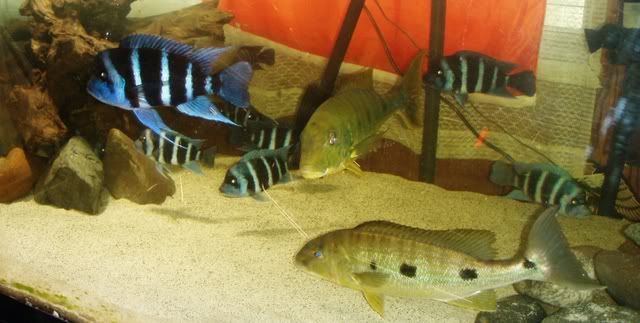
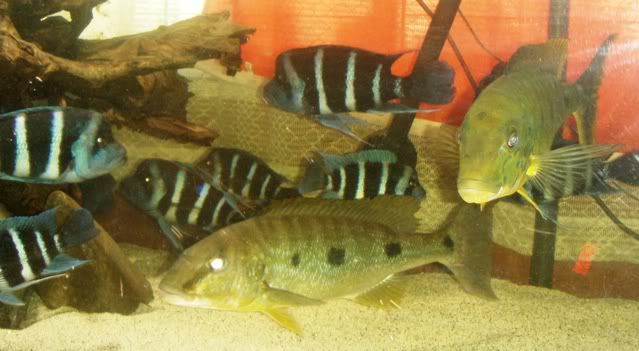
And to say my bye-bye, farewell, so long and whatever, this is one of my tanks, a 400gal Tanganyikan biotope with wild caughts, Boulengerochromis Microlepis pair and a colony of Cyphotilapia Gibberosa Kitumba 6m/16f in the 12" range (Blue Zaires for the less familiar with).
- Status
- Not open for further replies.
