

Eheim Canisters have been in USE since the 60s , I have 4 classic 2217s in use since the 90s , NO issues. I have reef tanks w sumps and freshwater with aquaclears too. KNOWLEDGE is the key. Most tanks are underfiltered in my opinion and Most people are not cleaning or using their filters as they were meant to be used. I have 40 years experience in aquaristics and I know that all filters have their uses if you USE them Properly . To each his own. Sumps are great for media reactors and skimmers if you regularlly top them off. Personally I think Canisters are great for media bio and chemical, Like I said you need to know their limitations and uses.
Why are canister filters so popular despite their drawbacks? Rant.
- Thread starter MultipleTankSyndrome
- Start date
You are using an out of date browser. It may not display this or other websites correctly.
You should upgrade or use an alternative browser.
You should upgrade or use an alternative browser.


Can't believe I forgot to mention this at the beginning of the thread, but duanes has said canisters are tiny pressurized sumps. What are the thoughts of those who have commented (and those who haven't yet!) on it?
Having never had a sump and not being overly familiar with them, my brief research makes me think this is probably a correct statement.
Not really comparable imo. Sure a canister can hold media and circulates water through it, but a sump is that and much more. Several huge advantages of the sump are ease of access, storing equipment, supplemental water and media volume, and versatility to change or add pumps, media, equipment, or a refugium to your setup as it's needs change. Even a modestly sized sump outclasses even the largest cans in any of these capabilities imo.
The one and only small advantage of the can is pump efficiency since they are essentially closed loops and do not lose flow to head pressure the way a sump pump does.
pumps
Just curious, by pumps are you referring to water flow pumps?
I've heard of some fishkeepers putting water flow pumps in their sump, which makes no sense to me. If the fish needs the flow, it should be in the main tank.
Just curious, by pumps are you referring to water flow pumps?
I've heard of some fishkeepers putting water flow pumps in their sump, which makes no sense to me. If the fish needs the flow, it should be in the main tank.
Return pump(s). Sometimes you may want to swap them out if your changing up the tank or if they fail. When a canisters pump fails youre essentially out of a filter until you can get a replacement or new pump on it.
I sometimes keep a circulation pump in my larger sumps. They keep grime from accumulating in corners and provide surface agitation to prevent bacteria and other crud forming on the surface.
I feel the key is that each type of filter has its uses, capabilities, benefits, and drawbacks. They are not really directly comparable and in fact, should not be compared one-to-one, as it is like comparing apples to grapes.
However, one item I cannot agree with happens to be one that is often stated even by otherwise very knowledgeable people, even earlier in this thread
That canister are by necessity nitrate factories and nitrate spewers
If the tank is filthy (as in full of nitrate), then the canister is too, just as much as the tank. However, if the tank is clean due to good maintenance routines, with low nitrate level, and the canister is also serviced regularly (and ideally provided with a prefilter), then the canister CAN NOT spew any more nitrate than that contained in the overall water in the tank. Nitrate is dissolved in water, it is not solid; if the canister is flowing properly, and the conditions above held (cleanliness, prefilter), the water coming out the canister CAN NOT be very different than the water in the tank.
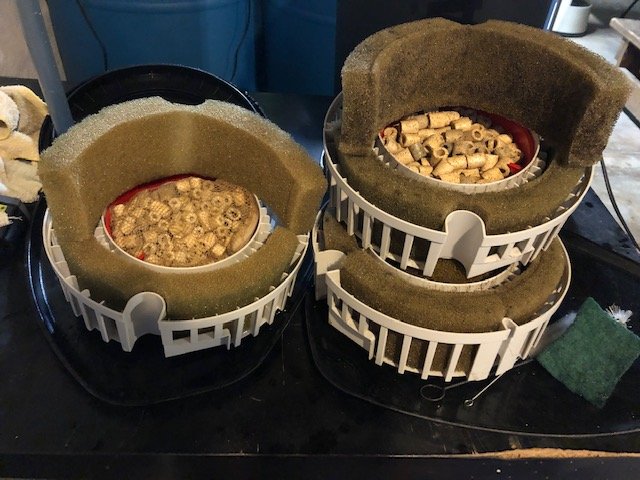
I currently use two FX6 canister and a number of Aquaclear HOB's and 2 Penguins. All have prefilters, and these are cleaned weekly, so little solid actually enters the filters. All media in HOB's is non-disposable and is cleaned weekly. Media in canister is cleaned every 3 months so about 4 times per year (but prefilters cleaned weekly). In the photo below (from 09Aug2022, the media in the RIGHT is before cleaning, whereas on the LEFT is after cleaning. Yes, there is a difference, but very little solids enter the actual canister as (hopefully) can be seen. With weekly water changes of at least ~70% (I strive for more), overall nitrate levels in this tank (125g) range up to 20ppm but usually around 10. The tank has an FX6 + 1 Aquaclear 110 + 1 Penguin 350. Yes, I would prefer to have a drip system instead, and to have several tanks connected to one large or several sumps, but find that it is perfectly fine in the manner I am doing.
However, one item I cannot agree with happens to be one that is often stated even by otherwise very knowledgeable people, even earlier in this thread
That canister are by necessity nitrate factories and nitrate spewers
If the tank is filthy (as in full of nitrate), then the canister is too, just as much as the tank. However, if the tank is clean due to good maintenance routines, with low nitrate level, and the canister is also serviced regularly (and ideally provided with a prefilter), then the canister CAN NOT spew any more nitrate than that contained in the overall water in the tank. Nitrate is dissolved in water, it is not solid; if the canister is flowing properly, and the conditions above held (cleanliness, prefilter), the water coming out the canister CAN NOT be very different than the water in the tank.
I currently use two FX6 canister and a number of Aquaclear HOB's and 2 Penguins. All have prefilters, and these are cleaned weekly, so little solid actually enters the filters. All media in HOB's is non-disposable and is cleaned weekly. Media in canister is cleaned every 3 months so about 4 times per year (but prefilters cleaned weekly). In the photo below (from 09Aug2022, the media in the RIGHT is before cleaning, whereas on the LEFT is after cleaning. Yes, there is a difference, but very little solids enter the actual canister as (hopefully) can be seen. With weekly water changes of at least ~70% (I strive for more), overall nitrate levels in this tank (125g) range up to 20ppm but usually around 10. The tank has an FX6 + 1 Aquaclear 110 + 1 Penguin 350. Yes, I would prefer to have a drip system instead, and to have several tanks connected to one large or several sumps, but find that it is perfectly fine in the manner I am doing.
If the tank is filthy (as in full of nitrate), then the canister is too, just as much as the tank. However, if the tank is clean due to good maintenance routines, with low nitrate level, and the canister is also serviced regularly (and ideally provided with a prefilter), then the canister CAN NOT spew any more nitrate than that contained in the overall water in the tank. Nitrate is dissolved in water, it is not solid; if the canister is flowing properly, and the conditions above held (cleanliness, prefilter), the water coming out the canister CAN NOT be very different than the water in the tank.
With all due respect, I think you may have misunderstood the meaning of canisters being NO3 factories. This is what I meant when I said so, and I assume others meant it too.
When you run a canister, it sucks up poop, detritus and uneaten food, and these accumulate in its sponges (even with a prefilter, I can tell you from my experience with a prefilter that a lot of waste gets past them, just not in solid form).
Once these 3 accumulate (be it solid form or not) and just sit there with months between cleanings, they break down into NO3 just as they would if in the tank and not caught by a filter. This vicious cycle of waste being sucked up, sitting, and decomposing continues until the filter is cleaned.
We are not implying dirty canisters spew more NO3 than contained in the tank water. But because they contain lots of waste that breaks down into lots of NO3, they are essentially just adding excess bioload to the tank with no benefit and greater difficulty in keeping the tank clean that would not be present if the filters were cleaned out several times a week.
Besides, allowing canisters to fill up with NO3-spewing gunk has problems beyond the NO3. As mentioned at the start of this thread:
-All that gunk smothers aerobic nitrifying bacteria.
-It creates great anaerobic conditions to produce fish-killing H2SO4.
-Large amounts of gunk is a great breeding ground for nasty pathogens like columnaris.
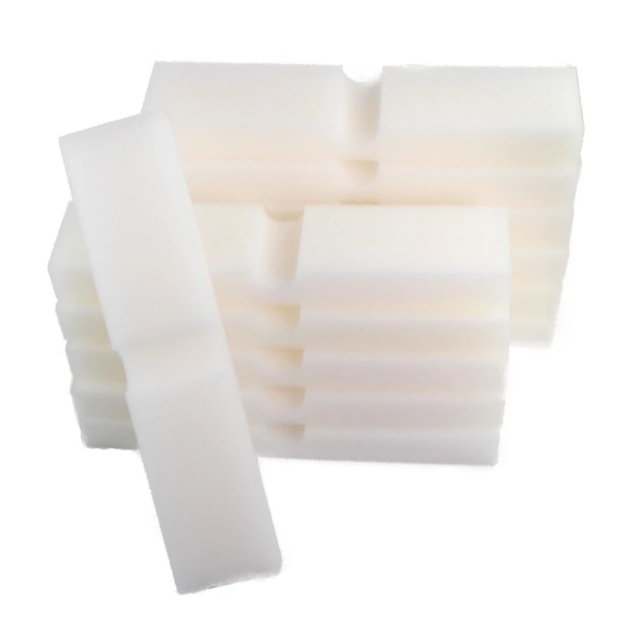
Finally, with regards to the picture, the filters are still very dirty even if it's not solids (since as mentioned, a lot gets past the prefilter).
It's easy to see why, when compared to a clean sponge.
10-20 mg/l nitrate is not advisable either. You really want it less than 5 and as close to 0 as possible, as per duanes' advice.

So clean your cannister as you would other types of filtration. The set it and forget it mindset is a little crazy imo, but knocking cannister or any type of filtration is pointless imo. They all have there uses and they all must be maintained. We all have opinions and things we like but to continue to try and correct others about their opinions... I mean come on, just dont use a cannister yourself. Disaster averted lol
Not correcting any opinions, and I'd hate to have come off that way. I just wanted to underline the process of HOW what I was talking about happens since there seemed to be a misunderstanding.
Then I'm sorry. But it really does come off that way a lot! Either they fall inline with ur reasoning or they stop responding. I like most of ur posts but there are some that just trigger me, since you want others to listen and respect ur opinions yet you refuse to do the same. Or thats how it reads. Try and realize text has no emotion but if you keep quoting others in an effort to prove them wrong it comes off as combative and a know it all. Just try and give others the same they give youNot correcting any opinions, and I'd hate to have come off that way. I just wanted to underline the process of HOW what I was talking about happens since there seemed to be a misunderstanding.

"Not correcting any opinions"? Okay...
Let's get real. Any filter is a "nitrate factory" since the biomedia encourages the breakdown of wastes into nitrates. As the nitrates accumulate, they must be removed by water changes. The faster they accumulate, the more frequent and larger the water changes must be.
Obviously, the more waste matter we can remove quickly and easily...before it has been in the tank long enough to be acted upon by bacteria...the less will eventually be converted to nitrate. In other words, the more often the mechanical filtration media is cleaned or changed...the more waste will be removed rather than turned into nitrate...so, naturally, a filter that is easy to clean is preferable. The more difficult it is to clean a filter, the less often it will be done; basic human nature. So, calling a canister a nitrate factory is simply admitting that you don't, won't or can't clean it as often as would be ideal, or as would be the case with another style of filter.
I like to clean the initial stage of my mechanical filter daily when possible; so I set up my filter to allow me to do that easily. There is no way in hell that I would attempt to clean a canister that often; so...IMHO only...that simple fact alone makes the relatively-difficult-to-clean canister inherently inferior to my sump, i.e. because my weak-willed human laziness doesn't lend itself to keeping the canister as clean as the sump.
As
Wideglide04
stated: don't like it? Don't use it! Simple. 
Let's get real. Any filter is a "nitrate factory" since the biomedia encourages the breakdown of wastes into nitrates. As the nitrates accumulate, they must be removed by water changes. The faster they accumulate, the more frequent and larger the water changes must be.
Obviously, the more waste matter we can remove quickly and easily...before it has been in the tank long enough to be acted upon by bacteria...the less will eventually be converted to nitrate. In other words, the more often the mechanical filtration media is cleaned or changed...the more waste will be removed rather than turned into nitrate...so, naturally, a filter that is easy to clean is preferable. The more difficult it is to clean a filter, the less often it will be done; basic human nature. So, calling a canister a nitrate factory is simply admitting that you don't, won't or can't clean it as often as would be ideal, or as would be the case with another style of filter.
I like to clean the initial stage of my mechanical filter daily when possible; so I set up my filter to allow me to do that easily. There is no way in hell that I would attempt to clean a canister that often; so...IMHO only...that simple fact alone makes the relatively-difficult-to-clean canister inherently inferior to my sump, i.e. because my weak-willed human laziness doesn't lend itself to keeping the canister as clean as the sump.
As
Wideglide04
stated: don't like it? Don't use it! Simple. 