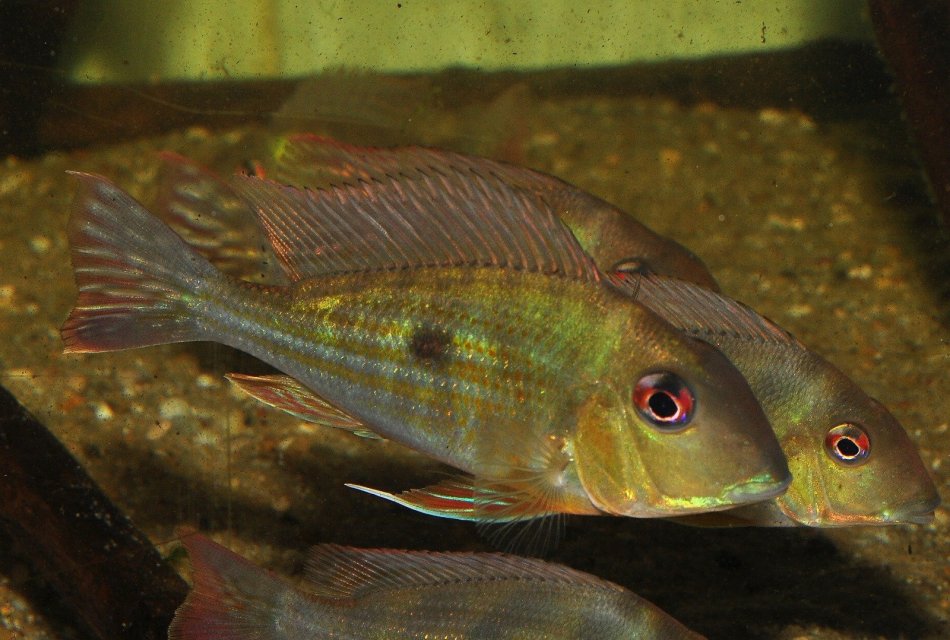
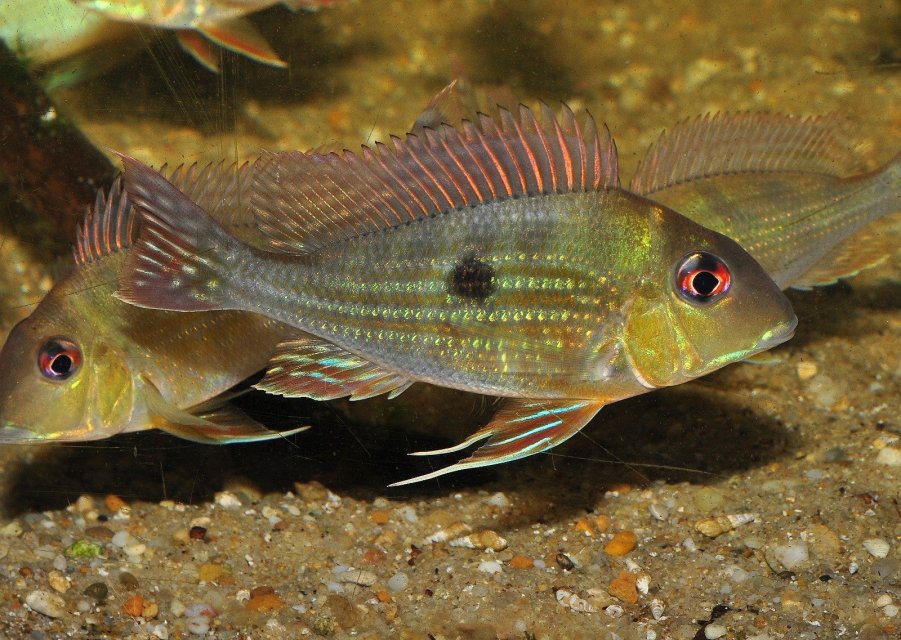
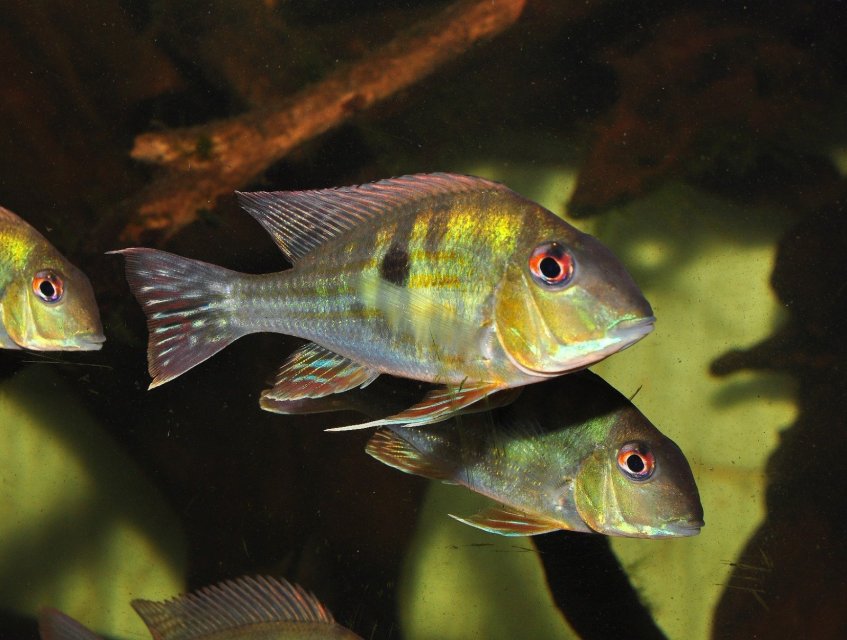
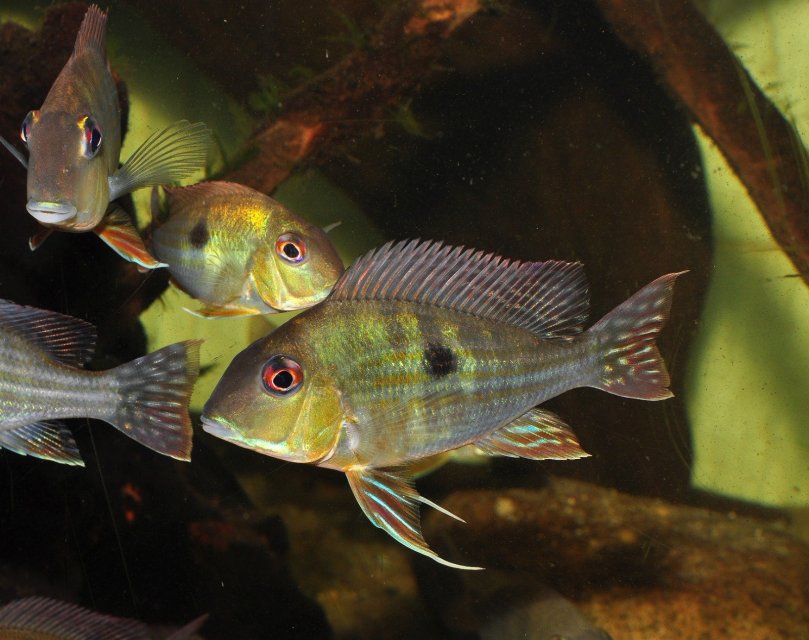
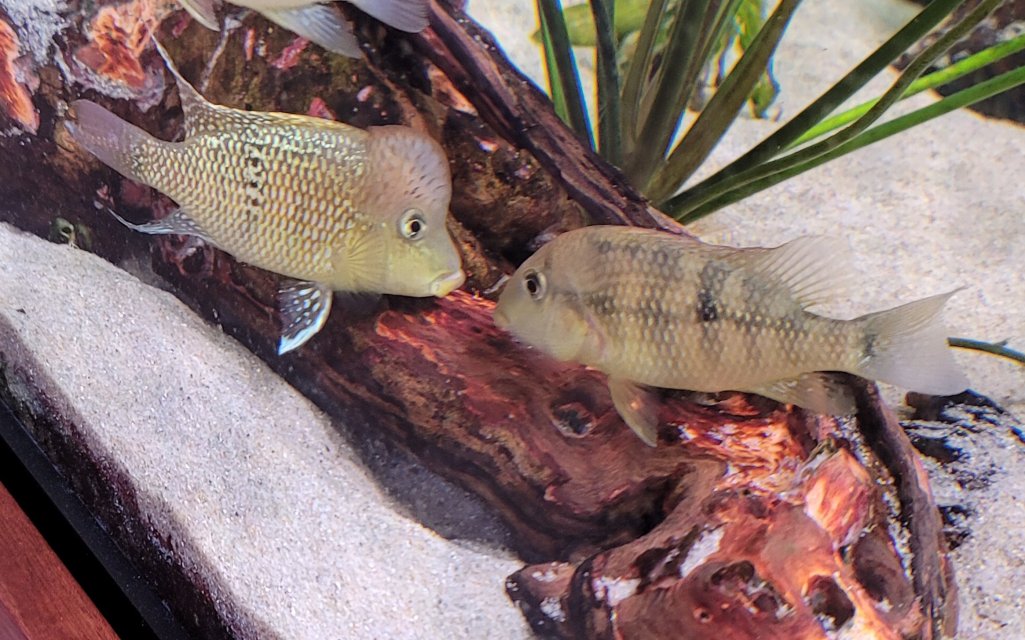
What kind of geophagus is this ?

  • We are currently upgrading MFK. thanks! -neo
I'm not sure - the ones i have look very different then your posted pictures - i posted these in the geo thread about 2 weeks ago - and even with the lighting difference and possibly age difference they look unlike yours - mine are currently 4 1/2 to nearly 6 inches large with one distinctly larger - i presume they have another year to grow till they reach maturity. I keep them at 83 ec 22-24 and ph 4.7 (blackwater condition - the higher temp is because they are with my wc discus) - here are some pictures for comparison:
View attachment 1573904View attachment 1573905

First even at this young age they have developed much longer filaments which your lack; the red splotches in the body is a bit of unknown long term - wetspot thinks it is an age thing that will change but i'm not sure; and the stirpe pattern looks more exensive though that might be due to lighting. Still even the dorsal fins are showing long filament which your fish lacks

btw - you mentioned another G. spec Caqueta in your original post - I assume you mean this Geophagus species? They share the tank with G. spec Caqueta II :))

38e59b8e-3f71-4d3d-88af-6830bf37c0db.jpeg

0f3f0a90-0ed9-4efd-9cf1-9e487c4eb204.jpeg

890d94ce-de36-41f7-90ed-630d6f784966.jpeg

fa6c3b69-b4ec-4100-93a3-9751636f10a5.jpeg
 
  • Like
Reactions: Milingu
btw - you mentioned another G. spec Caqueta in your original post - I assume you mean this Geophagus species? They share the tank with G. spec Caqueta II :))

View attachment 1573906

View attachment 1573907

View attachment 1573908

View attachment 1573909
The pictures I provided are of the cf winemiller from the Caqueta region - cf winemilleri was an abitrary name chosen by wetspot. That is the only species mentioned in this thread and they are not the same as your fish thuogh you might have the '#2' version.
 
The pictures I provided are of the cf winemiller from the Caqueta region - cf winemilleri was an abitrary name chosen by wetspot. That is the only species mentioned in this thread and they are not the same as your fish thuogh you might have the '#2' version.
sorry, i was referring to your post from sept 3rd (my fault) in which you mentioned another species from the Caqueta region with a different pattern. i was just curious if it was the species on my four additonal photos you were talking about. sorry, it doesn't matter... ;)

"As for the name they chose (cf winemilleri); they had posted a picture on their facebook page and a geo expert contact them and note they were clearly not winemilleri having a 5th stripe but were likely very simlar. They had not ordered this fish but another known as geo cf Caqueta which has a clearly different pattern of stripes."
 
sorry, i was referring to your post from sept 3rd (my fault) in which you mentioned another species from the Caqueta region with a different pattern. i was just curious if it was the species on my four additonal photos you were talking about. sorry, it doesn't matter... ;)

"As for the name they chose (cf winemilleri); they had posted a picture on their facebook page and a geo expert contact them and note they were clearly not winemilleri having a 5th stripe but were likely very simlar. They had not ordered this fish but another known as geo cf Caqueta which has a clearly different pattern of stripes."
Yes the sept 3 post was additional information I obtained from them about the fish from the Caqueta region which was named cf winemilleri.

They dont' actually know where this fish was found but the exportered indicated it was from Caqueta region; it does beg the question how many different species are out there or if this is related to any known species.

Since I have no clue on the final size and presume it is around 8 to 12 inches they might change further but i've not seen any species with similar looks so far.
 
Yes the sept 3 post was additional information I obtained from them about the fish from the Caqueta region which was named cf winemilleri.

They dont' actually know where this fish was found but the exportered indicated it was from Caqueta region; it does beg the question how many different species are out there or if this is related to any known species.

Since I have no clue on the final size and presume it is around 8 to 12 inches they might change further but i've not seen any species with similar looks so far.

yes, it is a pity that catching locations often are either kept secret by the fishermen or are not recorded by the exporter. That makes things sooo unnecessarily complicated. I also asked at Aquarium Glaser in germany (the importer and wholesaler) where this second spec Caqueta was found - but the results was the same like of your attempt to find out more at wetspot. I also asked other importers in germany if they ever had received such fishes from the Caqueta area - but nothing... nada...

Well, at least the question regarding the relationship with other geophagus will be answered. I took fin clips of spec. Caqueta and spec. Caqueta II and send them to a friend for DNA analyses this week. It might take until the end of 2026, but at least we can be sure that this new Geophagus will be mentioned in the book Jens Gottwald is working at :)

you are right - there is really no geophagus looking like ours (i believe they are the same, just different ages)
 
yes, it is a pity that catching locations often are either kept secret by the fishermen or are not recorded by the exporter. That makes things sooo unnecessarily complicated. I also asked at Aquarium Glaser in germany (the importer and wholesaler) where this second spec Caqueta was found - but the results was the same like of your attempt to find out more at wetspot. I also asked other importers in germany if they ever had received such fishes from the Caqueta area - but nothing... nada...

Well, at least the question regarding the relationship with other geophagus will be answered. I took fin clips of spec. Caqueta and spec. Caqueta II and send them to a friend for DNA analyses this week. It might take until the end of 2026, but at least we can be sure that this new Geophagus will be mentioned in the book Jens Gottwald is working at :)

you are right - there is really no geophagus looking like ours (i believe they are the same, just different ages)
Yea i was told by someone who goes to sa frequently to catch fishes that fisherman consider others competitors so they make a point of keeping catch locations secret. Even researchers which have mapped many species won't release this information in respect to their guides but they do have maps at least for some groups of their locations.

How large are yours - you said you think they are the same species but they should have long filament if they are over 4 inches.
 
Yea i was told by someone who goes to sa frequently to catch fishes that fisherman consider others competitors so they make a point of keeping catch locations secret. Even researchers which have mapped many species won't release this information in respect to their guides but they do have maps at least for some groups of their locations.

How large are yours - you said you think they are the same species but they should have long filament if they are over 4 inches.
regarding the catching locations: at least for scientific papers the exact data have to be deposited. :) When i was travelling in SA for each fishing spot we recorded the GPS data, fotos of the location and water parameters - that's how research should work... But of course i can understand fishermen keeping "their" places secret since many of them need the money for the fishes they catch. And most really earn just a few cents for fishes we pay hundreds of euro/dollars for. it is complicated...

mine are about 3-3,5 inch, and i think the problem is that they were kept in the traders facility for some month at low temperatures 24 °C and very hard water (the trader sells maaaany malawi and tanganjika cichlids and just starts the business with SA cichlids). I think the filaments will grow quickly as soon as the fishes are kept warm and under more appropiate water conditions.
I received mine on feb 21 and after a little more than 2 weeks with warm water, less stress and lots of good food they spawned... lol I'm convinced they'll reach 8-9 inches after 2 or 3 years, hopefully. And if not, as long as they stay so beautiful i do not complain
 
:)
i think time will tell... Mine seem to be somewhat younger than yours - give them 6 month and there will be extensions at their fins too. I'm optimistic... lol

When mine began courting, I thought to myself that they were actually still too small, but perhaps the sudden improvement in their living conditions compared to those at the dealer had something to do with them spontaneously beginning to court. In any case, it helped to clearly distinguish them from proximus and winemilleri.
I keep mine in a large group of 8 G. spec Caqueta I and 8 G. spec Caqueta II, as well as 6 of my F1 G. spec. Araca and two G. G. spec. Panta Rhei in a relatively dark tank with lots of wood and a floating plant cover ( Ceratophyllum ). That could explain the differences in colouring. I increased the lighting for a few video clips, and then your geos and mine look more similar. I think that the yellow zone in front of the lateral spot on my animals will still develop. It's a question of age... I'm curious to see whether your animals are also larvophilic mouthbrooders.

maybe this link to the video on my facebook page works?

Those look pretty much identical to mine - so i guess they are the same. Mine have not shown any courting behavior i've observed. I had purchased 6 but one developed the whirls about a month after purchased and quickly died. That was about 6 or 8 months ago.

My aquarium is only 180 and it has 8 wc discus so i did not want to buy too many. I have to move in approx 2 years and at that point i will split the discus and geo with each getting much larger aquariums. Probably 8ftx3ft each; though the hight will probably be only 20 inches to make management easier - maybe 24 for the discus. At that point i could consider adding more though finding the exact species might be difficult.

The other geos i have are mouth brooder so i suspect these are but time shall tell. I have some wc albios and dicrozoster (both sold as winemilleri but obviously were not) and some sp alto; though those are domestic and obviously suffering from inbreeding - my understanding new blood is not readily available for them - they are also harem breeders making 'peace' somewhat difficult as well as the males being very colourful with the females rather plain. I dislike their harem behavior but as a fishkeeper they are smaller and easier to manage (they are in a 8ftx4ft aquarium; and yes there are plants in the aquarium they haven't figured out how to disrupt ;) )

geo_golddust.jpg
 
hi, sorry for the delay - there were very busy days here... :)

@spec Caqueta: have you tried to let them starve for some days and then start with their preferred food? ;) Mine love glassworms and adult brine shrimps... Changing water with RO water of 3-4 degree lower temperature than in their tank (every 3-4 days) might also trigger courtship behaviour.
btw - i tried to catch the fry carrying female tuesday night. 50 % success: i got her, but she released the larvae and did not take them up again. the good thing is that the larvae look healthy and probably start to swim tomorrow evening or saturday morning.

regarding the number and size of tank: be careful with your wishes! LOL You might end up like me... about 40 tanks with overall 15.000 liters of water. :D And i've already reduced the number of tanks from 50 to 40 (haha, not getting younger and tanks near the floor make me feel my back)

Geos: great! i like your choice of geophagus! I keep dicrozoster too (sorted of of a mix of abalios and dicrozoster imported as winemilleri. haha
duplicity of events...
Yep - Alto Sinu can be a pain the ass regarding their social behaviour. I keep a trio in a 1200 liter tank together with Cincelichthys bocourti, 1,2 Astronotus mikoljii and a pair of Heros liberifer "Inirida red" - that combination works because the other cichlids ignore the hyperactive Alto sinu male.
Besides these eartheaters i keep 16 other geophagus species and some Guianacara, Satanoperca, Gymnogeophagus, Biotodoma and Retroculus. And in order to make it worse there are also about 30 species of other neotropical and west african cichlids... daaamn, i urgently need to get rid of some fishes. way too many here. Lol

562387641_3975858232667104_744077331345336076_n.jpg

452177671_3581544258765172_986613446984622192_n.jpg

487673827_3792769314309331_4992247807260401114_n.jpg

notatus.jpg

mirabilis.jpg
 
  • Like
Reactions: Milingu and jake37
hi, sorry for the delay - there were very busy days here... :)

@spec Caqueta: have you tried to let them starve for some days and then start with their preferred food? ;) Mine love glassworms and adult brine shrimps... Changing water with RO water of 3-4 degree lower temperature than in their tank (every 3-4 days) might also trigger courtship behaviour.
btw - i tried to catch the fry carrying female tuesday night. 50 % success: i got her, but she released the larvae and did not take them up again. the good thing is that the larvae look healthy and probably start to swim tomorrow evening or saturday morning.

regarding the number and size of tank: be careful with your wishes! LOL You might end up like me... about 40 tanks with overall 15.000 liters of water. :D And i've already reduced the number of tanks from 50 to 40 (haha, not getting younger and tanks near the floor make me feel my back)

Geos: great! i like your choice of geophagus! I keep dicrozoster too (sorted of of a mix of abalios and dicrozoster imported as winemilleri. haha
duplicity of events...
Yep - Alto Sinu can be a pain the ass regarding their social behaviour. I keep a trio in a 1200 liter tank together with Cincelichthys bocourti, 1,2 Astronotus mikoljii and a pair of Heros liberifer "Inirida red" - that combination works because the other cichlids ignore the hyperactive Alto sinu male.
Besides these eartheaters i keep 16 other geophagus species and some Guianacara, Satanoperca, Gymnogeophagus, Biotodoma and Retroculus. And in order to make it worse there are also about 30 species of other neotropical and west african cichlids... daaamn, i urgently need to get rid of some fishes. way too many here. Lol

View attachment 1573975

View attachment 1573976

View attachment 1573977

View attachment 1573978

View attachment 1573979
I only have 20 aquariums but i mostly keep sa dwarf cichild and a few west africans. I plan to mostly get out of the geo business when i move - though i will keep my wavarni and probably hte cupido (two different aquariums). I prefer the wavarni but in truth both species are well behave.

I'll probably just keep the cf winemilleri if they turn out interesting or maybe the bounded albios though i strong prefer the dicrozoster being a little darker and richer in colouring.

I can't lower the temp in the discus tank - it is 83 so drifts from 82 to 83.5 and if it drops below 82 the discus get really pissed and make their displeasure known by laying flat against the glass. Of course when i split them this will change. In truth i don't expect them to be sexually mature yet even though they are the same size as yours. They came in small and i ahven't had them long enough to fill out all the way. I fully expect they need 6 to 14 more months to consider mating - esp if they turn out to be 10ish inch as adults. Even my nijjensi fry take over a year to reach sexual maturity.

What fish is that pictured at the very bottom with the blue fin (though the lighting is pulling out more blue) ?
 
MonsterFishKeepers.com