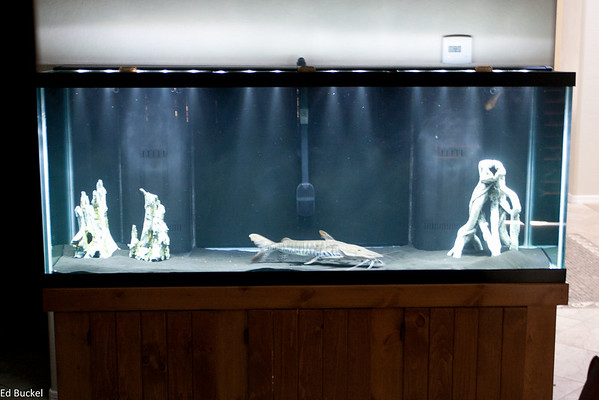
Hey guys, this topic has been beaten to death, but in looking around I haven't been able to find an answer that made me happy. I just bought a 240 gallon acrylic tank (8x2x2) and I'm in the process of planning out the filtration side of things for it. The tank is pre-drilled with two 3/4" NPT holes in the bottom and a single 1/2" NPT hole which I imagine was originally a return since I can't imagine why you'd make one hole smaller than the other two. There are also a pair of holes in the top of the tank near the side panel which will fit 3/4" SCH 40 PVC pipe, though I was planning on using those holes to run wires to Koralia pumps.
The 1/2" NPT hole is troublesome as it is threaded (they're all threaded actually) and I can't get a nipple long enough to protrude all the way through the tank to get enough to comfortably screw a 1-1/4" bushing onto with a rubber washer and still have something to work with on the outside of the tank. The 3/4" NPT holes seem to be okay and I've made "bulkheads" that I hope will work using a 1-1/4" reducing threaded bushing, a rubber washer, 3/4" all thread nipple, and a 1" reducing threaded bushing on the outside. I'm not sure if I should just use a dremmel and make the 1/2" hole a little wider and just slide a 1/2" NPT nipple that's long enough, but unthreaded, through and wrench the whole thing down or not. I can't see why it would be a "bad thing" since what would be sealing the system would be the washer and not the threads/teflon tape. But I'm a little hesitant to just start modding a tank that's 5 times bigger than anything else I've ever owned in a material I have no experience with.
I've also mostly decided that I'll be going with the old tried-and-true DIY sump setup with a pair of Mag 18's for returns but that brings me to my second problem. I'm aware that I'll lose flow from the pumps as head increases and that they'll be closer to a combined 2400 gph once all is said and done. I also realize that I'm going to need to drill more holes in the tank to be able to process that much water flowing through the tank. What I'm not sure of is how exactly to do that. I can expect at best around 900-1000 gph coming from what's already drilled in the tank, but I recall someone saying that using a tank the way it was drilled can be more trouble than it's worth.
I mean I get that you go out and buy a hole saw the size that's appropriate for your bulkhead, cut a hole and then plumb it up. What I'm not sure about is exactly how to figure out where the bulkhead should be placed relative to the top of the tank I guess. Are there advantages to setting things up one way vs. another? As I write this I have three stand pipes ready to go which are about 21-22" high in the tank and have gutter mesh to act as a strainer to keep fish out. I really am a newb when it comes to actually owning a large tank and I've never drilled a tank before either. I've always owned glass and it would be simple if this were a glass tank to just buy a couple of HOB overflows and plumb everything up that way since it's non-invasive.
So is it worth working with the fittings that are already installed in the tank or should I seal them up and just punch new holes the size and location that I want/need to overflow my pumps of choice? Is there a more effective way to seal up those existing holes if I'm not going to use them?
The 1/2" NPT hole is troublesome as it is threaded (they're all threaded actually) and I can't get a nipple long enough to protrude all the way through the tank to get enough to comfortably screw a 1-1/4" bushing onto with a rubber washer and still have something to work with on the outside of the tank. The 3/4" NPT holes seem to be okay and I've made "bulkheads" that I hope will work using a 1-1/4" reducing threaded bushing, a rubber washer, 3/4" all thread nipple, and a 1" reducing threaded bushing on the outside. I'm not sure if I should just use a dremmel and make the 1/2" hole a little wider and just slide a 1/2" NPT nipple that's long enough, but unthreaded, through and wrench the whole thing down or not. I can't see why it would be a "bad thing" since what would be sealing the system would be the washer and not the threads/teflon tape. But I'm a little hesitant to just start modding a tank that's 5 times bigger than anything else I've ever owned in a material I have no experience with.
I've also mostly decided that I'll be going with the old tried-and-true DIY sump setup with a pair of Mag 18's for returns but that brings me to my second problem. I'm aware that I'll lose flow from the pumps as head increases and that they'll be closer to a combined 2400 gph once all is said and done. I also realize that I'm going to need to drill more holes in the tank to be able to process that much water flowing through the tank. What I'm not sure of is how exactly to do that. I can expect at best around 900-1000 gph coming from what's already drilled in the tank, but I recall someone saying that using a tank the way it was drilled can be more trouble than it's worth.
I mean I get that you go out and buy a hole saw the size that's appropriate for your bulkhead, cut a hole and then plumb it up. What I'm not sure about is exactly how to figure out where the bulkhead should be placed relative to the top of the tank I guess. Are there advantages to setting things up one way vs. another? As I write this I have three stand pipes ready to go which are about 21-22" high in the tank and have gutter mesh to act as a strainer to keep fish out. I really am a newb when it comes to actually owning a large tank and I've never drilled a tank before either. I've always owned glass and it would be simple if this were a glass tank to just buy a couple of HOB overflows and plumb everything up that way since it's non-invasive.
So is it worth working with the fittings that are already installed in the tank or should I seal them up and just punch new holes the size and location that I want/need to overflow my pumps of choice? Is there a more effective way to seal up those existing holes if I'm not going to use them?