

Anyone tried frozen bait as food?
- Thread starter Logan487
- Start date
You are using an out of date browser. It may not display this or other websites correctly.
You should upgrade or use an alternative browser.
You should upgrade or use an alternative browser.

At risk of sounding like one of the "anti-scientists" that are so common nowadays...I just don't think that thiaminase is quite as threatening as it is often made out to be.
Yes, if you have a predatory fish and feed it exclusively on a diet of high-thiaminase prey such as goldfish or rosy reds or smelt...then perhaps it may suffer as a result. But, how do we explain those people who do just that? I personally know aquarists who keep predatory fish and feed strictly goldfish. In some cases, they have done this for years. How do those predators survive? All the current "thiminasophobic" literature tells us that those fish will suffer from B1 deficiency and quickly perish...but somehow, some or even many of them don't. To be sure, problems do arise at times, but why don't they always surface?
Do thiaminase levels vary within fish of a given species from one population to the next? Is it true that there is more thiaminase in frozen/thawed fish? How does that work? How about predatory species whose natural food supply consists of thiaminase-loaded prey? This must be true in some cases; Great Lakes Pacific salmon species in the Great Lakes (obviously stocked/introduced) feed largely upon thiaminase-loaded Shad...but they live out their normal 4-year lifespan and grow to adult size. How? If you believe the thiaminase-whisperers, that shouldn't be possible.
Diets as varied as possible go a long way towards ensuring that there is enough of the stuff that your fish do need to stay healthy...and not enough of the bad stuff to kill them. That's probably the best we can hope for; now let's all get back to the really important parts of the hobby, like how to boil rocks to make them aquarium-safe.
Yes, if you have a predatory fish and feed it exclusively on a diet of high-thiaminase prey such as goldfish or rosy reds or smelt...then perhaps it may suffer as a result. But, how do we explain those people who do just that? I personally know aquarists who keep predatory fish and feed strictly goldfish. In some cases, they have done this for years. How do those predators survive? All the current "thiminasophobic" literature tells us that those fish will suffer from B1 deficiency and quickly perish...but somehow, some or even many of them don't. To be sure, problems do arise at times, but why don't they always surface?
Do thiaminase levels vary within fish of a given species from one population to the next? Is it true that there is more thiaminase in frozen/thawed fish? How does that work? How about predatory species whose natural food supply consists of thiaminase-loaded prey? This must be true in some cases; Great Lakes Pacific salmon species in the Great Lakes (obviously stocked/introduced) feed largely upon thiaminase-loaded Shad...but they live out their normal 4-year lifespan and grow to adult size. How? If you believe the thiaminase-whisperers, that shouldn't be possible.
Diets as varied as possible go a long way towards ensuring that there is enough of the stuff that your fish do need to stay healthy...and not enough of the bad stuff to kill them. That's probably the best we can hope for; now let's all get back to the really important parts of the hobby, like how to boil rocks to make them aquarium-safe.


Nope, I tried this when there was a supply issue at my LFS and he looked at me like I was the rudest person alive lol. Was really hoping too as it would allow me to just get bags from the store of frozen tilapia.Will they take the thawed taliapa fillet? If so I would alleviate alot of the issues your having.
At risk of sounding like one of the "anti-scientists" that are so common nowadays...I just don't think that thiaminase is quite as threatening as it is often made out to be.
Yes, if you have a predatory fish and feed it exclusively on a diet of high-thiaminase prey such as goldfish or rosy reds or smelt...then perhaps it may suffer as a result. But, how do we explain those people who do just that? I personally know aquarists who keep predatory fish and feed strictly goldfish. In some cases, they have done this for years. How do those predators survive? All the current "thiminasophobic" literature tells us that those fish will suffer from B1 deficiency and quickly perish...but somehow, some or even many of them don't. To be sure, problems do arise at times, but why don't they always surface?
Do thiaminase levels vary within fish of a given species from one population to the next? Is it true that there is more thiaminase in frozen/thawed fish? How does that work? How about predatory species whose natural food supply consists of thiaminase-loaded prey? This must be true in some cases; Great Lakes Pacific salmon species in the Great Lakes (obviously stocked/introduced) feed largely upon thiaminase-loaded Shad...but they live out their normal 4-year lifespan and grow to adult size. How? If you believe the thiaminase-whisperers, that shouldn't be possible.
Diets as varied as possible go a long way towards ensuring that there is enough of the stuff that your fish do need to stay healthy...and not enough of the bad stuff to kill them. That's probably the best we can hope for; now let's all get back to the really important parts of the hobby, like how to boil rocks to make them aquarium-safe.
Hehe, Thanks. I will admit as an engineer by trade I tend to over design and over think things. Especially when it comes to hobbies.[/QUOTE]
Nope, I tried this when there was a supply issue at my LFS and he looked at me like I was the rudest person alive lol. Was really hoping too as it would allow me to just get bags from the store of frozen tilapia.
That's what comes of feeding a limited diet of only one or two types of food. You end up with spoiled fish who "demand" their favourite food.
Be firm. Adult fish can go a long time without food, and if they refuse it today...they can wait until tomorrow. This won't necessarily work with wild fish just being acclimated to non-living food for the first time. But when you have an established fish that ate a given food before, and has suddenly decided to stamp his little foot and throw a hissy fit when he doesn't get his first choice of food now...well, you go ahead and eat your own supper and let your fish think about his decision. Then try him again tomorrow.
I always offer them the same choice at each meal that I was presented at each meal while I was growing up: take it...or leave it.

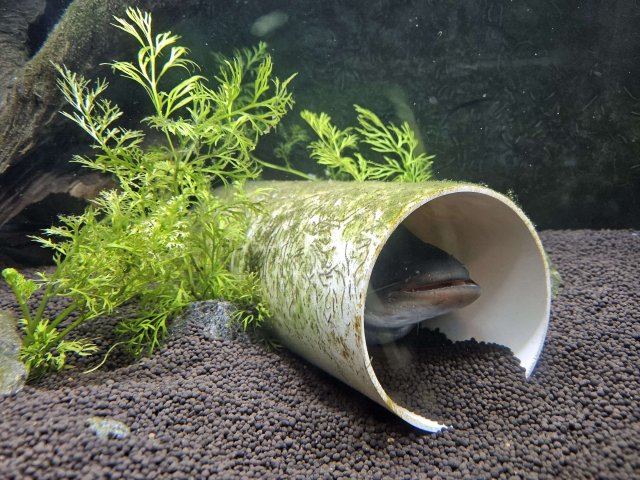
View attachment 1527761
He's just waiting for silversides I know it.... Lol.
Great pic; I love seeing a catfish like this, in his favourite hidey-hole, mouth open and waiting for service.
I want one of these guys!
That's what comes of feeding a limited diet of only one or two types of food. You end up with spoiled fish who "demand" their favourite food.
So pretty much exactly what I am dealing with lol, did I mentioned he is also the spoiled favorite of the kids.
I want one of these guys!
I can honestly say he is probably my favorite cat I have ever kept given they have this slow hover like movement to them, and aside from just keeping an eye on sizes of other fish vs his mouth he has also never really been that aggressive or destructive to the aquascape. Only downside I guess is he does reach around 40" for his subspecies but if you don't mind making sure anything with them is big enough to stay out of food range they are great. They also have a tendency to pick spots like around large pieces of wood and just sit there, or goes for haunts through the tank at the mid level as well. Only issue I have noticed really is that he occasionally will 'tail' the other mid level fish as if trolling them, although he never attempts to bite or aggression, just like a gentle nose touch and continues which he did not start until I tried to starve him once then caved in when he began to do that...And this is the moment when I realize the fish has conditioned us, not the other way around *facepalms*
I'm curious if anyone has tried using frozen Mackerel for feeding large predators. For many years I purchased small Mackerel, not sure of exact species, as bait for winter pike fishing. The fish were around 10-12 inches in length, and could often be purchased whole and intact. Haven't seen them for awhile, not sure if they are still available anywhere.
I have also recently been using large frozen raw shell-on shrimp for both catfish bait and also as food for my Jelly Cat. Not sure of the species, but they certainly look like freshwater Macrobrachium of some sort. Again, I don't use them as an exclusive diet, but as a component of a varied one. Easy to store, easy to feed, easy to convince visitors to hold gingerly above the tank so that the rest of us can get a laugh...
Well, the first step in dealing with a problem is admitting that you have one...
I have also recently been using large frozen raw shell-on shrimp for both catfish bait and also as food for my Jelly Cat. Not sure of the species, but they certainly look like freshwater Macrobrachium of some sort. Again, I don't use them as an exclusive diet, but as a component of a varied one. Easy to store, easy to feed, easy to convince visitors to hold gingerly above the tank so that the rest of us can get a laugh...
...And this is the moment when I realize the fish has conditioned us, not the other way around *facepalms*
Well, the first step in dealing with a problem is admitting that you have one...
