

Centromochlus musaicus dying
- Thread starter fishguy1978
- Start date
You are using an out of date browser. It may not display this or other websites correctly.
You should upgrade or use an alternative browser.
You should upgrade or use an alternative browser.


I’m not entirely sure why the losses but as
 duanes
pointed out these are a rheophillic species something I was not aware of prior.
duanes
pointed out these are a rheophillic species something I was not aware of prior.
The system they were in is ~1000l distributed in eight 120l tanks and a 140l sump. All of the tanks are planted so nitrates are kept low.
I’m also running 1440l/h (1.5x) turnover with 100w DC pump at 50% power. I had not calculated my flow before so it could be that I am running an O2 deficit. Would this explain the losses?
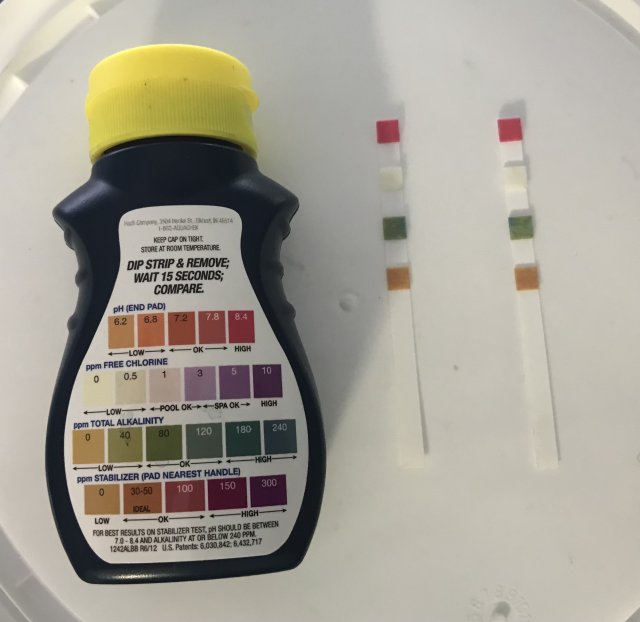
I have a constant water change running with cold water dripping 15l/h. My municipality only runs 0.5ppm chlorine so it doesn’t even register when testing. Tap water on the right and T m tank on the left. Test strip reads from ph 8.4 (red), chlorine 0ppm (white), alkalinity 80ppm (green). The brown is stabilizer which might be 30-50ppm Gh? This a swimming pool test kit so I don’t know how accurate these strips are. My liquid AP kit shows a similar result for ph though.
duanes
pointed out these are a rheophillic species something I was not aware of prior.The system they were in is ~1000l distributed in eight 120l tanks and a 140l sump. All of the tanks are planted so nitrates are kept low.
I’m also running 1440l/h (1.5x) turnover with 100w DC pump at 50% power. I had not calculated my flow before so it could be that I am running an O2 deficit. Would this explain the losses?
I have a constant water change running with cold water dripping 15l/h. My municipality only runs 0.5ppm chlorine so it doesn’t even register when testing. Tap water on the right and T m tank on the left. Test strip reads from ph 8.4 (red), chlorine 0ppm (white), alkalinity 80ppm (green). The brown is stabilizer which might be 30-50ppm Gh? This a swimming pool test kit so I don’t know how accurate these strips are. My liquid AP kit shows a similar result for ph though.
Last edited:
Rheophillic species have evolved to live in a strong flow, something akin to rapids, or riffles (depending on the species), and in aquaria need an arguably stronger laminar flow of water along the length of a tank, than most standard aquarium fish.
For a number of reasons (dissolved oxygen being just for one), but are not limited to just that, and some species, more than others.
This is often "not" provided by the simple uplift of air stones, or standard made for aquarium aeration gear.
I have learned this the hard way, and tried to keep a number of rheophillic cichlids, and when I have not provided enough of a moving wall of directional flow (like rapids (or at least riffles) in a river, ..... everything from bacterial diseases, to heightened aggression within the group has been the result.
With the cichlid Tomocichla tuba, overt aggression was the obvious result for me with not enough gph flow.
And .....
The same happened with the rheophillic Malagasy cichlid, Paretroplus nourisatti, where after spending $300 on a group of 6 for a 150 gall tank, without providing a heavy enough flow, they subtly killed each other.
Trout of course ae another example, although aggression might to be the bugaboo, with them the waters they have adapted to thrive in, often have dissolved oxygen levels of 12 ppm or higher (considered super saturated), and if not given that DO level end up full of fungal, and bacterial maladies.
There are even a number of Geophagus, that come from riffle areas where they live in compatible large shoals, or groups, but if put in a aquariums without strong enough flow, get aggressive as they age, and quarrel.
If all other parameters are in line, and problems begin to arise, creating more turbulent laminar flow is my go to solution.
Below is a video of what I am am using these day with riverine species, that are not really considered rheophillc.
For a number of reasons (dissolved oxygen being just for one), but are not limited to just that, and some species, more than others.
This is often "not" provided by the simple uplift of air stones, or standard made for aquarium aeration gear.
I have learned this the hard way, and tried to keep a number of rheophillic cichlids, and when I have not provided enough of a moving wall of directional flow (like rapids (or at least riffles) in a river, ..... everything from bacterial diseases, to heightened aggression within the group has been the result.
With the cichlid Tomocichla tuba, overt aggression was the obvious result for me with not enough gph flow.
And .....
The same happened with the rheophillic Malagasy cichlid, Paretroplus nourisatti, where after spending $300 on a group of 6 for a 150 gall tank, without providing a heavy enough flow, they subtly killed each other.
Trout of course ae another example, although aggression might to be the bugaboo, with them the waters they have adapted to thrive in, often have dissolved oxygen levels of 12 ppm or higher (considered super saturated), and if not given that DO level end up full of fungal, and bacterial maladies.
There are even a number of Geophagus, that come from riffle areas where they live in compatible large shoals, or groups, but if put in a aquariums without strong enough flow, get aggressive as they age, and quarrel.
If all other parameters are in line, and problems begin to arise, creating more turbulent laminar flow is my go to solution.
Below is a video of what I am am using these day with riverine species, that are not really considered rheophillc.
Last edited by a moderator:

A long time member on planet catfish is experiencing something similar with his three Gulper cats. The only difference I see is one of his fish developed lesions along its lateral line. He took the fish to an actual fish vet for diagnosis which came back as Aeromonas sobria. I did a little googling of symptoms. Tattered fins is one of the evidences of infection. None of my fish showed reddening or lesions

Hate to dig up a long-dead thread, but I've just ran into this problem again. Lost my male musaica last week; he had oddly shredded and reduced fins- figured it was postmortem damage, but I just found my female with reduced and deteriorating fins. Will try to get her out for pics later.
My Spinipteris seems unaffected; same with my last remaining C. orca.
It does seem to be a death sentence, right?
Think I'll put the female in a quarantine tank later in the evening; don't want to really run the risk of my other woodcats getting infected.
My Spinipteris seems unaffected; same with my last remaining C. orca.
It does seem to be a death sentence, right?
Think I'll put the female in a quarantine tank later in the evening; don't want to really run the risk of my other woodcats getting infected.
Sorry to hear. It does seem to be a death sentence. I'm not sure of the cause either. My T. grynia have the same issue but haven't died though.Hate to dig up a long-dead thread, but I've just ran into this problem again. Lost my male musaica last week; he had oddly shredded and reduced fins- figured it was postmortem damage, but I just found my female with reduced and deteriorating fins. Will try to get her out for pics later.
My Spinipteris seems unaffected; same with my last remaining C. orca.
It does seem to be a death sentence, right?
Think I'll put the female in a quarantine tank later in the evening; don't want to really run the risk of my other woodcats getting infected.

Looking at your latest test results, it appears your pH is even slightly higher than I at first thought, in the 8.2+ range, and Total Alkaninity is 100 or above (alkalinity has a direct relationship to KH).
These parameters are a lot like mine here in Panama, so chosing soft water species from S America may be an exercise in futility, unless your are willing to alter your water parameters with RO, especially when trying to keep rarer, less commonly bred aquarium, and wild caught strains.
As an example for me, I have always wanted Uaru fernadezyepezi, but trying to keep those species healthy in my hard, basic water parameters without alteration would be a constant battle, that could be costly and stressful.
These parameters are a lot like mine here in Panama, so chosing soft water species from S America may be an exercise in futility, unless your are willing to alter your water parameters with RO, especially when trying to keep rarer, less commonly bred aquarium, and wild caught strains.
As an example for me, I have always wanted Uaru fernadezyepezi, but trying to keep those species healthy in my hard, basic water parameters without alteration would be a constant battle, that could be costly and stressful.
Weirdly enough, my water's quite soft, to the point that I have no trouble keeping sensitive fish like altums, apistos, Dicrossus, etc. in just straight dechlorinated tap water; and I have trouble keeping the vast majority of African and CA cichlids without excessive buffering. Even Neocaridina die off easily without extensive buffering in my tanks.Looking at your latest test results, it appears your pH is even slightly higher than I at first thought, in the 8.2+ range, and Total Alkaninity is 100 or above (alkalinity has a direct relationship to KH).
These parameters are a lot like mine here in Panama, so chosing soft water species from S America may be an exercise in futility, unless your are willing to alter your water parameters with RO, especially when trying to keep rarer, less commonly bred aquarium, and wild caught strains.
As an example for me, I have always wanted Uaru fernadezyepezi, but trying to keep those species healthy in my hard, basic water parameters without alteration would be a constant battle, that could be costly and stressful.
Params are: pH: 6.4; KH: 0; GH: 1-2; NH3/4: 0; NO2: 0; NO3: 10; I do 60% water changes every week or so.
Because of that, I don't really know if the fin-melting issue is strictly water- parameter- based, though I would agree that it has some influence.
