FSM;2720996; said:
facts? sounds like total BS.
if they actually cited real sources instead of just saying "scientists from ____" it would actually seem believable.
any real data to support your claims?
..

Here is the fact sheet on honey
Honey
From Wikipedia, the free encyclopedia
Jump to:
navigation,
search
For other uses, see
Honey (disambiguation).
"Wild Honey" redirects here. For other uses, see
Wild Honey (disambiguation).
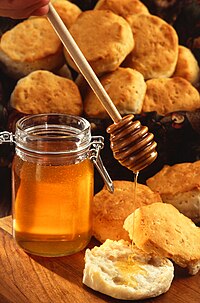

A jar of honey, shown with a honey dipper and
scones

A capped frame of
honeycomb

A
honey bee on
calyx of
goldenrod
Honey is a sweet fluid produced by
honey bees (and some other species
[1]), and derived from the
nectar of
flowers. According to the United States National Honey Board and various international food regulations, "honey stipulates a pure product that does not allow for the addition of any other substance
this includes, but is not limited to, water or other
sweeteners".
[2] This article refers exclusively to the honey produced by
honey bees (the genus
Apis); honey produced by other bees or other insects has very different properties.
[3]
Honey gets its sweetness from the
monosaccharides fructose and
glucose and has approximately the same relative
sweetness as
granulated sugar (97% of the sweetness of
sucrose, a
disaccharide).
[4][5] Honey has attractive chemical properties for baking, and a distinctive flavor which leads some people to prefer it over sugar and other sweeteners.
[4]
Most micro-organisms do not grow in honey because of its low
water activity of 0.6.
[6] However, honey frequently contains dormant
endospores of the bacterium
Clostridium botulinum, which can be dangerous to infants as the endospores can transform into toxin-producing bacteria in the infant's immature intestinal tract, leading to illness and even death
[7] (see
Precautions below).
The study of
pollens and
spores in raw honey (
melissopalynology) can determine floral sources of honey.
[8] Because bees carry an
electrostatic charge, and can attract other particles, the same techniques of melissopalynology can be used in area environmental studies of
radioactive particles,
dust, or particulate
pollution.
[9][10]
A main effect of bees collecting nectar to make honey is
pollination, which is crucial for
flowering plants.
[11]
The beekeeper encourages overproduction of honey within the hive so that the excess can be taken without endangering the bees. When sources of foods for the bees are short the beekeeper may have to give the bees supplementary nutrition.
[12]
Contents
[
hide]
[edit] Honey formation
Honey is laid down by bees as a food source. In cold weather or when food sources are scarce, bees use their stored honey as their source of energy.
[13] By contriving for the bee
swarm to make its home in a
hive, people have been able to semi-
domesticate the insects. In the hive there are three types of bee: the single
queen bee, a seasonally variable number of
drone bees to fertilize new queens, and some 20,000 to 40,000
worker bees.
[14] The worker bees raise larvae and collect the nectar that will become honey in the hive. They go out, collect the sugar-rich flower nectar, release
Nasonov pheromones and return to the hive. These pheromones enable other bees to find their way to the site by smell.
[15] Honeybees also release Nasonov pheromones at the entrance to the hive, which enables returning bees to return to the proper hive.
[15] In the hive the bees use their "honey stomachs" to ingest and
regurgitate the nectar a number of times until it is partially digested.
[16] The bees work together as a group with the regurgitation and digestion until the product reaches a desired quality. It is then stored in the
honeycomb. Nectar is high in both water content and natural yeasts which, unchecked, would cause the sugars in the nectar to ferment.
[13] After the final regurgitation, the honeycomb is left unsealed. Bees inside the hive fan their wings, creating a strong draft across the honeycomb which enhances
evaporation of much of the
water from the nectar.
[13] The reduction in water content raises the sugar concentration and prevents
fermentation. Ripe honey, as removed from the hive by the
owner of the bees, has a long shelf life and will not ferment.
[13]
[edit] Nutrition
Honey
Nutritional value per 100 g (3.5 oz)Energy 300 kcal 1270 kJ
Carbohydrates 82.4 g- Sugars 82.12 g-
Dietary fiber 0.2 g
Fat0 g
Protein0.3 g
Water17.10 g
Riboflavin (Vit. B2) 0.038 mg 3%
Niacin (Vit. B3) 0.121 mg 1%
Pantothenic acid (B5) 0.068 mg 1%
Vitamin B6 0.024 mg2%
Folate (Vit. B9) 2 μg 1%
Vitamin C 0.5 mg1%
Calcium 6 mg1%
Iron 0.42 mg3%
Magnesium 2 mg1%
Phosphorus 4 mg1%
Potassium 52 mg 1%
Sodium 4 mg0%
Zinc 0.22 mg2%Shown is for 100 g, roughly 5 tbsp.
Percentages are relative to US
recommendations for adults.
Source:
USDA Nutrient databaseHoney is a mixture of sugars and other compounds. With respect to carbohydrates, honey is mainly fructose (about 38.5%) and glucose (about 31.0%),
[4] making it similar to the synthetically produced
inverted sugar syrup which is approximately 48% fructose, 47% glucose, and 5% sucrose. Honey's remaining carbohydrates include maltose, sucrose, and other
complex carbohydrates.
[4] Honey contains trace amounts of several
vitamins and
minerals.
[17] As with all nutritive sweeteners, honey is mostly sugars and is not a significant source of vitamins or minerals.
[18] Honey also contains tiny amounts of several compounds thought to function as
antioxidants, including
chrysin,
pinobanksin,
vitamin C,
catalase, and
pinocembrin.
[19][20] The specific composition of any batch of honey will depend largely on the mix of flowers available to the bees that produced the honey.
[18]
Typical honey analysis
[18]
Honey has a
density of about 1.36 kilograms per liter (36% denser than water).
[21]
Isotope ratio mass spectrometry can be used to detect addition of
corn syrup or
sugar cane sugars by the carbon
isotopic signature. Addition of sugars originated from corn or sugar cane (
C4 plants, unlike the plants used by bees which are predominantly
C3 plants) skews the isotopic ratio of sugars present in honey, but does not influence the isotopic ratio of proteins; in an unadulterated honey the carbon isotopic ratios of sugars and proteins should match. As low as 7% level of addition can be detected.
[3]
[edit] Types of honey
[edit] Blended
Most commercially available honey is blended, meaning that it is a mixture of two or more honeys differing in floral source, color, flavor, density or geographic origin.
[22]
[edit] Polyfloral
Polyfloral honey, also known as wildflower honey,
[23] is derived from the nectar of many types of flowers.
[24]
[edit] Monofloral
Main article: Monofloral honey
Different monofloral honeys have a distinctive flavor and colour because of differences between their principal
nectar sources. Beekeepers keep monofloral beehives in an area where the bees have access to only one type of flower, because of that flower's properties. In practice, because of the difficulties in containing bees, a small proportion of any honey will be from additional nectar from other flower types. Typical examples of monofloral or varietal honeys are "orange blossom", "sage", "eucalyptus", "tupelo", "manuka", "buckwheat", "sourwood", and "clover".
[edit] Honeydew honey
Instead of taking nectar, bees can take
honeydew, the sweet secretions of
aphids or other plant sap-sucking insects. Bees collecting this resource have to be fed protein supplements, as honeydew lacks the protein-rich pollen accompaniment gathered from flowers.
Germany's
Black Forest is a well known source of honeydew-based honeys, as well as some regions in Bulgaria. Honeydew honey is popular in some areas, but in many areas beekeepers have difficulty selling the stronger flavored product.
Honeydew honey has a much larger proportion of indigestibles than light floral honeys, which can cause
dysentery, resulting in the death of colonies in areas with cold winters. Good beekeeping management requires the removal of honeydew prior to winter in colder areas.
[edit] Honey processing
 This section may require cleanup to meet Wikipedia's quality standards.
Please
improve this article if you can.
(May 2008)
- Comb honey is honey sold in the original bees' wax comb. Comb honey was once packaged by installing a wooden framework in special honey supers, but this labor intensive method is being replaced by plastic rings or cartridges.
- Certified Organic Honey is honey produced, processed, and packaged in accordance with national regulations, and certified as such by some government body or an independent organic farming certification organization. For example, in the United Kingdom, the standard covers not only the origin of bees, but also the siting of the apiaries. These must be on land that is certified as organic, and within a radius of 4 miles from the apiary site, nectar and pollen sources must consist essentially of organic crops or uncultivated areas.[4]. According to TheOrganicReport.com, organic honey is quite scarce to find because most beekeepers "routinely use sulfa compounds and antibiotics to control bee diseases, carbolic acid to remove honey from the hive, and calcium cyanide to kill colonies before extracting the honey, not to mention that conventional honeybees gather nectar from plants that have been sprayed with pesticides." [25]
- Chunk honey or Cut-comb honey Honey packed in widemouth containers consisting of one or more pieces of comb honey surrounded by extracted liquid honey.
- Crystallized honey Honey in which some of the glucose content has spontaneously crystallized from solution as the monohydrate. Also called "granulated honey."
- Heat-Treated honey Heat-treatment after extraction reduces the moisture level, destroys yeast cells, and liquefies crystals in the honey. Heat-exposure also results in product deterioration, as it increases the level of hydroxymethylfurfural (HMF) and reduces enzyme (e.g. diastase) activity. The heat also affects sensory qualities and reduces the freshness. Heat processing can darken the natural honey color (browning), too. [26]
- Raw honey Honey as it exists in the beehive or as obtained by extraction, settling or straining without adding heat above 120 °F. Raw honey contains some pollen and may contain small particles of wax. Local raw honey is sought after by allergy sufferers as the pollen impurities are thought to lessen the sensitivity to hay fever (see Medical Applications below).
- Strained honey or Honey which has been passed through a mesh material to remove particulate material (pieces of wax, propolis, other defects) without removing pollen, minerals or valuable enzymes.
- Ultrafiltered honey Honey processed by very fine filtration under high pressure to remove all extraneous solids and pollen grains. The process typically heats honey to 150170 °F to more easily pass through the fine filter. Ultrafiltered honey is very clear and has a longer shelf life, because it crystallizes more slowly because of the high temperatures breaking down any sugar seed crystals, making it preferred by the supermarket trade.
- Ultrasonicated honey Ultrasonication is a non-thermal processing alternative for honey. When honey is exposed to ultrasonication, most of the yeast cells are destroyed. Yeast cells that survive sonication generally lose their ability to grow. This reduces the rate of honey fermentation substantially. Ultrasonication also eliminates existing crystals and inhibits further crystallization in honey. Ultrasonically aided liquefaction can work at substantially lower temperatures of approx. 35 °C and can reduce liquefaction time to less than 30 seconds.[27]
- Whipped honey also called Creamed Honey, Spun Honey, Churned Honey, Candied Honey, and Honey Fondant. It refers to honey that has been processed to control crystallization. Whipped honey contains a large number of small crystals in the honey. The small crystals prevent the formation of larger crystals that can occur in unprocessed honey. The processing also produces a honey with a smooth spreadable consistency.
[edit] Honey grading
Honey grading is performed voluntarily based upon
USDA standards. The quality of honey is graded based upon a number of factors including: soluble solids, water content, flavor, aroma, clarity, absence of defects, and color.
[28] The honey grade scale is:
- Grade A - Good
- Grade B - Reasonably Good
- Grade C - Fairly Good
- Substandard - Poor, Failing
[edit] Honey preservation
Because of its unique composition and the complex processing of nectar by the bees which changes its chemical properties, honey is suitable for long term preservation and is easily assimilated even after long conservation. History knows examples of honey preservation for decades, and even centuries.
A number of special prerequisites are, however, necessary to achieve the conservation periods of this order. These might include sealing the product in vessels of chosen material, kept in a favorable environment of specific humidity, temperature, etc. An example of natural sealing of the honey with wax by the bees in little separated honey comb cells could be taken for reference.
When conventional preservation methods are applied, it is not recommended to preserve the honey for longer than 2 (maximum 3) years. As honey has a strong tendency to absorb outside smells, it is advisable to keep it in clean, hermetically sealed vessels. It is also advisable to keep it in darkened (not lucid) vessels, or in dark store-places. Honey should also be protected from oxygen inflow, which brings about accelerated crystallization. Optimal preservation temperature is +4 to +10 °C. The store-place should be dark and dry, preventing the honey from absorbing any moisture. If excessive moisture is soaked up by the honey, it might start fermenting. "Bee honey can absorb the moisture from the air; therefore it might ferment in a damp place"
[29]
"Exposure to fresh air brings about the soaking up of external smells, oxygen and moisture, which cause fundamental chemical change of the productdecay of valuable amino acids, vitamins, enzymes and "antibiotics". The light has a similar influence."
[30]
Acacia honey is known to be more resistant to crystallization. "The acacia honey would not crystallize (as quick as other types)
"
[31]
For the aforementioned reasons (high tendency to absorb outside smells and moisture), it is not advisable to preserve honey uncovered in a refrigerator, especially together with other foods and products. Honey is considered to gradually become toxic when preserved in metal containers. "Honey must not be preserved in metal containers, because the acids contained in its structure may cause oxidation. This leads to increased content of heavy metals in honey and decreases the amount of valuable healthy ingredients. Such a honey may cause obnoxious sensations in the stomach and even bring about a poisoning
"
[32] It used to be preserved in ceramic and wooden containers in ancient times. Glass bottles are recommended nowadays. "The wooden vessels of coniferous wood are not suitable for honey preservation (honey soaks up the coniferous smell in such vessels). In the oak wood vessels honey grows black."
[29]
Traditionally honey was preserved in deep cellars, but not together with wine or other products. It is considered even more sensitive to the store-place conditions than the best wines.
Honey should not be heated above 40°С (104°F).
[33][34][
clarification needed]
"The best honey is in the uncut honey combs. After being pumped out from there it is very vulnerable, and the main losses of quality take place during preservation and distribution. Heating up to 37°С causes loss of nearly 200 components, part of which are antibacterial. Heating up to 40°С destroys the invertasethe main bee enzyme, thanks to which the nectar becomes honey; heating up to 50°С turns the honey into caramel (the most valuable honey sugars become analogous to synthetic sugar). Generally any larger temperature fluctuation (10°С is ideal for preservation of ripe honey) causes decay."
[30]
[edit] Distinguishing quality honey
High quality natural honey can be distinguished by its fragrance and taste. The ripe, freshly collected, high quality honey at 20°C (68°F) flows from the knife in a straight squirt, without breaking into separate drops. After falling down the honey should form a clear hillock.
The honey should not lay down in layers. If this is a case, it indicates the excessive humidity (over 20%) of the product, and such a honey would not be suitable for long term preservation.
A fluffy thin layer on the surface of the honey (like a white foam), or marble-coloured and white spots in crystallized honey at the wallsides of the bottle are caused by filling of liquid honey with subsequent sealingthe air bubbles are surfacing and part of them is concentrated at the wallsides. This is an indication of a high quality honey, which was filled without pasteurization (heating).
If the honey is transparent, burning with amber-like colours, then (unless it is very fresh) it has most likely been heated. Transparent and reluctant to thicken honey can also indicate its being a result of feeding the bees with sugar syrup or even sugar itself, which is bad both for the bees and for the honey they produce, as naturally they are supposed to feed on flower nectar.
A true honey that is at least one month old is usually of demure (not translucent) colours.
A 2008
Italian study determined that
nuclear magnetic resonance spectroscopy can be used to distinguish between different honey types, and can be used to pinpoint the area where it was produced. Researchers were able to identify differences in acacia and polyfloral honeys by the differing proportions of
fructose and
sucrose, as well as differing levels of aromatic
amino acids phenylalanine and
tyrosine. This ability allows greater ease of selecting compatible stocks.
[35]
[edit] Consumption by vegans
Vegans do not eat honey as it is considered an
animal product.
[edit] Honey in history, culture, and folklore
This section may require cleanup to meet Wikipedia's quality standards.
Please
improve this article if you can.
(May 2008)In many cultures, honey has associations that go far beyond its use as a food. In language and literature, religion, and folk belief, honey is frequently a symbol or talisman for sweetness of every kind.
 Honey comb
[edit] Honey collection
Honey comb
[edit] Honey collection
Honey collection by humans is an ancient activity.
Eva Crane The Archaeology of Beekeeping (1983) states that humans began hunting for honey at least 10,000 years ago.
Eva Crane (1983) evidences this with a depiction a line drawing of a
Mesolithic rock painting showing two honey-hunters collecting honey and honeycomb from a wild nest. The two women are naked and employ a long wobbly
ladder which appears to be made out of a kind of grass in order to reach the wild nest. Both women carry baskets or bags. This rock painting is on a wall in a cave in
Valencia,
Spain.
[edit] Biblical Period
The
Old Testament contains many references to honey. The book of
Exodus famously describes the
Promised Land as a "land flowing with
milk and honey" (33:3). However, the claim has been advanced that the original Hebrew (
devash) actually refers to the sweet syrup produced from the juice of
the date.
[36] In
The Book of Judges, Samson found a swarm of bees and honey in the carcass of a lion (14:8). In
Matthew 3:4, John the Baptist is said to have lived for a long period of time in the wilderness on a diet consisting of locusts and wild honey.
In Jewish tradition, honey is a symbol for the new year
Rosh Hashana. At the traditional meal for that holiday, apple slices are dipped in honey and eaten to bring a sweet new year. Some
Rosh Hashana greetings show honey and an apple, symbolizing the feast. In some congregations, small straws of honey are given out to usher in the new year.
[edit] Buddhism
Honey plays an important role in the festival of
Madhu Purnima, celebrated by
Buddhists in
India and
Bangladesh. The day commemorates
Buddha's making peace among his disciples by retreating into the wilderness. The story goes that while he was there, a
monkey brought him honey to eat. On Madhu Purnima, Buddhists remember this act by giving honey to
monks. The monkey's gift is frequently depicted in
Buddhist art.
[edit] Mediterranean region
In the
Roman Empire, honey was possibly used instead of
gold to pay
taxes.
Pliny the Elder devotes considerable space in his book
Naturalis Historia to the bee and honey, and its many uses.
In some parts of
Greece, it was formerly the custom for a
bride to dip her fingers in honey and make the
sign of the cross before entering her new home.
Ancient Egyptian and
Middle-Eastern peoples also used honey for
embalming the dead.
[37]
After his death in battle, the head of
Vlad III Ţepeş (of later
Dracula fame) was cut off and presented to the Ottoman Sultan, preserved in a jar of honey.
[38]
[edit] Western culture
In
Western culture,
bears are depicted as eating honey, even though most bears actually eat a wide variety of foods, and bears seen at beehives are usually more interested in bee larvae than honey.
[39] In some Slavic languages even the word for 'bear' (e.g. in Russian 'medvéd', in Czech 'medvěd, in Croatian 'medvjed') is coined from the noun which means 'honey' and the verb which means 'to eat'. Honey is sometimes sold in a bear-shaped
jar or
squeeze bottle.
"Honey", along with variations like "honey bun" and "honeypot" and the abbreviation "hon", has become a term of endearment in most of the English-speaking world. In some places it is used for loved ones; in others, such as the
American South, it is used when addressing casual acquaintances or even strangers.
[edit] Islamic tradition
The
Qur'an mentions the benefits of honey.
[40]
"And thy Lord taught the bee to build its cells in hills, on trees and in (men's) habitations
there issues from within their bodies a drink of varying colours, wherein is healing for mankind. Verily in this is a Sign for those who give thought".
[41]
There is an entire
Surah in the Qur'an called al-Nahl (the Honey Bee). According to
hadith, Prophet
Muhammad strongly recommended honey for healing purposes.
[42]
[edit] Modern use of honey
The main uses of honey are in
cooking, baking, as a spread on
breads, and as an addition to various beverages such as
tea and as a sweetener in commercial beverages such as
Sprecher's
root beer.
Honey is the main ingredient in the alcoholic beverage
mead, which is also known as "honey wine" or "honey beer" (although it is neither
wine nor
beer). It is also used as an
adjunct in
beer.
Its
glycemic index ranges from 31 to 78 depending on the variety. (
http://www.rirdc.gov.au/reports/HBE/05-027.pdf)
[edit] Medicinal uses and health effects of honey
For at least 2700 years, honey has been used by humans to treat a variety of ailments through topical application, but only recently have the antiseptic and antibacterial properties of honey been chemically explained. Wound Gels that contain antibacterial honey and have regulatory approval for wound care are now available to help conventional medicine in the battle against drug resistant strains of bacteria
MRSA. As an antimicrobial agent honey may have the potential for treating a variety of ailments. One New Zealand researcher says a particular type of honey may be useful in treating
MRSA infections.
[43] Antibacterial properties of honey are the result of the low
water activity causing osmosis,
hydrogen peroxide effect,
[44] and high acidity.
[45]
Honey appears to be effective in killing drug-resistant
biofilms which are implicated in chronic
rhinosinusitis.
[46]
[edit] Osmotic effect
Honey is primarily a saturated mixture of two
monosaccharides. This mixture has a low
water activity; most of the water molecules are associated with the sugars and few remain available for microorganisms, so it is a poor environment for their growth.
[edit] Hydrogen peroxide
Hydrogen peroxide in honey is activated by dilution. However, unlike medical hydrogen peroxide, commonly 3% by volume, it is present in a concentration of only 1 m
mol/L in honey. Honey chelates and deactivates the free iron, which starts the formation of oxygen free radicals produced by hydrogen peroxide and the antioxidant constituents in honey help clean up oxygen free radicals present.
http://www.worldwidewounds.com/2001/november/Molan/honey-as-topical-agent.html
C6H12O6 + H2O + O2 →
C6H12O7 +
H2O2 When used topically (as, for example, a wound dressing), hydrogen peroxide is produced by dilution with body fluids. As a result, hydrogen peroxide is released slowly and acts as an antiseptic.
[edit] In diabetic ulcers
Topical honey has been used successfully in a comprehensive treatment of diabetic ulcers when the patient cannot use other topical antibiotics.
[47]
[edit] Acidity
The
pH of honey is commonly between 3.2 and 4.5.
[45] This relatively acidic pH level prevents the growth of many bacteria.
[edit] Nutraceutical effects
Antioxidants in honey have even been implicated in reducing the damage done to the colon in
colitis.
[48] Such claims are consistent with its use in many traditions of
folk medicine.
[49]
[edit] For throats
Honey has also been used for centuries as a treatment for sore throats and coughs, and according to recent research may in fact be more effective than most common medicines.
[50]
Mixed with
lemon juice and consumed slowly, honey coats the throat, alleviating discomfort. The
antibacterial and
antiseptic properties of honey aid in healing sore
throats and
laryngitis.
[edit] Other medical applications
Some studies suggest that the topical use of honey may reduce odors, swelling, and scarring when used to treat wounds; it may also prevent the dressing from sticking to the healing wound.
[45]
Honey has been shown to be an effective treatment for
conjunctivitis in rats.
[51]
Though widely believed to alleviate allergies, local honey has been shown to be no more effective than placebos in controlled studies of ocular allergies.
[52] This may be because most seasonal allergies are caused by tree and grass pollens, which honeybees do not collect. However, a recent study has shown pollen collected by bees to exert an anti allergenic effect, mediated by an inhibition of IgE immunoglobulin binding to mast cells. This inhibited mast cell degranulation and thus reduced allergic reaction.
[53]
Honey mixed with water and
vinegar was also used as a
vermifuge. The concoction was called
Oxymellin.
A review in the Cochrane Library suggests that honey could reduce the time it takes for a burn to heal - up to four days sooner in some cases. The review included 19 studies with 2,554 participants. Although the honey treatment healed moderate burns faster than traditional dressings did, the author recommends viewing the findings with caution, since a single researcher performed all of the burn studies.
[54]
[edit] Honey producing countries

Honey output in 2005
In 2005, China, Turkey, and the U.S. were the top producers of natural honey, reports the Food and Agriculture Organization of the United Nations (FAO).
[55]
Mexico is also an important producer of honey, providing about ten percent of the world's supply. Much of this (about one-third) comes from the
Yucatán Peninsula. Honey production began here when the Apis mellifera and the A. Mellifer ligustica were introduced here early in the 20th century. Most of Mexico's Yucatán producers are small, family operations who use primitive techniques, moving hives to take advantage of the various tropical and sub-tropical flowers. The honey-producing cycle depends on the rainy season. The first and best harvest takes place in the dry season between February and May. Many species flower at this time. After the rainy season begins, there are still plenty of flowers but the bees have a difficult time traveling for nectar and producing the honey because of the weather conditions. Bees may not make enough for sale and what may be produced is of lower-quality.
[56]

China is the world's largest producer of honey
Honey is also one of the gourmet products of the French island of
Corsica. Corsican honey is certified as to its origin (
Appellation d'origine contrôlée) just as French wines are.
[57]
[edit] List of European Honeys with PDO/PGI[58]
[edit] Greece
[edit] Spain
[edit] France
[edit] Italy
[edit] Luxembourg
[edit] Poland
[edit] Portugal
[edit] Precautions
Because of the natural presence of
botulinum endospores in honey, children under one year of age should not be given honey. The more developed digestive systems of older children and adults generally destroy the spores. Infants, however, can contract
botulism from honey.
[59]
Honey produced from the flowers of
rhododendrons,
mountain laurels,
sheep laurel, and
azaleas may cause honey intoxication. Symptoms include dizziness, weakness, excessive perspiration, nausea, and vomiting. Less commonly, low blood pressure, shock, heart rhythm irregularities, and convulsions may occur, with rare cases resulting in death. Honey intoxication is more likely when using "natural" unprocessed honey and honey from farmers who may have a small number of hives. Commercial processing, with pooling of honey from numerous sources generally dilutes any toxins.
[60]
Toxic honey may also result when bees are in close proximity to tutu bushes (
Coriaria arborea) and the vine hopper insect (
Scolypopa australis). Both are found throughout New Zealand. Bees gather honeydew produced by the vine hopper insects feeding on the tutu plant. This introduces the poison tutin into honey.
[61] Only a few areas in New Zealand (Coromandel Peninsula, Eastern Bay of Plenty and the Marlborough Sound) frequently produce toxic honey. Symptoms of tutin poisoning include vomiting, delirium, giddiness, increased excitability, stupor, coma, and violent convulsions. In order to reduce the risk of tutin poisoning, humans should not eat honey taken from feral hives in the risk areas of New Zealand. Since December 2001, New Zealand beekeepers have been required to reduce the risk of producing toxic honey by closely monitoring tutu, vine hopper, and foraging conditions within 3 km of their apiary.
[edit] Images of harvesting honey
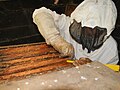
A beekeeper removing frames from the hive

A capped honey super frame
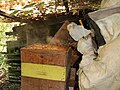
Smoking the hive

Using a blower to remove bees from honey super prior to removal to honey house

Opening the cells: Uncapping

An uncapping fork

Uncapping the cells by hand using an uncapping knife

Extracting the honey

Filtering the honey
Pouring in pots (after maturation)


 were ya trying to use a word so aptly suited to a thread on honey if not thats funny


.PNG)



