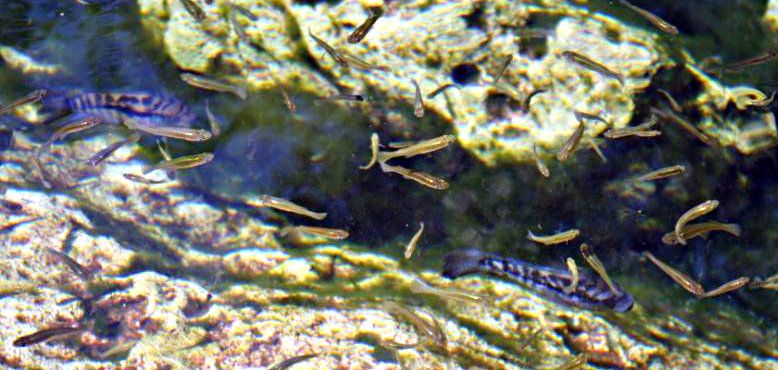
Florida "wild" salvini

  • We are currently upgrading MFK. thanks! -neo
I love where this post is going :). Glad I asked it. I know these fish have been out there for many generations. And the pictures I've been shown of other fish my friend has caught look amazing. All this makes me even more exited to get them. I know oscars and peacock bass where brought in for sport fishing. I'm curious to see what they look like being a mix of wild and the more colorful farm raised ones.


Sent from my iPhone using MonsterAquariaNetwork app
 
This is interesting, because any fish, be it salvini introduced to Florida, or managuense introduced in Mexico or Puerto Rico, or Amphilophus to Hawaii are subjected to all environmental pressures and predation that wild fish are. And this may help to eliminate any of the weaker individuals that are often saved in aquarium breeding, in fact allowing only the most fit individuals to survive .
 
So the fish NOT endemic to regions of say, Honduras, would also be considered "feral"? I understand the logic. Just not sure who's making the rules. LOL


What about the wholesalers that are raising fish in ponds in CA/SA? Are they considered F0?
I would personaly consider those F1 since they are the offspring of wild parents being tank raised to a bigger size but they are borderline wild. Jst what I believe


Sent from my SGH-T999 using MonsterAquariaNetwork App
 
I asked the question on my Aquamojo FB page (http://www.facebook.com/aquamojo) as well, with some interesting responses. Here's two that I think are worth repeating:

From Mats Pederson via Amazonas magazine FB page: Since there's two ways that filials get applied, this is even a more complex question.

Technically, F0 in the greater scientific community simply is used to describe mates in an outcross, F1 being the progeny of that outcross. As such, these "Florida-caught" cichlids would fully qualify as F0.

If we use F0 in the way most aquarist use it, to define a fish as wild-caught, I could go either way on this. We are technically making an assumption that a wild-caught fish represents a genetically diverse and healthy population; is that the case with a wild-caught fish out of Florida waters? Possibly. The information from FAO on genetic maintenance of a species and bottlenecking suggests that a population can be founded by as little as 5 specimens, provided it quickly blooms to a much larger size. So that means if all the wild Oscars in the canals of Miami were founded by as little as 5 fish, they might still be genetically diverse enough to be "healthy". Look at all the Lionfish in the Caribbean; my understanding is that genetically, they all share ancestry with only 3 females?

Of course, when we talk about a species like the Oscars in the canals, since the wild Oscar might not be one species but several, and since we don't know which type(s) were released to create the population we now see, it's difficult to say whether there is a pure species there or some new cocktail of genetics.

F0 fish out of Florida's canals - I think so, but with the caveat of geographic provenance and potentially dubious species purity in some cases.

And from Dr. Paul Loiselle: Interesting question. Strictly speaking, the Florida populations in question are feral rather than wild, since they spent at least a couple of generations in captivity before getting into Florida waters. Given the (presumably) limited number of founders, it would be interesting to compare a couple of these naturalized species genetically with representative wild populations. I tend to agree with you that for practical purposes, fish brought back into captivity from these naturalized populations should be considered F0.

From Mike Tuccinardi (Segrest Farms): Plenty of predators in Florida waters but I do think there might be an overall lack of genetic diversity on a lot of these introduced species. Of course this can just lead to rapid speciation so it will be interesting to see what happens in these populations.

From my friend, David Estes, Florida Fish Farmer: [Non native fish caught in Florida are not considered "wild caught" because the invasive species status trumps all other status. Most invasive fish in Florida come from a rather narrow gene pool and should not be used for anything in a breeding program. You can not label it a F0 either because of the invasive species status. The state of Florida's stance on this is kill every invasive species that you catch.

Seems like the consensus is "F0"...but the majority agree that the stock...or in this case lack of...that literally started what is there could be weak. The other unifying opinion...is that it's a difficult question to answer.

Hope this helps.

Mo

 
Thank's Mo! Great info and pretty much what I was saying, It's good to know I wasn't off base with my line of reasoning. Cichlasoma salvini Floradensis might be applicable here. I would like to see a genetic comparasin to the original population in it's natural range. So F0 they are, with a geographical caviot.
 
What I would like to know, is where all the cool Cichlids, like Jags, Salvini, Oscars, etc, are being found in FL? I'd love to fish / net for them. I have done this a few times, but have only found Mayans and Tilapia, nothing else.
 
1st off I am in no way for, releasing any non native fish.
But.. it will be interesting to see the difference in the feral North Dakota JDs as compared to wild forms.
While snorkeling cenotes in Mexico the drastic difference between wild and aquarium strains was very clear.
Just as when dogs become feral, they seem to revert to a wild form after a few generations, will the JDs revert to the more streamlined version.
087.jpg
 
Good stuff, Mo!

I think that best description is "feral population" or maybe "wild individuals from an introduced / non-native population". Calling them F0 (and their offspring F1) only serves to confuse the issue.

While living in the waterways of FL is definitely different than living in a fish tank or fish farm pond, it's also different than living in the fishes' native waters. Fish are the way that they are because of their specific environments. It speaks to the adaptability of cichlids that they're able to make their way in places that aren't native...but it changes them in ways that are obvious and not so obvious from their cousins in native waters.

Whether these changes are pleasing to aquarists is another issue (i.e. the feral populations might have more of different color or markings than native populations...might grow larger because of more or different food, etc.). I'd bet that Florida fish have great color because of the sun, though!

Matt


I asked the question on my Aquamojo FB page (http://www.facebook.com/aquamojo) as well, with some interesting responses. Here's two that I think are worth repeating:

From Mats Pederson via Amazonas magazine FB page: Since there's two ways that filials get applied, this is even a more complex question.

Technically, F0 in the greater scientific community simply is used to describe mates in an outcross, F1 being the progeny of that outcross. As such, these "Florida-caught" cichlids would fully qualify as F0.

If we use F0 in the way most aquarist use it, to define a fish as wild-caught, I could go either way on this. We are technically making an assumption that a wild-caught fish represents a genetically diverse and healthy population; is that the case with a wild-caught fish out of Florida waters? Possibly. The information from FAO on genetic maintenance of a species and bottlenecking suggests that a population can be founded by as little as 5 specimens, provided it quickly blooms to a much larger size. So that means if all the wild Oscars in the canals of Miami were founded by as little as 5 fish, they might still be genetically diverse enough to be "healthy". Look at all the Lionfish in the Caribbean; my understanding is that genetically, they all share ancestry with only 3 females?

Of course, when we talk about a species like the Oscars in the canals, since the wild Oscar might not be one species but several, and since we don't know which type(s) were released to create the population we now see, it's difficult to say whether there is a pure species there or some new cocktail of genetics.

F0 fish out of Florida's canals - I think so, but with the caveat of geographic provenance and potentially dubious species purity in some cases.

And from Dr. Paul Loiselle: Interesting question. Strictly speaking, the Florida populations in question are feral rather than wild, since they spent at least a couple of generations in captivity before getting into Florida waters. Given the (presumably) limited number of founders, it would be interesting to compare a couple of these naturalized species genetically with representative wild populations. I tend to agree with you that for practical purposes, fish brought back into captivity from these naturalized populations should be considered F0.

From Mike Tuccinardi (Segrest Farms): Plenty of predators in Florida waters but I do think there might be an overall lack of genetic diversity on a lot of these introduced species. Of course this can just lead to rapid speciation so it will be interesting to see what happens in these populations.

From my friend, David Estes, Florida Fish Farmer: [Non native fish caught in Florida are not considered "wild caught" because the invasive species status trumps all other status. Most invasive fish in Florida come from a rather narrow gene pool and should not be used for anything in a breeding program. You can not label it a F0 either because of the invasive species status. The state of Florida's stance on this is kill every invasive species that you catch.

Seems like the consensus is "F0"...but the majority agree that the stock...or in this case lack of...that literally started what is there could be weak. The other unifying opinion...is that it's a difficult question to answer.

Hope this helps.

Mo

 
Wow I've read JD's are fairly cold hardy, but North Dakota??? I bet down here in deep east Texas I could grow them in a pond lol. I've learned a lot from this thread, and if and when I breed these fish I will label them as Florida stock to keep the confusion down. I believe a few generations in any wild setting native or not will weed out the poor genetics. Look at African cichlids. So IMO a wild caught cichlid from Florida could be just as healthy as a fish from Mexico if it was born there and not caught a few months after someone released it. Keep the info coming!!


Sent from my iPhone using MonsterAquariaNetwork app
 
MonsterFishKeepers.com