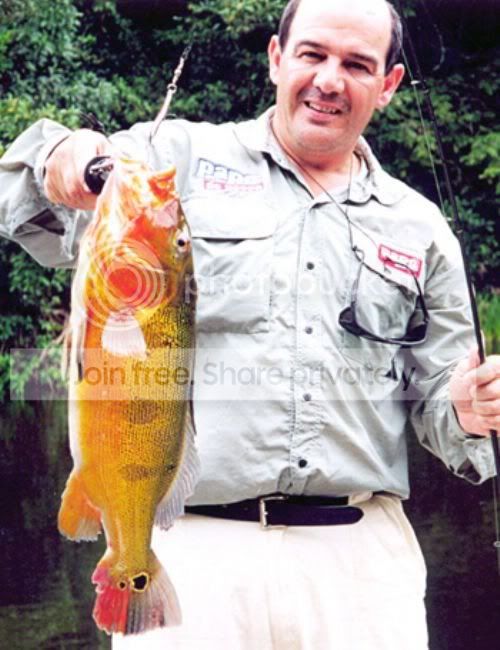
Experience of A Lifetime.

Enjoy what this guy wrote about rio sao benedito trip. I sent him an email just now.
Hopefully he replies and clears some of the debatable questions we have here...
--------------------------------------------------------------------------------------------------------------------------
FISHING IN BLESSED WATERS
Rubinho
Reading the Brazilian map and zeroing in on the South part of State of Para, we will find a small river called São Benedito. This blue line that flows into Telles Pires River, one of the main sources of Tapajos River, is one of the best fishing places in Brazil, with excelent infrastructure for game fishing. When we navigate on its water, we feel that this river is blessed by God. Not only for its splendid scenery, but also because of the different species of fish that are found in that region. Tucunare (peacock bass), trairão, jau, bicuda, caparari, matrinxa, pirarara, jundia and pacu borracha take the fishermen to heaven, burning adrenalin because technique and skill are a real must, considering the fighting instinct of those brave animals.
Sao Benedito River was also lucky because of the sensibility of a human being. The owner of the Thaimaçu Lodge, Carlos Francisco Arroyo, is a businessman who entered the sportfishing business with a serious, professional e futuristic atittude. Envrionment preservation is his main concern and the fishing system that he implanted in that region has become a model for all Brazilian regions. Perceiving the touristic potential for fishing, he transformed 207 km of river into an ecological reservation for sport fishing. Here the tourist can fish as much as he wants and even eat some fish, but he cannot take any fish whenever he goes home. Such a norm, set aproximately 4 years ago, is positive because the schools have increased and many species have grown in size. Consequently, the number of fishermen has increased every year, so the investments in the infrastructure of the lodge have grown as well as the local work force; before that, the local workers were envolved with predatory fishing and other activities of envrionmental impact like wood extraction and mining. Scientific research in this region (fish tagging) will surely provide signifcant data about the adoption of catch & release by the fishermen.
FINDING THE FISH
Our destination was the highest part of Sao Benedito River, a 6-hour trip by boat form the lodge. For 4 days we camepd in the middle of the Amazon jungle, in complet peace, far away from everyhting and everybody. A little bit far from ou camping place, a big rapids blocked the navigation: we could fish there if we pulled the boats. In the afternoon of the day, while we organized the camping place, two guides inteligently took two boats to the hihest part of the river. It should be remembered that this is a region with many islands and channels where rapids and pools of clear water form a perfect scenery for fly fishing.
We fished two days in the shallow channels and then we ended up the trip fishing from the boat in deeper waters. There are so many structures that we can walk during the whole day without trying all the perfect points available. Walking in the water, feeling its energy, fishing with the flies, etc make us a part of this wild scenery. The place is just like a warrant of a new and happy experience. With a camera handy we run the risk of taking all the pictures in the very first day because everywehre we look there is a new detail to be observed. With the fly rod, the fisherman must control his heart: the continous actions of big fish take all the time of our heartbeats.
Walking in clear water is great because, besides perceiving the aquatic life, we can see the fish and we can objectively cast the bait. Is is nice to change the work with the bait, increasing or diminishing the pulling speed whenever we notice the interest of the fish. This type of fishing, by having visual contact with the fish, is much more complete because it begins before the fish bites the bait. In the São Benedito surroundings such a possibility can be repeated many time a day, adding flavor to the actions. The amount and variety of fish take us to the past when we believed all resources would never end. To have such a feeling nowadays is a priviledge that should be stressed becausem taking the example, we can fight for the preservation of other Brazilian rivers.
Fishing from boats, after the rapids, the show is much nicer. Schools of various species swim under the boat in perfect synchronization, just like ballet dancers of hihg performance. Navigating through the channels, where big stones are all aorund, is dangerous and we have to watch out. Here the guide´s experience (this is a highlight of the Thaimaçu Lodge) warrants the safety of the fisherman. So, feeling safe, we can freely cast our flies and begin the fights with a great variety of fish.
MORE LINE FOR OTHER AGRESSIVE FIGHTERS
The tucunaré (peacok bass) and the pacu borracha also defyed us. We found the peacock bass down the river. According to the local guides, in clear water the species can survive because of the trairão aggressiveness. As a matter of fact, I am not sure if this is a typical behavior form other regions, but the fact is that the phenomenon was happening there. Anyway, this fact did not spoil our fishing because, after two minute, we found a good structure that provided many actions.
The peacock bass attacked in small schools, dividing the territory with some trairão. We fished 3 to 5-kilo peacock bass, although the great majority of the fish were smaller, more daring and faster. The pacu could be found over the stones where the water run fast. We were not able to fish from the boat because of the tyope of bait we had. We had to overpass the rapids and look for them in deeper water, with a lot of vegetation around. By casting near the margins, we let the bait (imitating coconut or small fruit) float under the branches of the trees. We did not catch many, but the few we manage to catch were pretty big. The pacu borracha is a great fighter - it runs in all directions and jumps out of the water (one mete hihg).
COMING BACK AND SAYING "I WILL SURELY MISS IT"
As we left the camping place towards the lodge, we were completely integrated with that environment and renewed by the experiences we had lived there. Our concern now was to clean the camping because we had no right to leave any vestige of our visit in thta beautiful region. This way everything would saty untouched and the fish would continue living there, providing happiness to other fishermen in the future.
At the São Benedito region it is possible to believe in full preservation of nature because the people in charge are really conscious of the importance of the role that they represent and of their responsibilities. They clearly understand that environment preservation and living fish are basic atittudes towards the life of the river, attracting fishermen from all every country of the world.
To those fishermen that do not share the same philosophy (catch & release), I recommend not visiting the region because they will not find shelter by the holy waters of the São Benedito River.