

Guttalatum?Help with id
- Thread starter crash83
- Start date
You are using an out of date browser. It may not display this or other websites correctly.
You should upgrade or use an alternative browser.
You should upgrade or use an alternative browser.

nice pics. love the dovii. how big is the tank? maybe a full tank shot? you have some nice fish in there!!! but they are still Znonatus tho.


Quote:
Originally Posted by darthodo
I've recently been looking at a Paratheraps zonatum with some red on it. Most of the ones I've seen pictures of don't have red. Have any of you seen red on a zonatum?
The only red in a Zonatum aree on the edges of the fins.
posted by aquamojo.
Originally Posted by darthodo
I've recently been looking at a Paratheraps zonatum with some red on it. Most of the ones I've seen pictures of don't have red. Have any of you seen red on a zonatum?
The only red in a Zonatum aree on the edges of the fins.
posted by aquamojo.
Maybe this is ex post facto, but I haven't too much free time for forums.
Maybe I can help clear something up.
To "start with," much of the beauty of so many CA cichlids is that they are as unique as snowflakes; no two are ever exactly alike - either in appearance or temperament. We all are aware that there seems to be a good deal of confusion/controversy/mystery surrounding the specification (and identification) of a few of these, partly due to websites and photographers and partly due to factors which many of us are already aware.
That being said, let's begin with a common name of what many believe to be the closest cousin of P. guttulatus, the P. hartwegi - at least based upon the behavior and morphology and perhaps to a lesser extent the mtDNA analysis - the so called "Red Freckled Cichlid" (Conkel).
The hartwegi, or Red Freckled Cichlid typically doesn't exhibit any "spangling" whatsoever about the head (to be extremely precise in our language). Obviously, precision in language (and powers of observation) is crucial when deliniating closely allied species in lingual terms. So Webster's defines a spangle as "a small glittering object or particle." The truth is that in accurate terms neither does guttulatus exhibit any spangling per se about the head.
It may be correct (to the casual observer) that the guttulatus is closer in appearance to zonatus than hartwegi. But at this juncture that's not so instructive.
Furthermore, guttulatus most certainly display little if any (truly) red spangling; on the contrary, it exhibits maroon freckling, or (pinpoint) speckling, or spotting, or reticulation, or occasionally even a combination of the last four. Oddly, however, you can sometimes catch a hint of reddish out of the same maroon spots if the lighting/angle are perfect. I think that if we examine any posted pics of "confirmed" guttulatus we'll likely see that. By comparing the red at the tips of the finnage to the maroon (or burgandy) of the freckling or reticulation - especially at or below the level of the eye - it should become evident. Naturally, there are other morphological differences between the zonatus and guttulatus too numerous to list in short space.
I'm keeping and breeding both the harts & gutts, because they're prettier than zonatus, except I might prefer the gilding pronounced in zonatus (Rio Nachatal) females in courtship, of which I've seen few if any representaive photos. FWIW, the female hartwegi might be fairest of them all.
No matter; I've handled quantities of wild caught m/f zonatus in the vats and stayed beside adult specimens many days & nights housed in glass tanks.
Anyhow, in general the Rio Nachatal zonatus absolutely does feature red (or more properly maroon) spangling (or more properly freckling). That seems less true of V. zonatus Rio Joltapec where the freckling tends to be deep brown or blackish. I can't speak to other populations. Here's my photo of a (female) Nachatal zonatus clearly indicating the extant "red," i.e., maroon freckling on the operculum and below the eye and around the jaw. Of course we've seen similar red/maroon in many of the shots of others:

Lest their be any confusion, here are couple of shots of one of my brood stock (male) wild caught P. guttulatus Rio Camecha:

Here's the same animal from the other side:

My wild caught P. guttulatus Rio Mosanito brood stock (both m/f) tend tohave more of the "pinpoint" maroon speckling whereas we can see from above that the Rio Camecha are predominantly reticulated in maroon though the camera angle casts it towards brown. Similar comments could be made of the various regional populations of P. hartwegi though they tend more towards the pinpoints; Nachatal VS Joltapec zonatus involve similar or related subtleties.
I personally think it's perfectly fine and natural (given the circumstances under which so few American CA enthusiasts insist on credibly or reliably "sourcing" their F1&tc. aquisistions) to post "ID this fish please," and for others to subsequently name the mystery fish. However, maybe we'd be more impressed if some of the responses were conceived and crafted in such a way to benifit the hobby as a whole rather than merely establish the alleged confidence of the ID'ers.
Perhaps there's a moral? Before making blunt, authoritative statements w/r/t some of the less common Central American cichlids about "that picture is of this species" ad nauesum, or even drawing (seemingly categorical) inferences based upon a limited/incomplete knowledge of the geographic source/sources of the various populations within a given species, maybe take time for reflection? Who's to say?
For those who would wish, I have (re)posted a pictures of my guttulatus Rio Camecha, Mexico breeders below (again as I'd done last year) as well as very soon posting my P. hartwegi Rio Platanar, Mexico pair. Then more will come clear. In reality it is sometimes just as tricky to distinguish a gutt from a hart as ANY two species; depends some on the mood of the fish but easily as importantly the lighting. Tank lighting and camera flashes don't always help. A 50/50 actinic bulb or something can skew colors around. The angle of the various body parts to the light source changes things.
God my fish are beautiful. I may be a ugly bastard, I may not; but my animals are nonpariel. I have my good friend and trusted associate Daddy Don Conkel to thank for that! For his kindness & mentorship & generousity I'm forever grateful. I would also like to express my deep appreciation for my collegue Christopher Watts for assisting me with the two photos above and for his affectionate patience. Paul Loiselle, if you catch this, you're a Titan amongst men - none of us would be where we are without you!
My advice: AS A PRACTICE - REMOVE THE ANIMAL FROM THE TANK AND PHOTOGRAPH IT IN NATURAL SUNLIGHT. THEN THE GUESSING GAMES USUALLY COME TO A QUICK (AND TIMELY) END.
BTW, IF YOU'VE NEVER SEEN THESE ANIMALS IN DIRECT SUNLIGHT THEN YOU MIGHT HAVE MISSED HALF OF THE FIREWORKS.
In general, your lacustrine zonatus are "high bodied" and more spadelike. Especially reophilics like guttulatus, hartwegi (and fenestratus to a degree) are typically more elongate, although the fenestratus are also found in one isolated volcanic crater lake. That is probably why some draw the conclusion that the guttulatus/hartwegi/fenestratus form a "Paratheraps" complex (along with the riverine breidohri) away from the zonatus/synspilus/bifasciatus "Vieja I" (lacustrine or even eutropic?) and (reophilic) morphologically/behaviorally similar argentia/regani "Vieja II." I'm vague about the maculicauda.
To this last point, there is some factually erroneous information attributed to Sven Kullander w/r/t classifying the Paratheraps/Vieja genii on cichlidae.com that my corresponces with Dr. Kullander clearly indicate. I will probably post excerpts from those letters I've recieved from him quite soon.
In a nutshell, it may be said that anything is possible, but some things are much more likely.
Just because one hasn't seen something doesn't necessarily mean it can't exist.
Your "fish on top" might well be a rather drab (photo) of a female hartwegi. Can't quite judge from here and don't care to. Anybody's guess is as good as mine on your "fish on the bottom."
PS: my wild nebuliferus & irregularis are prettier animals than any of my other CA's and easily trump any of the bruisers. The nebs are world class and photos coming VERY soon for proof positive. Irregs will take a bit longer.

I haven't much spare time these days but I'll sign back in ASAP.
Best To All
Maybe I can help clear something up.
To "start with," much of the beauty of so many CA cichlids is that they are as unique as snowflakes; no two are ever exactly alike - either in appearance or temperament. We all are aware that there seems to be a good deal of confusion/controversy/mystery surrounding the specification (and identification) of a few of these, partly due to websites and photographers and partly due to factors which many of us are already aware.
That being said, let's begin with a common name of what many believe to be the closest cousin of P. guttulatus, the P. hartwegi - at least based upon the behavior and morphology and perhaps to a lesser extent the mtDNA analysis - the so called "Red Freckled Cichlid" (Conkel).
The hartwegi, or Red Freckled Cichlid typically doesn't exhibit any "spangling" whatsoever about the head (to be extremely precise in our language). Obviously, precision in language (and powers of observation) is crucial when deliniating closely allied species in lingual terms. So Webster's defines a spangle as "a small glittering object or particle." The truth is that in accurate terms neither does guttulatus exhibit any spangling per se about the head.
It may be correct (to the casual observer) that the guttulatus is closer in appearance to zonatus than hartwegi. But at this juncture that's not so instructive.
Furthermore, guttulatus most certainly display little if any (truly) red spangling; on the contrary, it exhibits maroon freckling, or (pinpoint) speckling, or spotting, or reticulation, or occasionally even a combination of the last four. Oddly, however, you can sometimes catch a hint of reddish out of the same maroon spots if the lighting/angle are perfect. I think that if we examine any posted pics of "confirmed" guttulatus we'll likely see that. By comparing the red at the tips of the finnage to the maroon (or burgandy) of the freckling or reticulation - especially at or below the level of the eye - it should become evident. Naturally, there are other morphological differences between the zonatus and guttulatus too numerous to list in short space.
I'm keeping and breeding both the harts & gutts, because they're prettier than zonatus, except I might prefer the gilding pronounced in zonatus (Rio Nachatal) females in courtship, of which I've seen few if any representaive photos. FWIW, the female hartwegi might be fairest of them all.
No matter; I've handled quantities of wild caught m/f zonatus in the vats and stayed beside adult specimens many days & nights housed in glass tanks.
Anyhow, in general the Rio Nachatal zonatus absolutely does feature red (or more properly maroon) spangling (or more properly freckling). That seems less true of V. zonatus Rio Joltapec where the freckling tends to be deep brown or blackish. I can't speak to other populations. Here's my photo of a (female) Nachatal zonatus clearly indicating the extant "red," i.e., maroon freckling on the operculum and below the eye and around the jaw. Of course we've seen similar red/maroon in many of the shots of others:
Lest their be any confusion, here are couple of shots of one of my brood stock (male) wild caught P. guttulatus Rio Camecha:
Here's the same animal from the other side:
My wild caught P. guttulatus Rio Mosanito brood stock (both m/f) tend tohave more of the "pinpoint" maroon speckling whereas we can see from above that the Rio Camecha are predominantly reticulated in maroon though the camera angle casts it towards brown. Similar comments could be made of the various regional populations of P. hartwegi though they tend more towards the pinpoints; Nachatal VS Joltapec zonatus involve similar or related subtleties.
I personally think it's perfectly fine and natural (given the circumstances under which so few American CA enthusiasts insist on credibly or reliably "sourcing" their F1&tc. aquisistions) to post "ID this fish please," and for others to subsequently name the mystery fish. However, maybe we'd be more impressed if some of the responses were conceived and crafted in such a way to benifit the hobby as a whole rather than merely establish the alleged confidence of the ID'ers.
Perhaps there's a moral? Before making blunt, authoritative statements w/r/t some of the less common Central American cichlids about "that picture is of this species" ad nauesum, or even drawing (seemingly categorical) inferences based upon a limited/incomplete knowledge of the geographic source/sources of the various populations within a given species, maybe take time for reflection? Who's to say?
For those who would wish, I have (re)posted a pictures of my guttulatus Rio Camecha, Mexico breeders below (again as I'd done last year) as well as very soon posting my P. hartwegi Rio Platanar, Mexico pair. Then more will come clear. In reality it is sometimes just as tricky to distinguish a gutt from a hart as ANY two species; depends some on the mood of the fish but easily as importantly the lighting. Tank lighting and camera flashes don't always help. A 50/50 actinic bulb or something can skew colors around. The angle of the various body parts to the light source changes things.
God my fish are beautiful. I may be a ugly bastard, I may not; but my animals are nonpariel. I have my good friend and trusted associate Daddy Don Conkel to thank for that! For his kindness & mentorship & generousity I'm forever grateful. I would also like to express my deep appreciation for my collegue Christopher Watts for assisting me with the two photos above and for his affectionate patience. Paul Loiselle, if you catch this, you're a Titan amongst men - none of us would be where we are without you!
My advice: AS A PRACTICE - REMOVE THE ANIMAL FROM THE TANK AND PHOTOGRAPH IT IN NATURAL SUNLIGHT. THEN THE GUESSING GAMES USUALLY COME TO A QUICK (AND TIMELY) END.
BTW, IF YOU'VE NEVER SEEN THESE ANIMALS IN DIRECT SUNLIGHT THEN YOU MIGHT HAVE MISSED HALF OF THE FIREWORKS.
In general, your lacustrine zonatus are "high bodied" and more spadelike. Especially reophilics like guttulatus, hartwegi (and fenestratus to a degree) are typically more elongate, although the fenestratus are also found in one isolated volcanic crater lake. That is probably why some draw the conclusion that the guttulatus/hartwegi/fenestratus form a "Paratheraps" complex (along with the riverine breidohri) away from the zonatus/synspilus/bifasciatus "Vieja I" (lacustrine or even eutropic?) and (reophilic) morphologically/behaviorally similar argentia/regani "Vieja II." I'm vague about the maculicauda.
To this last point, there is some factually erroneous information attributed to Sven Kullander w/r/t classifying the Paratheraps/Vieja genii on cichlidae.com that my corresponces with Dr. Kullander clearly indicate. I will probably post excerpts from those letters I've recieved from him quite soon.
In a nutshell, it may be said that anything is possible, but some things are much more likely.
Just because one hasn't seen something doesn't necessarily mean it can't exist.
Your "fish on top" might well be a rather drab (photo) of a female hartwegi. Can't quite judge from here and don't care to. Anybody's guess is as good as mine on your "fish on the bottom."
PS: my wild nebuliferus & irregularis are prettier animals than any of my other CA's and easily trump any of the bruisers. The nebs are world class and photos coming VERY soon for proof positive. Irregs will take a bit longer.
I haven't much spare time these days but I'll sign back in ASAP.
Best To All
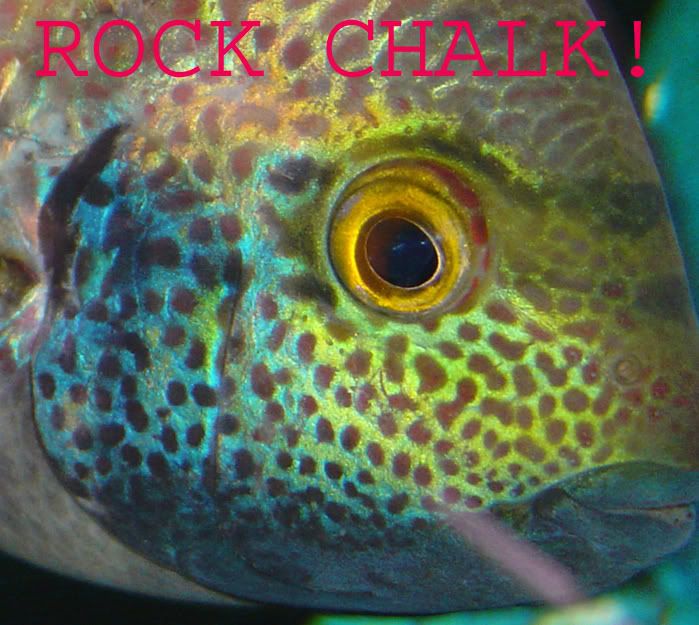
Almost forgot to mention: JayHawk!
Guttulatus guttulatus guttulatus guttu-yodle-ladie-ho hoo.
Can anybody else besides me yodle?
Thanks Kindly ... if I weren't a gentleman I'd say "suck my Duke"... but since I am I'll just say "Go Tarheels!" LOL
All kiddin' aside, glad ya liked it...appreciate the feedback ...GOTTA run...
All kiddin' aside, glad ya liked it...appreciate the feedback
...GOTTA run...