This was posted on 7/26/07 in a similar thread. I'm just reposting it with a few update changes.
When we set up our 300 gal tank, my husband was adamant about making it as maintenance-free as possible. He spent about two weeks putting in the plumbing. We have a bare-floor tank and have extreme mechanical filtration using two spa filters run with a big Hammerhead pump (5800 gph). Besides the main uptake in the tank, there are two "poop suckers" strategically placed in the tank that quickly remove all debris and feces from the tank. In the 4 years that the tank has been running, there has been no debris to vacuum out.
When doing water changes, the pump is turned off, and the valve to the dump line is opened. We can rapidly drain out 200 gallons in a very short time by syphoning through the poop suckers to a pipe under the house which dumps the water outside. 150 gal is max we remove now because the fish are so big. By turning various valves on/off, we can siphon water through the return nozzle, backwash the filter cartridges in the spa filters and then dump the water outside the house. (Of course, the return spray nozzle is only several inches below the waterline, so the backwashing is limited).
In our equipment room (where the mechanical filters are) we have a utility sink with a line running up to a 55 gallon tank sitting a high shelf. This tank is full of heated, conditioned water. A valve is opened, and water gravity flows into the tank. Since it only holds 55 gallons, we turn the water on at the sink which flows into the holding tank. We adjust the hot/cold to keep the water at approximately the same temp as the main tank. Prime is added. The slowest part of the whole operation is keeping the 55 gallon tank refilled, as the water siphons out faster than the water coming in from the sink. To compensate, we only partially open the valve to the main tank, so that the refill water can keep up. This system works very well, and when the water level in the wet/dry filter drops from fish splash and evaporation, we just open the valve and add more conditioned water to the main tank.
We change out 200 gallons on two consecutive days. (we run out of hot water the first day), and manage to keep nitrates < 20 ppm. We turn the pump on and rapidly pump in the last 100 gallons. Our fish love the turbulent water. Here's a video of them playing at the end of a water change when the last of the water is being pumped in. You can see how fast the tank is filling:
http://s148.photobucket.com/albums/s29/pacumom/Pacu/?action=view¤t=WaterChange.flv
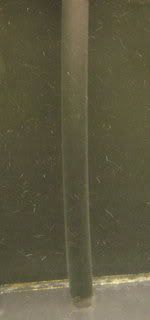
Poop Sucker:
Mechanical Filtration:

The vertical pipe on the right is the line coming from the 55 gal holding tank. Just behind it is a pipe going down through the floor, under the house, outside to the patio.
The two horizontal lines are the uptake lines from the main uptake and the two poop suckers. The oblique line at the back is the return line back to the tank. There are valves on each end of every pipe--at the filter and at the tank.
Water changes truly are a breeze with my husband's innovative system.
When we set up our 300 gal tank, my husband was adamant about making it as maintenance-free as possible. He spent about two weeks putting in the plumbing. We have a bare-floor tank and have extreme mechanical filtration using two spa filters run with a big Hammerhead pump (5800 gph). Besides the main uptake in the tank, there are two "poop suckers" strategically placed in the tank that quickly remove all debris and feces from the tank. In the 4 years that the tank has been running, there has been no debris to vacuum out.
When doing water changes, the pump is turned off, and the valve to the dump line is opened. We can rapidly drain out 200 gallons in a very short time by syphoning through the poop suckers to a pipe under the house which dumps the water outside. 150 gal is max we remove now because the fish are so big. By turning various valves on/off, we can siphon water through the return nozzle, backwash the filter cartridges in the spa filters and then dump the water outside the house. (Of course, the return spray nozzle is only several inches below the waterline, so the backwashing is limited).
In our equipment room (where the mechanical filters are) we have a utility sink with a line running up to a 55 gallon tank sitting a high shelf. This tank is full of heated, conditioned water. A valve is opened, and water gravity flows into the tank. Since it only holds 55 gallons, we turn the water on at the sink which flows into the holding tank. We adjust the hot/cold to keep the water at approximately the same temp as the main tank. Prime is added. The slowest part of the whole operation is keeping the 55 gallon tank refilled, as the water siphons out faster than the water coming in from the sink. To compensate, we only partially open the valve to the main tank, so that the refill water can keep up. This system works very well, and when the water level in the wet/dry filter drops from fish splash and evaporation, we just open the valve and add more conditioned water to the main tank.
We change out 200 gallons on two consecutive days. (we run out of hot water the first day), and manage to keep nitrates < 20 ppm. We turn the pump on and rapidly pump in the last 100 gallons. Our fish love the turbulent water. Here's a video of them playing at the end of a water change when the last of the water is being pumped in. You can see how fast the tank is filling:
http://s148.photobucket.com/albums/s29/pacumom/Pacu/?action=view¤t=WaterChange.flv
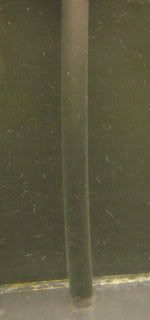
Poop Sucker:
Mechanical Filtration:
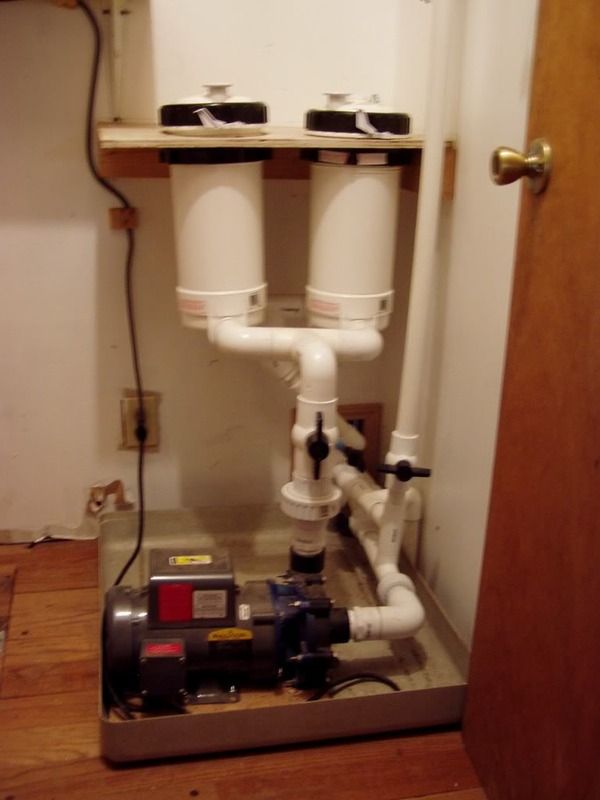
The vertical pipe on the right is the line coming from the 55 gal holding tank. Just behind it is a pipe going down through the floor, under the house, outside to the patio.
The two horizontal lines are the uptake lines from the main uptake and the two poop suckers. The oblique line at the back is the return line back to the tank. There are valves on each end of every pipe--at the filter and at the tank.
Water changes truly are a breeze with my husband's innovative system.